
.svg)
.svg)
%201.svg)
%201.svg)
.svg)

.svg)
.svg)
.svg)
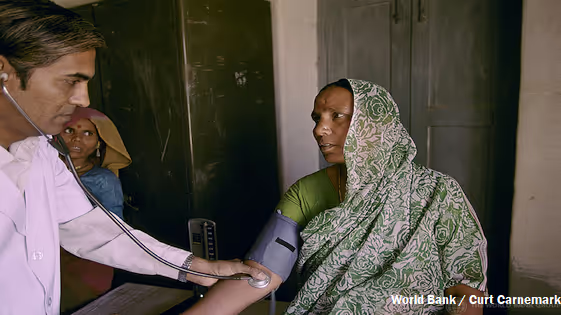
India’s primary healthcare reform: Improved service delivery, reduced mortality
.svg)

.svg)

Human Development
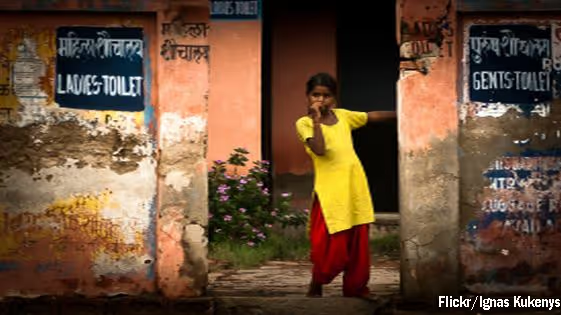
Collective action for environmental health: Evidence from sanitation in rural India
Access to and sustained use of improved household latrines have long been both a challenge as well as a policy priority in India, particularly in rural areas. Recognising the importance of social mechanisms that underlie household sanitation choices, this article utilises experimental games conducted in rural Bihar and Odisha, to examine how social factors, such as gender, influence preferences for improved sanitation.


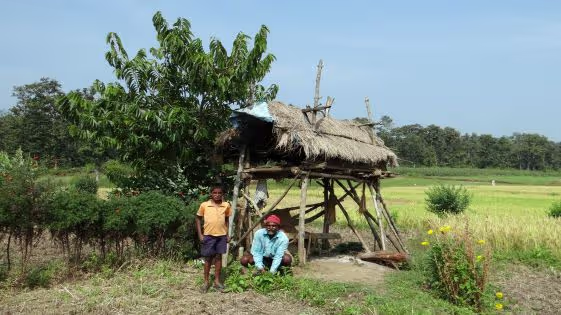
Does non-farm growth in rural areas reduce intergenerational educational mobility?
While the growth of the non-farm sector in a rural economy is known to reduce poverty, it may also exacerbate inequality. Comparing rural India and rural China the study finds that there is lower intergenerational education mobility in the former. Farmers’ sons in India attain higher schooling relative to non-farm sons when the father has low education, but the advantage flips when the father has over 10 years of education.

Pollution from coal-based power units and anaemic status of children and women
An extensive literature has considered the impact of air pollution on health. While studies have mainly focussed on outcomes such as general morbidity and mortality, this article evaluates the impact of pollution caused by coal-based power units on the anaemic status of young children and prime-age women in India. Factoring in these additional costs strengthens the case for a progressive shift to renewable energy and reduced reliance on coal.
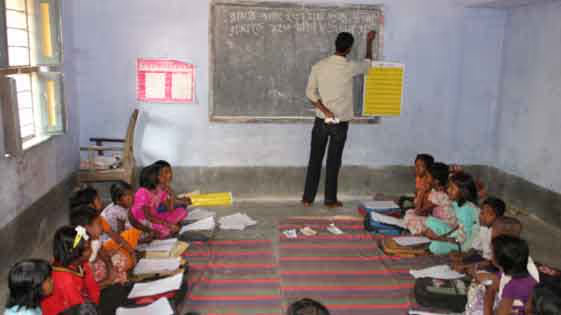
Designing incentives for mid-level officials in India's public sector
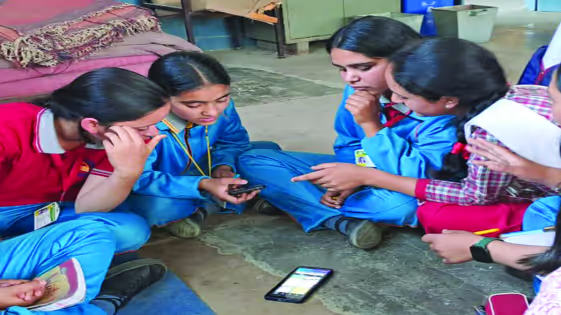
In the Indian public education system, block/cluster resource persons are mid-level officials who are responsible for monitoring the performance of teachers. In this note, Vivek et al. discuss their experience of working with the state government of Jharkhand to design a ‘results-based financing’ programme that incentivises these mid-level officials as well as teachers to perform better – with the ultimate objective of improving education outcomes.

Using phone surveys to measure mental health
The public health and humanitarian crises caused by Covid-19 have led to greater recognition of the issue of poor mental health. Although mental health can affect work and quality of life much like physical health, it remains under-researched. In this article, Coffey et al. show that mobile phone surveys can be a valuable medium for incorporating mental health measurement into population-level health surveys.

What will determine the costs of Prime Minister’s Jan Arogya Yojana?
The Pradhan Mantri Jan Arogya Yojana was launched in 2018 with the aim of covering hospitalisation expenses of the vulnerable 40% of the population, to protect them against financial risk arising out of catastrophic health expenses. It is touted as a game changer in the Indian health sector. Indrani Gupta and Abhijit Roy argue that if costs supersede the allocated funds for the programme, it may substitute other critical investments in the health sector and introduce distortions in the health services market.
Is trade with India changing Africa’s healthcare landscape?
After China, India has become the second largest trading partner with sub-Saharan Africa. The southern and western regions of Africa – which have the largest number of people living with HIV/AIDS worldwide – are the largest importers of Indian pharmaceuticals. In this post, Dixit, Emery, and Kumar discuss encouraging developments in healthcare trade between India and Africa, and the pathways for widening this life-saving trade.
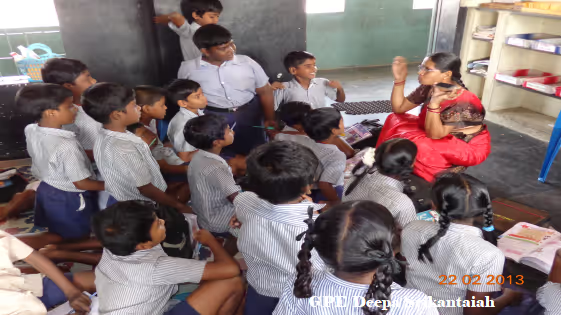
Understanding school choices under RTE’s 25% mandate
Section 12(1)(c) of the Right To Education Act mandates non-minority status private schools to reserve at least 25% seats for the disadvantaged and weaker sections of the society. This article analyses the impact of the mandate on changing school choices of relatively disadvantaged households based on a sample of over 1,600 households in urban Ahmedabad. It finds that the mandate expanded choice of schools for the participating eligible households.
Rural sanitation: A charter of demands
A government survey shows that 93% of rural households in India have access to a toilet and 96% of those having a toilet use them. However, critics point out contradictions between these data and micro-level assessments in different parts of India. Based on his experience of working for more than two decades in rural Odisha, Liby Johnson argues that an effective rural sanitation model requires both financial assistance to the households, and an integrated water supply.

Sign up to our newsletter to be notified about the latest updates
.svg)
Just One Step Away!
Complete your signup to start getting the latest news, stories, and updates delivered straight to your inbox.