
.svg)
.svg)
%201.svg)
%201.svg)
.svg)

.svg)
.svg)
.svg)
.svg)

.svg)
Poverty Inequality

Insights from long-term studies of Indian villages
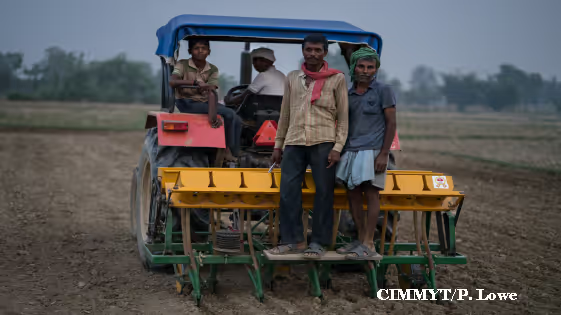
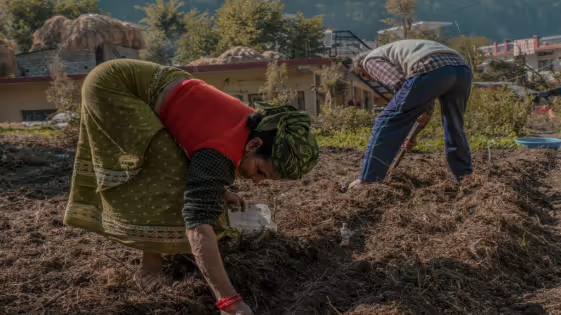
Much of our knowledge of change in rural areas depends on longitudinal village studies. Drawing upon a number of village studies carried out over the years in India, this column provides a broad picture of how the economic and social structures of villages are changing, and the consequences for production, employment, migration, inequality and other key issues.


Universal basic income: The best way to welfare
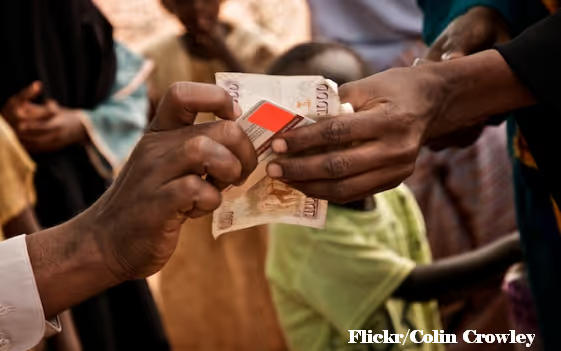
Abhijit Banerjee, Professor of Economics at MIT, suggests replacing welfare schemes of the government by a single universal basic income, which entitles every adult resident to a minimum weekly income as long as they verify their identity every week.
Afterword: What lies ahead for MNREGA?
In an afterword to the e-symposium on ‘10 years of MNREGA and the way forward’, I4I Editor Farzana Afridi contends that the evidence summarised in the e-symposium suggests that MNREGA is not merely a poverty alleviation programme. Given its multiple potential benefits, MNREGA needs more than mere lip service or it risks dwindling into irrelevance.
MNREGA, 10 years on: Glass half-full or half-empty?
In this article, Kunal Sen, Professor of Development Economics and Policy at the University of Manchester, evaluates whether MNREGA has achieved its broader development objectives. He further analyses why the programme’s implementation has been challenging, and what the implications of weak implementation have been for its objectives.
MNREGA: Technology vs. technocracy
In this article, Reetika Khera, Associate Professor of Economics at IIT Delhi, argues that for MNREGA to flourish in the future, technologies that empower workers should be encouraged, and the tendency to over-centralise the implementation of the programme should be reversed.


Sign up to our newsletter to be notified about the latest updates
.svg)
Just One Step Away!
Complete your signup to start getting the latest news, stories, and updates delivered straight to your inbox.