
.svg)
.svg)
%201.svg)
%201.svg)
.svg)

.svg)
.svg)
Symposia
Introduction to e-Symposium: Carrying forward the promise of International Year of Millets
Although millets were a staple food in many Indian diets, their consumption has declined over the last few decades. Taking into account their resilience to climate change and potential to contribute to nutritional security, the Indian government has vowed to increase millet production and consumption and successfully advocated the United Nations to declare 2023 as the International Year of Millets (IYoM). Starting from World Food Day on 16 October, Ideas for India will host six pieces from researchers and practitioners discussing how the promise of millets can be realised. Anchored by Bharat Ramaswami, this series will feature perspectives on increasing millets’ land under cultivation; investment in R&D and machinery for its production and processing; suggestions to revive demand by including millets in government food programmes; and increasing the scope for exports.


Introduction to e-Symposium: Understanding the new farm laws
Would the farm laws help increase farmers’ incomes? Could farmers benefit from an expanded access to markets? Would they be more willing to engage in contracts with urban firms because of the law on contract farming? Would the changes in the Essential Commodites Act help to reduce distress sales for perishable commodities? Or, would the reform bear fruit only after some essential infrastructure is built? Would these laws help in diversifying agriculture?

Introduction to e-Symposium: The GDP conundrum
Ever since India’s Central Statistical Organisation came out with the new GDP series with 2011-12 as the base year, controversy has surrounded it. The CSO claims that the new series is calculated based on a number of methodological changes that bring India closer to international practice. However, the resulting high growth figures do not seem to quite agree with several other indices that usually reflect the strength of the economy.
The Land Acquisition Bill
Will the new Land Acquisition Bill make protests like those in Singur and Bhatta-Parsaul a thing of the past? Will it make land acquisition so expensive and difficult that the pace of industrialisation will suffer? Will it achieve justice? Development? Neither? Experts from academia and industry examine a piece of legislation that is likely to have far reaching consequences for the future of the country.
The Land Acquisition Bill
Will the new Land Acquisition Bill make protests like those in Singur and Bhatta-Parsaul a thing of the past? Will it make land acquisition so expensive and difficult that the pace of industrialisation will suffer? Will it achieve justice? Development? Neither? Experts from academia and industry examine a piece of legislation that is likely to have far reaching consequences for the future of the country.

Covid-19 and mental health: Introduction to e-Symposium
The Covid-19 pandemic and associated lockdowns had a devastating effect on the economy, with loss of livelihoods, earnings, and food insecurity suffered by the most vulnerable sections. Although economic well-being has suffered more apparently, the pandemic’s impact on mental well-being has been equally adverse but less visible. In a symposium that will run through this week, experts from various domains will weigh in on the mental health impacts of the pandemic on two particularly vulnerable demographic groups – women and children.
Introduction to e-Symposium: Ideas for reforms in education policy in India
A New Education Policy is being formulated in India based on a time-bound grassroots consultative process. As a contribution to the discussions, Rukmini Banerji of the education NGO Pratham and Ashok Kotwal, Editor-in-Chief, I4I, are hosting an e-symposium on ideas for reforms in education policy. Over the next few days, the e-symposium will bring together key findings from recent research in education and experience-based insights by stakeholders from academia and civil society.

International Women’s Day 2025: Towards equality and empowerment
Throughout this week, I4I has been sharing some of the latest evidence and ideas around women’s empowerment to mark International Women’s Day 2025. Discover the five-part series, and more about I4I’s gender-focused research, in this post.
International Women’s Day 2025: Towards equality and empowerment
Throughout this week, I4I has been sharing some of the latest evidence and ideas around women’s empowerment to mark International Women’s Day 2025. Discover the five-part series, and more about I4I’s gender-focused research, in this post.
Women’s Month 2023: An International Women’s Day series
Throughout the month of March, I4I will be hosting the latest evidence and perspectives to mark International Women’s Day 2023. Follow this campaign across platforms and join the conversation using #Ideas4Women

Introduction to e-Symposium: The architecture of affirmative action
The Supreme Court of India recently upheld an amendment that excluded Scheduled Castes, Scheduled Tribes and Other Backwards Classes from the Economically Weaker Section (EWS) quota, restricting it only to general category applicants. However, the specifics of how this reservation policy is executed can have important social and political implications. Across this week, from 12-16 December, this I4I e-Symposium brings together articles that provide a theoretical basis – using principles of market design, and search and matching theory – for more efficient implementation of reservation policies. Anchored by I4I’s Editor-in-Chief Parikshit Ghosh, the e-Symposium aims to open a discussion on the architecture of affirmative action, from the mechanisms of vertical and horizontal reservations, to ensuring efficiency in meeting diversity targets.

Debate: The Aadhaar Bill
In a debate on the Aadhaar Bill, commentators from academia and civil society will weigh in on issues around potential benefits and privacy concerns.
The Mahatma Gandhi National Rural Employment Guarantee Act: is it working?
MNREGA is one of the government´s largest flagship schemes, and is the largest job creation programme of its kind in the world. Supporters believe that it is necessary to help rural workers smooth income in times of distress and increase labour market access for marginalised groups, whereas critics argue that it is taking labour from the troubled agricultural sector and doing more harm than good. What does the evidence really tell us - is MNREGA working or would resources be better spent elsewhere?
Introduction to e-Symposium: Estimation of poverty in India
Estimates of poverty in India put forth in two papers published earlier this year – by Bhalla, Bhasin and Virmani; and Roy and van der Weide – have sparked the “Great Indian Poverty Debate 2.0”. Across this week, from 3-8 October, this I4I e-Symposium brings together articles from the authors of the aforementioned papers, and commentaries from other contributors. They dissect the methodology employed by the two papers, and discuss the implications of the findings. Anchored by Maitreesh Ghatak, the e-Symposium aims to provide a nuanced view of the poverty estimates and what they truly say about the incidence and eradication of extreme poverty in India.
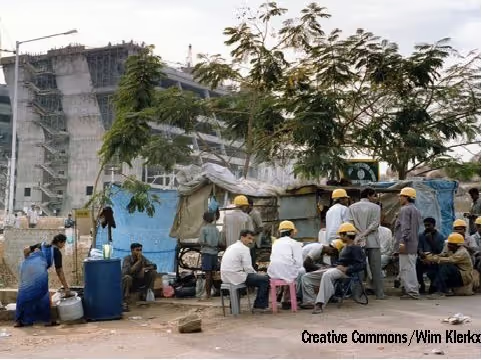
DUET: A proposal for an urban work programme
Jean Drèze presents a proposal for a simple scheme of subsidised public employment in urban areas, generated by multiple public institutions on their own initiative.
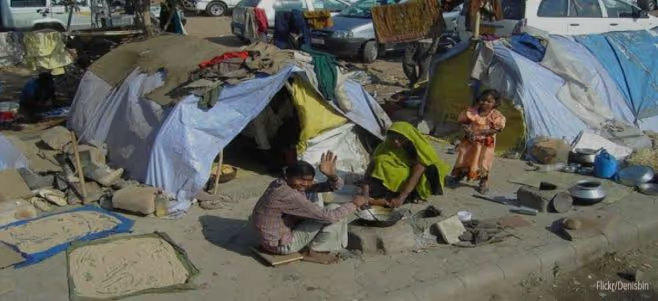
Introduction to e-Symposium: Decoding Congress’ NYAY
A major announcement in the Congress manifesto, in the ongoing parliamentary election, is the minimum income guarantee proposal – Nyuntam Aay Yojana (NYAY). In this symposium, Bharat Ramaswami (Ashoka University), Jean Drèze (Ranchi University), Pranab Bardhan (University of California, Berkeley), S. Subramanian (Indian Council of Social Science Research), Ashwini Kulkarni (Pragati Abhiyan), Karthik Muralidharan (University of California, San Diego), Pronab Sen (International Growth Center), Niranjan Rajadhyaksha (IDFC Institute), and Maitreesh Ghatak (London School of Economics), weigh in on key issues pertaining to the scheme.

Introduction to e-Symposium: The idea of a universal basic income in the Indian context
The idea of an unconditional basic income given to all citizens by the State, has caught on in the developed world. Does it make sense for India? To examine the issue, Parikshit Ghosh (Member of the I4I Editorial Board) is hosting an e-Symposium on the idea of a universal basic income in the Indian context. Over the next week, economists Pranab Bardhan (University of California, Berkeley), Abhijit Banerjee (Massachusetts Institute of Technology), Maitreesh Ghatak (London School of Economics), Debraj Ray (New York University), Kalle Moene (University of Oslo), T.N. Srinivasan (Yale University) and Vijay Joshi (University of Oxford) will contribute to the e-Symposium.

Introduction to e-Symposium: 10 years of MNREGA and the way forward
India’s Mahatma Gandhi National Rural Employment Guarantee Scheme – the largest public works programme in the world – completed a decade in February 2016. As a contribution to the discussions, I4I Editor Farzana Afridi is hosting an e-symposium to summarise the existing evidence on various aspects of the programme, and to discuss the future of the programme.
A symposium on Piketty: Introduction
Thomas Piketty’s book on ´Capital in the Twenty First Century’ has made waves. The fact that a 700-odd page tome full of numbers and graphs can become an international bestseller is itself noteworthy. It may be a testament to the concern that people have over the growing inequality within developed countries. What is startling is its claim that the developed world may be gravitating to the pattern of wealth distribution based on inheritance that characterised the pre-modern world. The contribution this book has made in putting together historical data that clearly indicate the trend of growing inequality is truly monumental.
Introduction to e-Symposium: The good jobs challenge in India
One of the primary concerns for India is the question of jobs – specifically good quality jobs. Why has India lagged in creating opportunities for its working age population, and how different sectors can be leveraged to create good jobs? In this e-Symposium, anchored by Kunal Sen and Nirvikar Singh, six experts will weigh in on the different facets of the job-creation conundrum, from the perspective of the manufacturing sector, cities, trade, clusters, financing small firms, and the tradeable service sector.
Introduction to e-Symposium: Firms and labour productivity
Eighty per cent of India’s labour force works ‘informally’. Providing employment with decent wages and benefits to this segment requires structural transformation of the economy to more high-productivity sectors. I4I Editor Farzana Afridi is hosting an e-symposium to bring together some fundamental issues around the challenge of raising labour and firm productivity in the country.
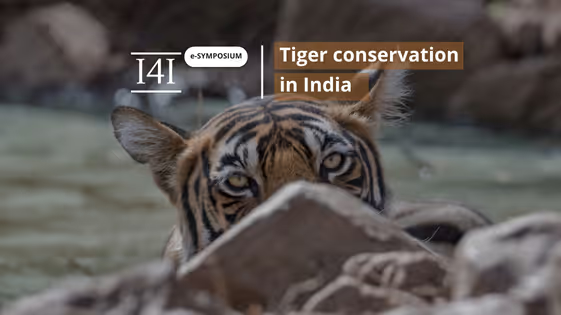
Introduction to e-Symposium: Tiger conservation in India
Despite a recent upward trend in tiger populations in India, the tiger remains on the endangered species list. Saving the tiger, therefore, is not a fait accompli but a continuous struggle that must be informed by scientific monitoring and analysis. Following Global Tiger Day on 29 July, Ideas for India will host a three-part series, anchored by Parikshit Ghosh, bringing together experts to discuss the challenges of tiger conservation, from human-animal conflict, to the unique ecosystem of various habits and climate-induced threats.
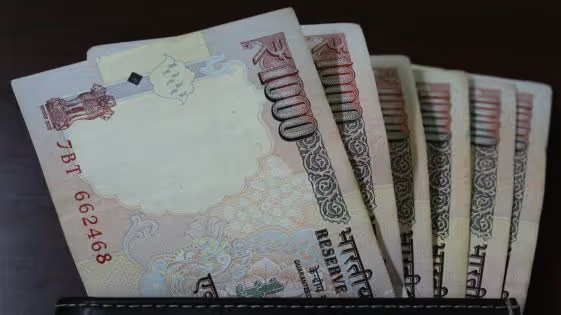
On demonetisation
On the evening of 8 November, the Prime Minister announced on national television that Rs. 1,000 and 500 notes are no longer legal tender, and must be exchanged at the banks for newly issued currency. This major policy intervention has sparked a country-wide debate. Will it curb black money? Is it going to nudge us towards a cashless society? How much will be the collateral damage from the liquidity shock and is it a price worth paying?
Ideas@IPF2024 series: Research from NCAER’s India Policy Forum
Every year, National Council of Applied Economic Research hosts the India Policy Forum, a platform where economists and policymakers dissect research ideas for their relevance to public policy. Following the 21st edition of IPF held on 2-3 July, Ideas for India presents the Ideas@IPF2024 series, introduced in this anchor post by NCAER Senior Advisor Pradip Kumar Bagchi. Between 10-16 July, we will host summaries of policy-relevant economics research presented at the IPF, on themes ranging from female leadership in corporate India, costs and benefits of holding foreign exchange reserves to social safety nets and economic development in the state of Punjab.
Ideas@IPF2023 series: NCAER’s India Policy Forum– where research meets policy
Every year, the National Council of Applied Economic Research (NCAER) hosts the India Policy Forum (IPF), a platform where economists and policymakers dissect five research ideas for their utility to public policy. To commemorate the 20th anniversary of the conference, Ideas for India launches the Ideas@IPF2023 series, introduced in this anchor by NCAER’s Anupma Mehta. Across this week, from 10-14 July, we host the five articles summarising cutting-edge empirical work at the intersection of economics and policy.
Sign up to our newsletter to be notified about the latest updates
.svg)
Just One Step Away!
Complete your signup to start getting the latest news, stories, and updates delivered straight to your inbox.