
.svg)
.svg)
%201.svg)
%201.svg)
.svg)

.svg)
.svg)
.svg)
.svg)

.svg)
Poverty Inequality
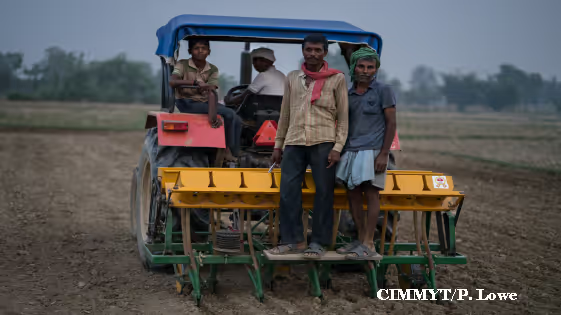
A short history of MNREGA: 20 years in 10 charts
Launched in 2005, the Mahatma Gandhi National Rural Employment Guarantee Act (MNREGA) has completed 20 years. In this post, Drèze and Ramesh reflect on the programme’s achievements, failures, and future. In 10 charts, they present an overview of major trends pertaining to MNREGA such as employment generation, participation of marginalised groups, real wages, administrative expenditures and processes, and variation in performance across states.


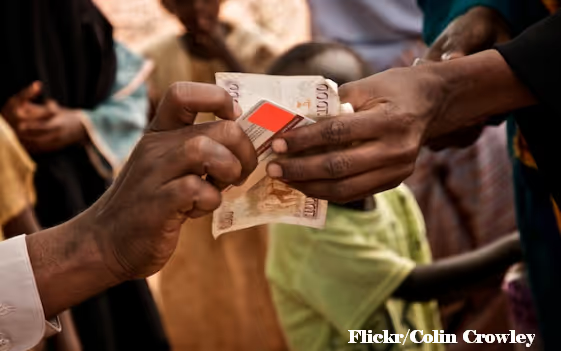
What broad lessons have we learned from 115 studies on unconditional cash transfers?
Globally, around 700 million people currently live in extreme poverty, and in recent years, unconditional cash transfers have emerged as a popular tool for poverty alleviation in low- and middle-income countries. This article presents findings from a meta-analysis of 115 studies, which shows that unconditional cash transfers have positive impacts on a range of key economic and social outcomes, including consumption, income, labour supply, and child health and education.
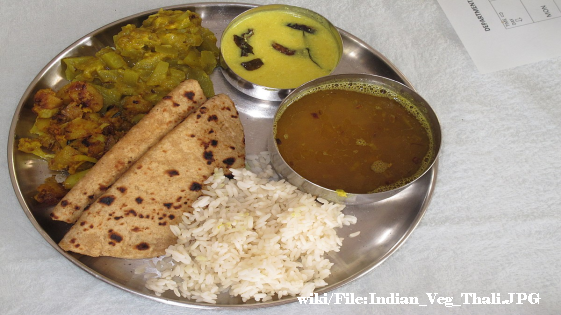
Food deprivation: A thali index reveals what poverty estimates do not
Poverty in India is typically estimated based on a poverty line that identifies the purchasing power needed to satisfy the daily calorific intake deemed necessary. In this post, Balakrishnan and Raj measure the standard of living in terms of a ‘thali meal’. Based on the extent of food deprivation that they find, they argue for a review of poverty measurement in India.
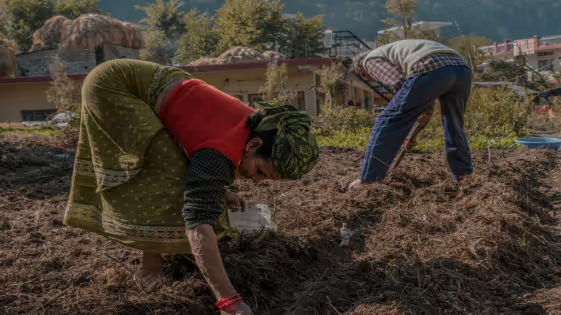
Could better jobs for men have improved gender equality?
Evidence indicates that economic growth can improve gender equality. In this post, Sujata Balasubramanian suggests that India’s high-growth period from 1982-83 to 2011-12 failed to do so substantially. She examines structural changes over those three decades, concluding that the failure was due to insufficient employment – not just for women, but also for poorer men. The analysis therefore emphasises the importance of employment for both pro-poor growth and gender equality.
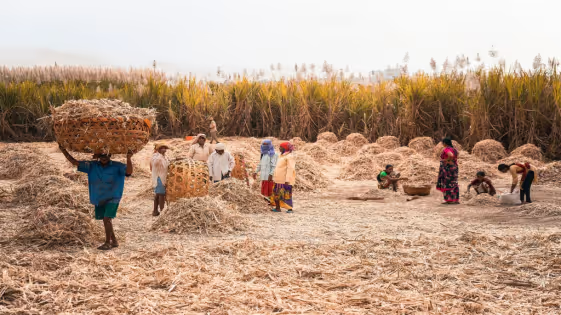
Do minimum wages reduce inequality in India?
Wage inequality in India has declined over the past two decades. This article examines the role of rising minimum wages in driving this trend. Exploiting state-level variations in legislative minimum wage changes, it finds that minimum wage increases account for 26% of the decline in wage inequality between 1999 and 2018. Moreover, these gains were achieved without adverse effects on employment.
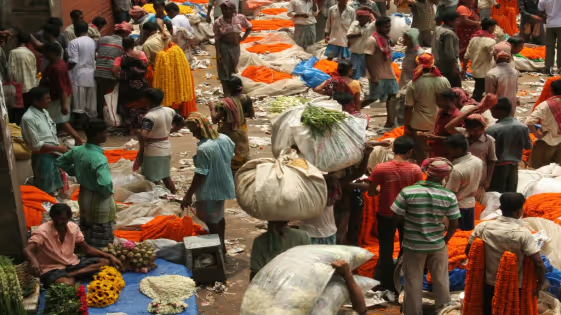
India’s poverty rate does not measure what you think it does
Like all national poverty rates, India’s poverty rate is interpreted as the share of the population that is poor in a given year. In this post, Merfeld and Morduch argue that, in practice, India’s poverty rate is better thought of as the approximate fraction of the year that households experience poverty. They describe how this is rooted in the nature of data collection, and how it changes understandings of poverty and policy in the country.

The economics of begging
Informal estimates suggest that 60% of the world’s population engages in giving to beggars. This article provides a theoretical and empirical analysis of begging as an economic activity. Based on observational and experimental surveys with real beggars and donors in Delhi, it presents various insights into the preferences and perceptions of beggars and donors when it comes to paid work, free-riding, honesty, and ability.
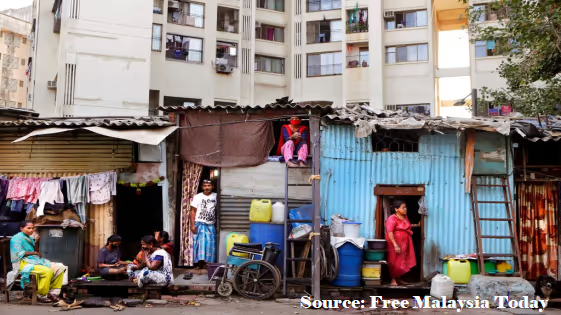
Poverty is bad – but is vulnerability worse?
Official data reveal that poverty in India has declined significantly over time. In this post, Kamila and Wadhwa make the case for policy discourse to shift towards the phenomenon of ‘vulnerability’. Presenting their view on alternative methods of quantifying vulnerability, they highlight the challenges of leveraging existing data for this purpose and the kinds of data that would be needed to capture the essence of vulnerability.
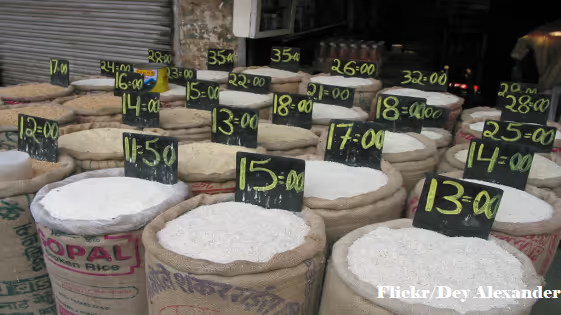
In-kind transfers: Deadweight losses or gains?
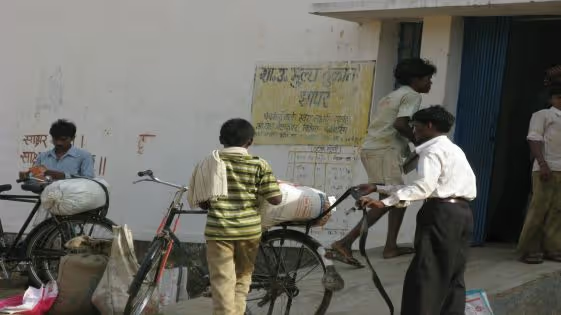
Do in-kind transfers for social assistance lead to ‘deadweight losses’ by restricting consumer choice? This article presents findings from an experiment in Maharashtra, which involved offering low-income respondents the choice between a free quantity of rice and varying amounts of cash to elicit their willingness to pay for rice. It finds that women with higher bargaining power within the household are more likely to choose cash over rice.


Sign up to our newsletter to be notified about the latest updates
.svg)
Just One Step Away!
Complete your signup to start getting the latest news, stories, and updates delivered straight to your inbox.