
.svg)
.svg)
%201.svg)
%201.svg)
.svg)

.svg)
.svg)
Jean Drèze

Jean Drèze studied Mathematical Economics at the University of Essex and did his Ph.D. at the Indian Statistical Institute, New Delhi. He has taught at the London School of Economics and the Delhi School of Economics, and is currently Visiting Professor at Ranchi University as well as Honorary Professor at the Delhi School of Economics. He has made wide-ranging contributions to development economics and public policy, with special reference to India. His research interests include rural development, social inequality, elementary education, child nutrition, health care and food security. Jean Drèze is co-author (with Amartya Sen) of Hunger and Public Action (Oxford University Press, 1989) and An Uncertain Glory: India and Its Contradictions (Penguin, 2013)", and also one of the co-authors of the Public Report on Basic Education in India, also known as “PROBE Report”.
.svg)

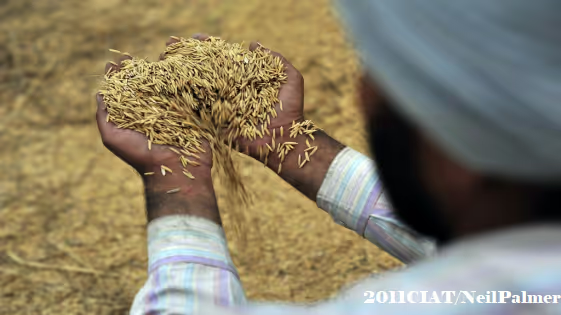
100 million tonnes of cereals are missing… every year
In an earlier I4I post, Drèze and Oldiges drew attention to India’s ‘cereal gap’ – a large difference between net availability of cereals and household consumption. In this post, they use recently released consumption survey data, and find that the gap is more than twice as large as their earlier estimate of 45 million tonnes for 2022-23. They discuss the possible reasons for this yawning gap.



The ‘cereal gap’: Looming issues in India’s foodgrain policy
Cereal production in India recently crossed 300 million tonnes for the first time. In this post, Drèze and Oldiges point out that a major gap has emerged between the net availability of cereals and household consumption – and it is unclear where the balance goes. With cereal production expected to increase further, they argue that there is a looming inconsistency between pricing policy and the realities of cereal demand.
कृषिक्षेत्र के द्वार पर ‘ड्रामा’
नए 'एपीएमसी (एग्रीकल्चर प्रोड्यूस मार्केट कमेटी) बाइपास एक्ट' को 'डुअल रेगुलेशन ऑफ एग्रीकल्चर मार्केटिंग एक्ट' या ‘ड्रामा’ बताते हुए ज्यां द्रेज़ यह तर्क देते हैं कि केंद्र और राज्य सरकारों द्वारा दोहरे नियंत्रण की इस कानून की विषम रूपरेखा से इसके द्वारा किसानों का हित होने की संभावना नहीं है।
DRAMA at the farm gate
Describing the new ‘APMC (Agricultural Produce Market Committee) Bypass Act’ as a ‘Dual Regulation of Agricultural Marketing Act’ or DRAMA, Jean Drèze argues that the legislation's odd framework of dual control by the central and state governments is unlikely to serve farmers' interests.
बुढ़ापे का भविष्य
भारत में बुजुर्गों के लिए सार्वजनिक सहायता के व्यापक स्तर पर विस्तार की आवश्यकता है। ड्रेज़ और डफ्लो इस लेख में तर्क देते हैं कि इसकी अच्छी शुरुआत निकट-सर्वव्यापक सामाजिक सुरक्षा पेंशन से हो सकती है। बुजुर्ग व्यक्ति- विशेष रूप से विधवाएं, अक्सर गरीबी, खराब स्वास्थ्य और अकेलेपन से जूझती हैं, और इसके चलते उनके अवसाद-ग्रस्त होने का जोखिम होता है। वित्तीय सहायता मिलने से उन्हें एक आसान जीवन जीने में मदद होगी। कुछ भारतीय राज्यों में पहले से ही निकट-सर्वव्यापक पेंशन दी जा रही है, और ये पूरे देश में अपनाये जाने का आधार बनता है।
The future of old times
India needs to plan for a radical expansion of public support for the elderly. In this piece, Drèze and Duflo argue that near-universal social security pensions would be a good start. Elderly persons, especially widows, often struggle with poverty, ill health and loneliness, all associated with a risk of depression. Financial assistance would help them to lead an easier life. Some Indian states already have near-universal pensions, and there is a case for extending this approach across the country.

Child development: How are Indian states faring?
The recent release of the ‘Rapid Survey On Children’ report presents an opportunity to take a fresh look at the state of Indian children. Based on a simple Child Development Index constructed for 2005-06 and 2013-14, this column finds that Kerala, Tamil Nadu and Himachal Pradesh are at the top. Other states – even Bihar – can catch up, but only if they learn the right lessons from the leading states.
Accountability and responsibility
Accountability of public institutions and employees is deemed important for them to function for the common good. In this post, Drèze and Sen argue that accountability is only one aspect of a much broader concern for responsibility. Explaining how a sense of responsibility can be an immense force for social progress, they call for bringing such ideas back to the forefront of mainstream economics.

Food Security Act: How are India's poorest states faring?
The National Food Security Act was passed in 2013. This column reports findings from a recent survey on the status of the Act in six of India’s poorest states. Chhattisgarh, Madhya Pradesh, Odisha and West Bengal are doing quite well - the PDS is in good shape and most people are covered; however, Bihar and Jharkhand are yet to complete essential PDS reforms.
Aadhaar Bill: UID without excessively compromising privacy?
Can something like UID be created without compromising privacy beyond acceptable limits? If so, how should the Aadhaar Bill have been written? What are its specific and avoidable weaknesses?
Aadhaar Bill: Move towards a surveillance State?
Most advanced economies have had some version of UID for a long time, example, the Social Security number in the US, the Social Insurance Number in Canada, etc. This is recorded not only in interactions with the State (example, tax filing) but also in many kinds of non-governmental transactions (example, college admissions or property purchase). Yet, it is arguable that these nations have not become police States, occasional abuse notwithstanding. If privacy concerns in India are justified, is it a reflection of the trust deficit in government specific to India (or poorer countries more generally)? Or do schemes like UID inevitably lead to a surveillance State anywhere in the world?
Aadhaar Bill and government benefits: Risk of increasing exclusion?
Supporters of Aadhaar express the hope that will reduce inclusion errors and corruption by eliminating ghost beneficiaries, say in schemes like MNREGA. Are there substantial benefits to be reaped on this account? Tweet using: #AadhaarBill
Aadhaar Bill and government benefits: Better targeting and reduced corruption?
Supporters of Aadhaar express the hope that will reduce inclusion errors and corruption by eliminating ghost beneficiaries, say in schemes like MNREGA. Are there substantial benefits to be reaped on this account?
Aadhaar Bill: Incremental information-gathering powers for government?
The government already has the means to collect a lot of information on citizens (example, phone conversations and logs, credit card transactions, income tax records, bank account details, etc.). Conversely, there are many activities which happen under the radar (example, cash transactions, informal sector employment, etc.). What kind of information-gathering powers will Aadhaar confer on the State over and above what it already has?
The Mahatma Gandhi National Rural Employment Guarantee Act: is it working?
MNREGA is one of the government´s largest flagship schemes, and is the largest job creation programme of its kind in the world. Supporters believe that it is necessary to help rural workers smooth income in times of distress and increase labour market access for marginalised groups, whereas critics argue that it is taking labour from the troubled agricultural sector and doing more harm than good. What does the evidence really tell us - is MNREGA working or would resources be better spent elsewhere?
A short history of MNREGA: 20 years in 10 charts
Launched in 2005, the Mahatma Gandhi National Rural Employment Guarantee Act (MNREGA) has completed 20 years. In this post, Drèze and Ramesh reflect on the programme’s achievements, failures, and future. In 10 charts, they present an overview of major trends pertaining to MNREGA such as employment generation, participation of marginalised groups, real wages, administrative expenditures and processes, and variation in performance across states.
भारत में स्थिर वास्तविक मज़दूरी की समस्या
श्रम ब्यूरो और राष्ट्रीय नमूना सर्वेक्षण कार्यालय के नए नए आँकड़े पिछले एक दशक में भारत में वास्तविक मज़दूरी के वास्तविक ठहराव की ओर इशारा करते हैं। इस शोध आलेख में दास और ड्रेज़ तर्क देते हैं कि यह प्रवृत्ति देश के अनौपचारिक क्षेत्र में गहरे संकट को इंगित करती है तथा इस पर अब तक की तुलना में कहीं अधिक नीतिगत ध्यान दिए जाने की आवश्यकता है।
The problem of India’s stagnant real wages
New data from the Labour Bureau and the National Sample Survey Office point to a virtual stagnation of real wages in India over the past decade. In this post, Das and Drèze argue that this trend points to a deep crisis in the country’s informal sector, and warrants a lot more policy attention that it has hitherto received
Weighty evidence? Poverty estimation with missing data
Attempts have been made to estimate poverty in India with biased survey data, by adjusting household weights to remove the bias. Based on simulation exercises with artificially contaminated household surveys, Drèze and Somanchi illustrate the limitations of this method. Its ability to correct poverty estimates varies wildly, depending on the nature of the underlying bias, which may be hard to guess – there lies the rub. When the bias changes over time, estimating poverty trends becomes truly problematic.
कोविड-19 संकट और खाद्य सुरक्षा
2020 में कोविड -19 के प्रसार को रोकने के लिए भारत में लगाए गए राष्ट्रीय लॉकडाउन ने लाखों लोगों को बेरोजगार कर दिया और जो लोग रोज़गार में बने रहे उनकी कमाई में तेजी से कमी आई। बहु-राज्य सर्वेक्षणों के आंकड़ों के आधार पर, द्रेज़ और सोमंची खाद्य-सुरक्षा पर महामारी के विनाशकारी प्रभाव को उजागर करते हैं, और मजबूत राहत उपायों का पक्ष रखते हैं।
The Covid-19 crisis and food security
India’s national lockdown in 2020, imposed to contain the spread of Covid-19, threw millions of people out of work and sharply reduced earnings for those who remained employed. Based on data from multi-state surveys, Drèze and Somanchi highlight the devastating impact of the pandemic on food security, and make a case for stronger relief measures.
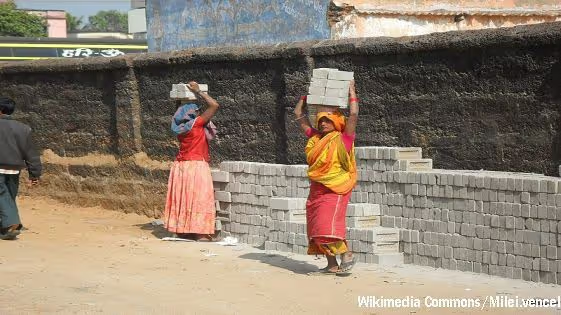
ड्यूएट-विकेंद्रीकृत शहरी रोजगार और प्रशिक्षण: संशोधित
सितंबर 2020 में, शहरी रोजगार के लिए ज्यां द्रेज़ का ड्यूएट (विकेंद्रीकृत शहरी रोज़गार एवं प्रशिक्षण) नामक प्रस्ताेव आइडियाज फॉर इंडिया पर प्रस्तु त किया गया था।इसके बाद आयोजित एक गहन परिसंवाद में ख्याततिप्राप्त अर्थशास्त्रियों एवं पेशेवरों ने उस प्रस्ता व पर अपने-अपने मत व्यपक्तख किए। इस पोस्ट में द्रेज़ ने अपने मूल प्रस्तादव को महत्वंपूर्ण मायने में अद्यतन करते हुएयह सुझाव दिया है कि यह कार्यक्रम शहरी महिलाओं के लिए होना चाहिए और उनके द्वाराही संचालित किया जाना चाहिए।परिसंवाद के प्रतिभागियों के प्रश्नों और महत्वकपूर्ण टिप्प णियों में से कुछ के उत्त्र देते हुए द्रेज़ यह तर्क देते हैं कि ड्यूएट की प्रभावकारिता का आकलन करने का सर्वोत्तम तरीका उसको अमल में लाने का एक अवसर देना है।
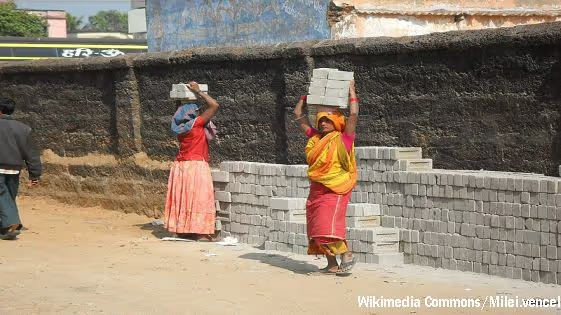
DUET re-examined
In September 2020, Jean Drèze’s proposal for an urban work programme called DUET (Decentralised Urban Employment and Training) was presented on I4I. This was followed by an extensive symposium in whicheminent economists and practitioners provided their perspectives on the proposal. In this post, Drèze updates his original proposal in one important respect, by suggesting that the programme should be run by and for urban women. Responding to some of the key comments and questions of the symposium contributors, he argues that the best way to assess the efficacy of DUET in practice is to give it a chance.
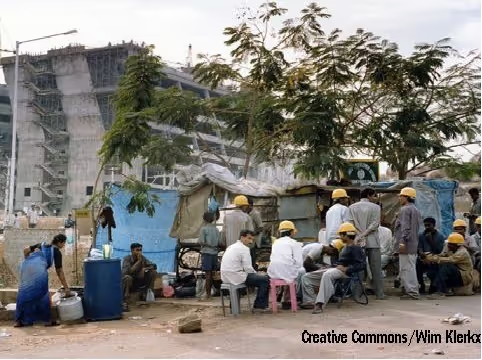
DUET: A proposal for an urban work programme
Jean Drèze presents a proposal for a simple scheme of subsidised public employment in urban areas, generated by multiple public institutions on their own initiative.

Webinar: Impact of Covid-19 on informal and migrant workers in India
The International Growth Centre (IGC), in collaboration with I4I, organised a Webinar on 'The impact of Covid-19 on informal and migrant workers in India', with Jean Drèze (Ranchi University), Farzana Afridi (Indian Statistical Institute), Purnima Menon (IFPRI), and Shahid Vaziralli (IGC), on 13 May 2020.
'न्याय' विचार-गोष्ठी: न्याय से अन्याय न हो
रांची विश्वविद्यालय के विजिटिंग प्रोफेसर ज्यां द्रेज़ ने भारत में सामाजिक सुरक्षा के व्यापक संदर्भ में ‘न्याय’ की भूमिका पर चर्चा की है और इस योजना के लिए कुछ संभावित सिद्धांत प्रस्तावित किए हैं।
NYAY e-Symposium: Doing justice to NYAY
Jean Drèze (Visiting Professor, Ranchi University) discusses the role of NYAY in the larger context of social security in India, and proposes some tentative principles for the scheme
The tale and maths of universal basic income
Commenting on the discussion on universal basic income in the recently released Economic Survey, Jean Drèze argues that UBI is an idea whose time will come, but that time is still quite distant as far as India is concerned.
Decoding universal basic income for India
In this article, Jean Drèze argues that while universal basic income is a good idea in principle, as far as India today is concerned, it sounds like premature articulation. It could also become a Trojan horse for the dismantling of hard-won entitlements of the underprivileged.
Squaring the poverty circle
An expert group headed by C Rangarajan has recommended a poverty measurement methodology for India. In this article, Deaton and Drèze argue that the method proposed by the expert group to set poverty lines is both theoretically and empirically implausible. A simple and transparent benchmark, amenable to democratic debate, would be more useful.

JAM and the pursuit of nirvana
The Finance Ministry is proposing to roll all subsidies into a single, lump-sum cash transfer to households, on the back of the JAM (Jan Dhan Yojana, Aadhaar, Mobile numbers) trinity. In this article, Jean Drèze, Honorary Professor at the Delhi School of Economics, argues that a single-minded focus on high-tech cash transfers as a foundation for social policy in India is fraught with dangers.

Jacques Drèze’s intellectual journey
Eminent economist Jacques Drèze passed away on 25 September 2022 at the age of 93. Professor Drèze was known for his contributions to economic theory and public policy, from general equilibrium analysis to employment strategies in Europe. He founded the Centre for Operations Research and Econometrics (CORE), one of Europe’s leading centres for research in economics. In this piece, his son Jean Drèze remembers his father’s journey as an economist and scholar.
अंतर्निहित प्रयोगों में जोखिम
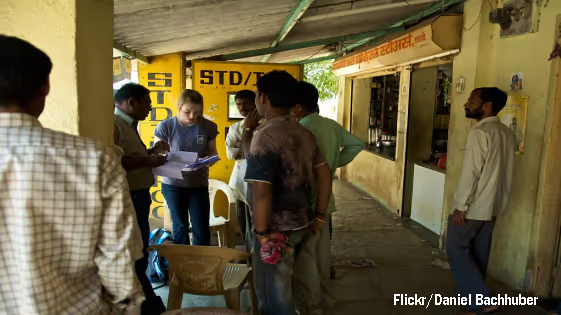
शोधकर्ताओं और नीति-निर्माताओं द्वारा एक टीम के रूप में किये जा रहे 'अंतर्निहित प्रयोगों' में रुचि बढ़ रही है। क्षमता के पैमाने के अलावा,इन प्रयोगों का मुख्य आकर्षण किये गए शोध को शीघ्र ही नीति में परिवर्तित करने की सुविधा वाले प्रतीत होना है। बिहार में किये गए एक केस स्टडी पर चर्चा करते हुए, जीन ड्रेज़ तर्क देते हैं कि ऐसे दृष्टिकोण से नीति और अनुसंधान दोनों बिगड़ जाने का खतरा है।
Memories of Ashok Kotwal
Prof. Jean Drèze pens a heartfelt tribute to our founder Editor-in-Chief Prof. Ashok Kotwal.
On the perils of embedded experiments
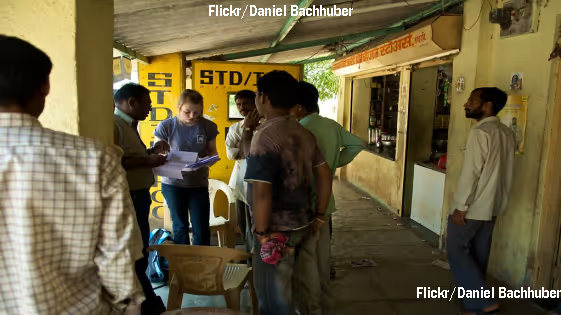
There is growing interest in ‘embedded experiments’, conducted by researchers and policymakers as a team. Aside from their potential scale, the main attraction of these experiments is that they seem to facilitate speedy translation of research into policy. Discussing a case study from Bihar, Jean Drèze argues that this approach carries a danger of distorting both policy and research.

Evidence, policy, and politics
Commenting on the concept of evidence-based policy, Jean Drèze argues that the relation between evidence and policy needs further thought. Based on his involvement with social policy in India, he believes that while economists can contribute to more informed policy discussions and public debates they ought to be cautious in offering advice on policy design.
Ashok Kotwal speaks with Jean Drèze
I4I Editor-in-Chief Ashok Kotwal speaks with Jean Drèze, visiting Professor at Ranchi University and an ‘economist-activist’ who has been working in India at the grassroots level for a long time. They discuss a range of issues including cash vs. in-kind transfers; combining academic research with on-the-ground action; improving governance; and the principles of a good society.
Economics among the road scholars
Jholawala Economics’ is a derogatory term that the urban elites use to dismiss the arguments of social activists without having to contend with them. However, some of the jholawalas are indeed first-rate economists and their arguments cannot be dismissed easily. Jean Drèze is a prime example. His book ‘Sense and Solidarity: Jholawala Economics for Everyone’ puts together the wisdom that he and his co-authors (especially Reetika Khera) have gathered while doing research motivated by the problems they found at the grassroots level. This article is a condensed version of the thought-provoking introduction to the book.