
.svg)
.svg)
%201.svg)
%201.svg)
.svg)

.svg)
.svg)
.svg)
India’s primary healthcare reform: Improved service delivery, reduced mortality
.svg)

.svg)
Human Development
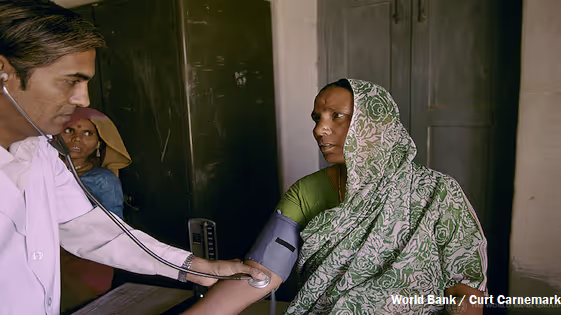
India’s primary healthcare reform: Improved service delivery, reduced mortality
On average, a 60-year-old in India can expect to live for about 19 years, four years less than their counterparts in high-income countries – with the gap being partly driven by poor access to quality healthcare services. Based on data from Rajasthan, this article shows that adding a mid-level healthcare worker to public healthcare facilities in rural areas – a reform undertaken at scale across the country – improves service provision, increases patient visits, and decreases all-age mortality rates.


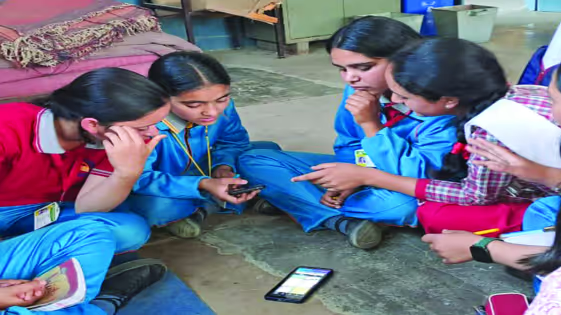
Youth’s digital readiness in rural India
As India undergoes rapid technological transformation, digital literacy has become a key driver of youth’s preparedness for future educational, economic, and social opportunities. In this note, Kumar and Bhutada examine digital readiness among rural youth, based on insights offered by the Annual Status of Education Report (ASER) 2023 and 2024. While there is widespread smartphone access, significant gaps remain in digital skills and readiness to adapt to an increasingly technology-driven world.

Lighting the path to learning: Can electricity boost children’s test scores?
When households gain access to electricity, children are more likely to be enrolled in school. But do they also perform better? Based on West Bengal’s universal household electrification programme and nationally representative data, this article shows that children in families with electricity access score higher on reading and math tests. The key mechanisms are identified as longer study time, higher household incomes, and reduced need for fuel collection.
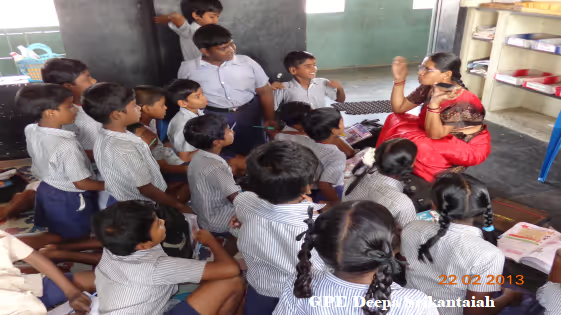
Reflections on how the New Education Policy plays out in the classroom
The National Education Policy, 2020 emphasises the acquisition of foundational literacy and numeracy by Standard 2. Yet, little is known about how the related initiatives have translated into changes in teaching-learning in the classroom. In this note, Bhattacharjea, Bhutada and Bisht share insights from a study involving classroom observations and teacher interviews across eight states in India – on aspects such as classroom composition, teachers’ attitudes towards young children, and teaching methods.

The unintended effect of alcohol prohibition on adolescents’ mental health
Alcohol consumption is typically initiated during adolescence, with long-lasting implications on adult health, economic stability, and well-being. Analysing Bihar’s alcohol ban, this article finds adverse impacts on adolescents’ mental health – driven by increased access to illegal alcohol from neighbouring states and higher consumption of home-brewed and locally produced alcohol. Additionally, there was an increase in risky behaviours and deterioration in the adolescent social environment.
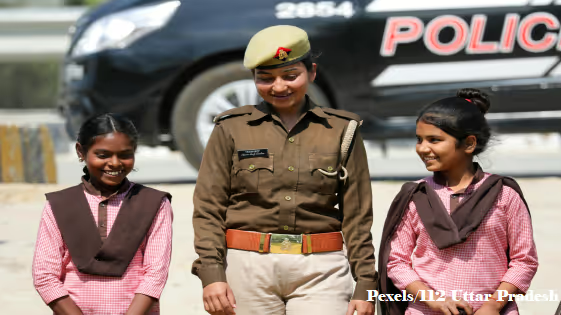
How police patrols reduced severe street harassment in India
Street harassment is a pervasive issue, with negative impacts on women’s safety and mobility in urban public spaces. Based on an experiment conducted in collaboration with the Hyderabad City Police, this article demonstrates that visible, anti-harassment policing strategies combined with efforts to transform underlying social attitudes, can make a difference.
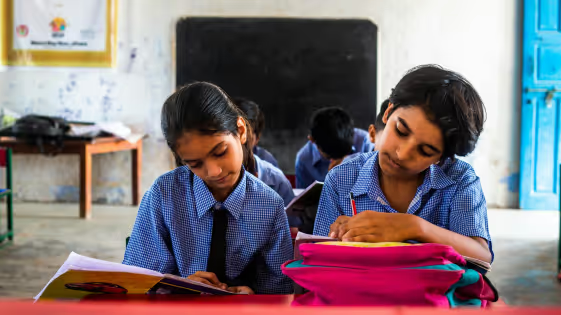
ASER 2024: More than a post-pandemic recovery in learning
The Annual Status of Education Report (ASER) 2024 reports on children’s schooling status and reading and arithmetic levels from almost all rural districts of India. In this post, Wilima Wadhwa, Director of the ASER Centre, discusses the key trends in school enrolment and learning outcomes across government and private schools. Noting improvements in learning, she attributes the gains to the focus on foundational learning and numeracy in the New Education Policy.
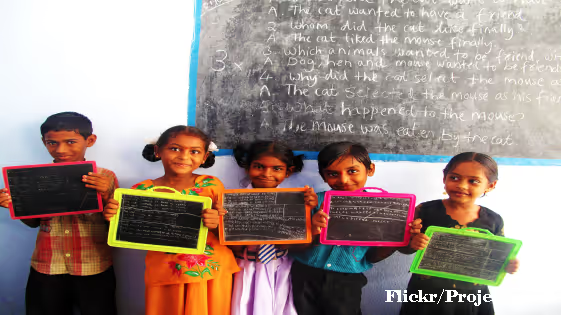
Enhancing foundational learning through parent-teacher collaboration
Despite advancements in primary school enrolment, over 50% of pupils in rural India fail to achieve core literacy, while 44% lack numeracy skills at the end of grade 5. Based on a randomised experiment in rural Uttar Pradesh this article finds that community participation, facilitated through a collaborative and participatory approach between parents and teachers, enhances accountability in schools, and significantly improves children’s foundational learning.

The wide-ranging benefits of India’s Public Distribution System
India’s Public Distribution System (PDS) is the world’s largest food transfer programme and India’s most far-reaching social safety net, accounting for 60% of the country’s social assistance budget at one time. This article shows that the expansion of the PDS, following the National Food Security Act, prevented approximately 1.8 million children from being stunted, while also raising wage incomes and improving dietary diversity.


Sign up to our newsletter to be notified about the latest updates
.svg)
Just One Step Away!
Complete your signup to start getting the latest news, stories, and updates delivered straight to your inbox.