
.svg)
.svg)
%201.svg)
%201.svg)
.svg)

.svg)
.svg)
.svg)
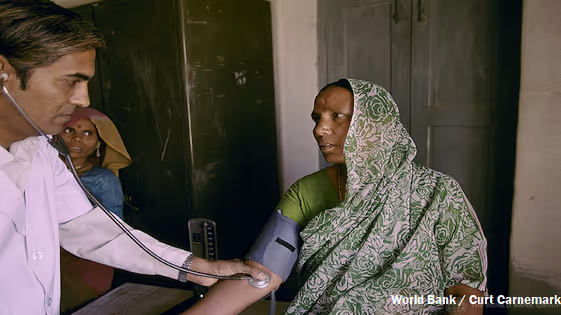
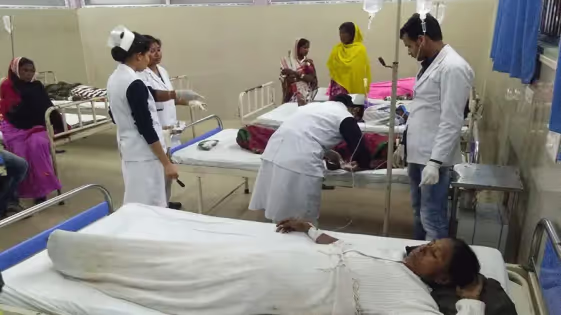
India’s primary healthcare reform: Improved service delivery, reduced mortality
.svg)

.svg)

Human Development
Network membership and demand for health insurance
Despite being free and having liberal eligibility criteria, the adoption of public health insurance in India remains low. This article examines how informal networks influence adoption behaviour, in the context of Andhra Pradesh’s Aarogyasri programme. It shows that network type matters: information networks do not significantly impact the uptake of public insurance, whereas financial networks actually facilitate, rather than hinder, public insurance adoption.


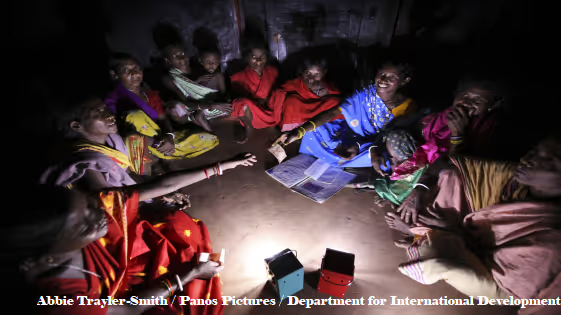
Powering progress: How reliable community electrification boosts women’s autonomy
While there has been significant progress in expanding access to grid electricity in India, the reliability of electricity remains a concern. Based on five national-level datasets spanning over a period of almost two decades., this article shows that improved reliability of electricity at the community level is beneficial for women’s empowerment in terms of mobility, participation in household decision-making, health autonomy, and safety.
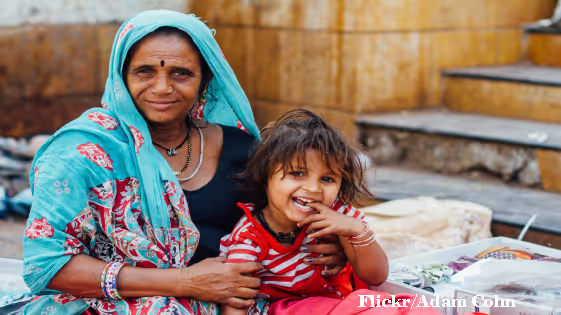
Empowering daughters: How conditional cash transfers can shift cultural norms
During the last 30 years, Indian governments have implemented over 20 programmes that reward parents who have daughters and invest in them after birth. Yet, very little is known about these programmes’ effectiveness in reducing son preference and shifting cultural norms. Analysing the impact of a scheme with many typical design features, the article finds that such programmes are rightfully part of the policy toolkit and deserve more attention.

Competitive jobseekers: When sharing less leaves firms at a loss
For efficient matching of jobs and workers in the labour market, it is essential that information on job postings reaches suitable jobseekers. While social networks play a key role in this regard, competition for jobs may disincentivise information-sharing. Based on an experiment with college students in Mumbai, this article finds that these disincentives reduce the overall quality of applicants and hires.

Street safety and girls’ secondary schooling in India
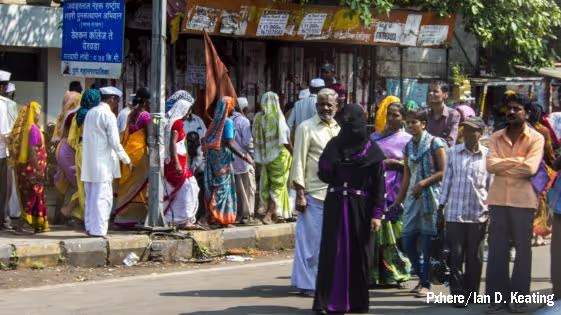
Street harassment in India is still a constraint on women's education, dimming their future. Analysing the case of ‘SHE teams’ in the state of Telangana, this article shows that the introduction of special police units dedicated to women's safety on streets led to a significant increase in girls finishing grade 12. Further, it establishes that the impact is not driven by non-street safety determinants of schooling.

Contraception as a pathway to better child nutrition and health
India is home to one-third of the world’s stunted children, and half of all under-five mortality can be attributed to undernutrition. Existing literature has shown an association between larger families and poorer child health outcomes. Based on analysis of data from the National Family Health Survey, 2019-2021, this article finds that reducing fertility through increased use of contraception can lead to significant improvements in child health and malnutrition indicators.

Moratorium on new subsidies to garner resources for public spending on health
Employability is fundamentally driven by human capital development, encompassing health and education. Based on analysis of data from about 100 economies, Shishir Gupta argues that in India, the lack of sufficient public spending constrains healthcare – rather than education, where the issues are different. In his view, one pragmatic way to increase public spending on healthcare is by putting a moratorium on new subsidies and rationalising existing ones
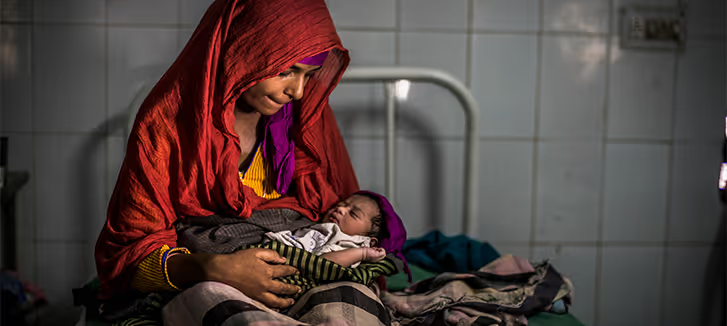
Does subsidising publicly provided services discipline markets or distort demand?
Prior research has documented the failure of India’s flagship safe motherhood programme in reducing perinatal mortality, despite substantially increasing the share of mothers delivering at public healthcare facilities – presenting a conundrum for policymakers. Examining responses to the programme across various segments of the maternal healthcare market, this article locates the explanation in the interactions between public and private healthcare providers.
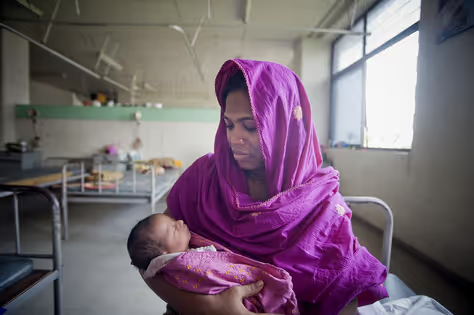
Did Covid-19 pandemic increase incidence of low-birth-weight among newborns?
Globally, one in four babies are born with low birth weight, with long-term impacts on health and economic outcomes. This article uses Indian data from 2019-2021 to analyse the impact of the Covid-19 pandemic on birth outcomes, given the disruption of essential maternal and neonatal services. It finds that infants born post-pandemic had 45 grams lower birth weight, with 3% greater incidence of low birth weight than infants born before the pandemic.


Sign up to our newsletter to be notified about the latest updates
.svg)
Just One Step Away!
Complete your signup to start getting the latest news, stories, and updates delivered straight to your inbox.