
.svg)
.svg)
%201.svg)
%201.svg)
.svg)

.svg)
.svg)
.svg)
Night shift bans and female employment in Indian manufacturing
.svg)

.svg)
Productivity and Innovation
Night shift bans and female employment in Indian manufacturing
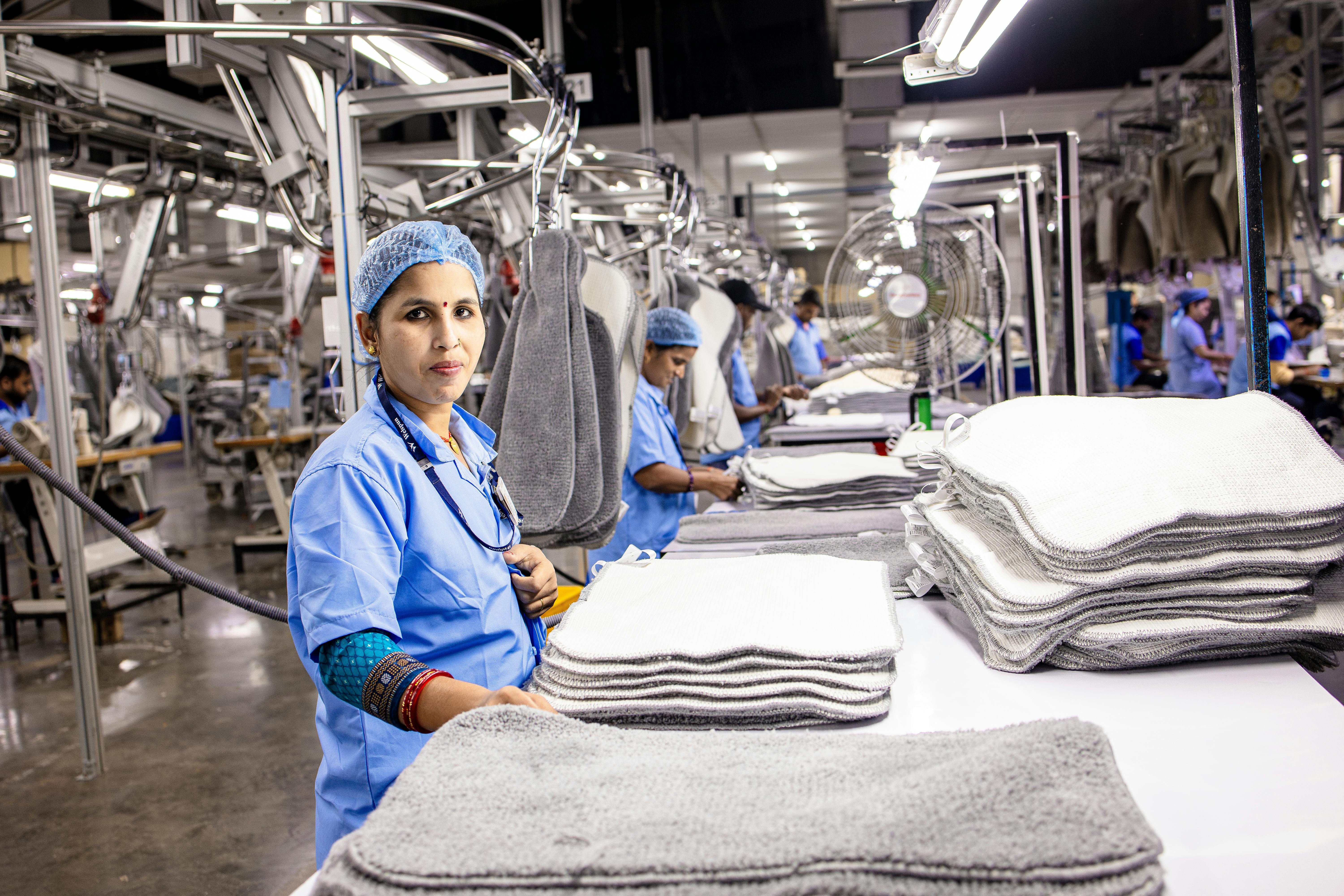
Do laws designedto protect women from unsafe working conditions constrain the demand for theirlabour? This question sits at the centre of global debates about protectivelegislation in labour markets. Our recent research (Gupta et al.2025) examines what happened when Indian states lifted long-standing bansthat prevented women from working night shifts in factories. Our findings offerimportant lessons for policymakers seeking to expand female employment,particularly considering the significant labourreforms that have been recently initiated by many state governments.



Global software piracy: Does US Special 301 pressure matter?
Section 301 of the US Trade Act seeks to combat global software piracy, with non-compliance by partner countries potentially leading to trade sanctions. Examining data from 1994-2017 involving 83 countries, this article shows that the process has no significant impact on international software piracy overall. It finds that countries that are below-median in terms of development, State capacity, and institutional quality, are unable and/or unwilling to bend to such pressure. By contrast, multilateral enforcement of stronger intellectual property protection appears to be an effective instrument in curbing piracy.

Manufacturing share in GDP: Comparing India with China and South Korea
: It is commonly believed that Indian manufacturing performance is weak, as the sector has not been able to capture a large enough GDP share. Presenting a comparison of manufacturing share in gross domestic product in India, China and South Korea, Bishwanath Goldar argues that this can be explained predominantly by changing terms of trade between manufacturing and services, and manufacturing translating technological and productivity advances into lower prices and better-quality products for customers in India.

Planning for ‘jobs of the future’ in a changing world
Following decades of structural transformation, in the coming years, external factors including climate change, increasing automation, and global economic policies will all play a role in determining India’s employment landscape. To mark International Workers’ Day on 1 May, I4I Deputy Managing Editor Nikita Mujumdar summarises some research on addressing these challenges to ensure worker well-being and productivity, and equitable access to future-proof jobs.

Wartime mobilisation and economic development in India
Can temporary wartime mobilisation permanently reshape an economy? This article shows that Indian districts that received more orders related to World War II saw greater transformation from agriculture to industry and services more than six decades later – with the majority of this structural transformation driven by procurement in heavy industries. These districts also experienced higher consumption levels, urbanisation rates and nighttime luminosity.
Complementarity between labour and energy in Indian manufacturing
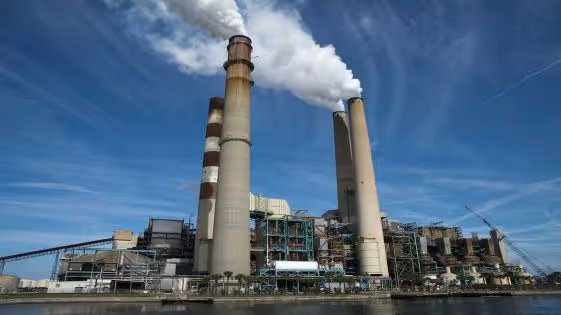
As India develops its carbon markets to mitigate climate change, it is important to consider the short-term costs for industry. Analysing data on formal manufacturing from 2009-10 to 2019-20, this article finds that energy and labour are complementary inputs in production – if an intervention such as a carbon tax raises the cost of energy and reduces its use in manufacturing, employment will go down as well.

Unlocking women’s workforce potential
Despite significant progress in educational attainment and health outcomes, India lags in enabling women’s economic participation, which, in turn, impedes the goal of fast and inclusive economic growth. This article shows that formalising part-time employment and redistributing unpaid care work between men and women could raise female labour force participation by six percentage points, from 37% to 43%. This is the first post of a five-part series to mark International Women’s Day 2025.
Old or new: What’s driving employment growth in formal manufacturing?
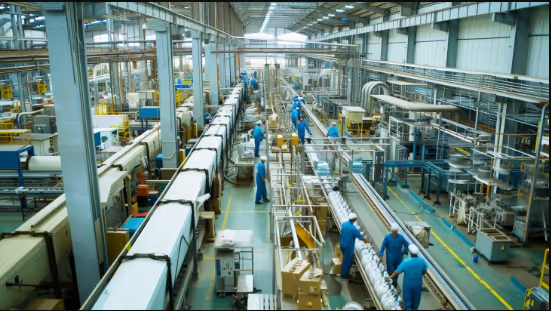
As the government undertakes various initiatives for manufacturing, it is important to understand what type of firms drive employment growth in the sector. Based on data on registered firms from the Annual Survey of Industries from 2000-2016, this article highlights the importance of older, larger firms in creating jobs. It suggests that policies should encourage entry of new medium-sized plants and facilitate growth of dynamic, incumbent small and medium firms.
Technological advancement and employment changes: Recent trends in India
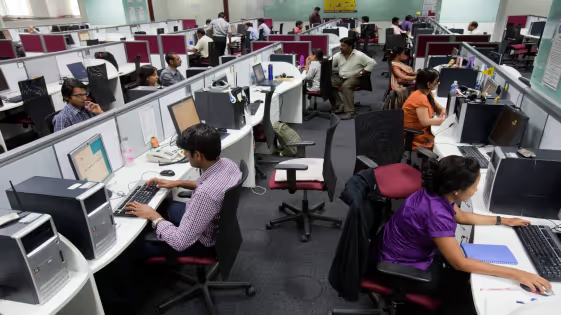
What is the impact of rapid technological advancements on employment in the Indian economy? In this post, Kathuria and Dev analyse ‘Consumer Pyramids Household Survey’ data to explore this question. They note a consistent decline in the share of low-skilled workers across sectors, along with reduced employment prospects, particularly in the post-Covid-19 era. They advocate for training these workers – especially women – so that they can transition into higher-skill, higher-paying jobs.


Sign up to our newsletter to be notified about the latest updates
.svg)
Just One Step Away!
Complete your signup to start getting the latest news, stories, and updates delivered straight to your inbox.