
.svg)
.svg)
%201.svg)
%201.svg)
.svg)

.svg)
.svg)
.svg)
Why India's plan to sell rice for ethanol undermines food and water security
.svg)

.svg)

Agriculture
Why India's plan to sell rice for ethanol undermines food and water security
In a recent policy shift with regard to India’s Ethanol Blended Petrol Programme, excess rice stocks of the Food Corporation of India are being made available for ethanol production at a reduced reserve price. In this post, Akanksha Jain argues that while the move might resolve an immediate supply chain bottleneck, it risks distorting the long-term balance between food security, environmental sustainability, and bioenergy policy.


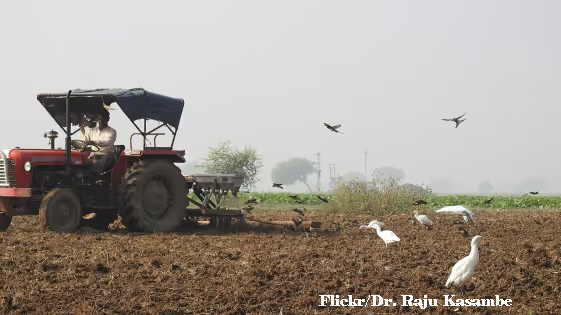
Internal migration and spatial reorganisation of agriculture
While migrants and their urban destinations are extensively studied, less is known about how their departure transforms the rural economies they leave behind. Analysing Indian data, this article shows that migrant-sending households near cities reduce farm size and investment rather than replacing workers with capital. On the other hand, non-migrant, remote households expand production in response to falling land prices and rising crop prices

Sowing sunshine: Can agriphotovoltaics offer a path to doubling farmers’ income?
In recent years, the contribution of agriculture and allied sectors to economic output has declined, with farmers’ real incomes virtually stagnating. This article demonstrates that new ideas such as agriphotovoltaics, which combine solar power with crop cultivation, have the potential to boost farmers’ incomes while also enhancing land-use efficiency and combating climate change.
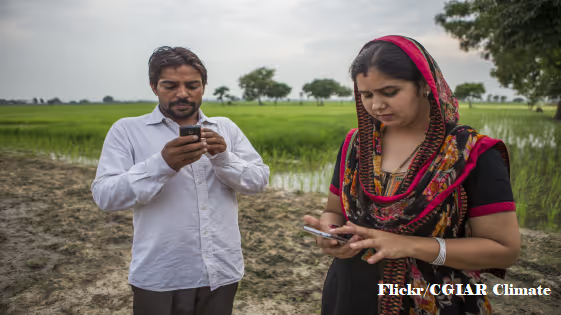
Information is power: ICT and agricultural productivity
One reason for low agricultural productivity in developing countries is that farmers lack sufficient information or guidance in the use of modern agricultural methods. This article examines the impact of an Information and Communication Technology initiative in Bangladesh, involving call centres that enable farmers to consult experts regarding agricultural practices. It finds that, post intervention, villages with access to phone service experienced a 50% reduction in agricultural inefficiency at the plot level.

Impact of climate change on smallholder dairy farmers in India
A considerable number of agricultural households in India engage in livestock rearing and milk production to supplement their income and improve household nutrition. This article examines how global warming impacts smallholder dairy farmers, particularly through a decline in milk yields. It finds a significant negative impact of higher maximum or minimum temperatures on milk yield, with the highest impact for the range above 350C.
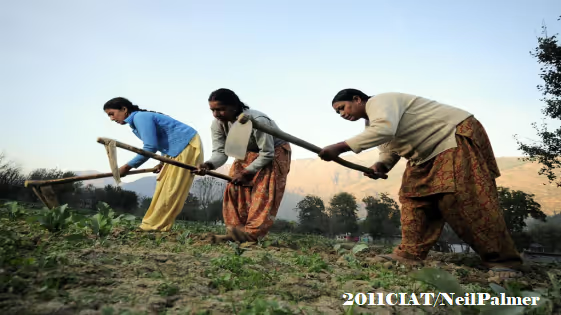
The agricultural productivity gap: Informality matters
There are various explanations in the literature for the observed productivity gap between agriculture and other sectors, in developing countries. Using Indian data, this article questions the standard view of the two-sector productivity gap. It shows that while the productivity gap between the farm sector and informal non-farm sector is negligible, a worker in the formal non-farm sector is 3-4 times more productive than a worker in the farm sector.

Sign up to our newsletter to be notified about the latest updates
.svg)
Just One Step Away!
Complete your signup to start getting the latest news, stories, and updates delivered straight to your inbox.