
.svg)
.svg)
%201.svg)
%201.svg)
.svg)

.svg)
.svg)
.svg)
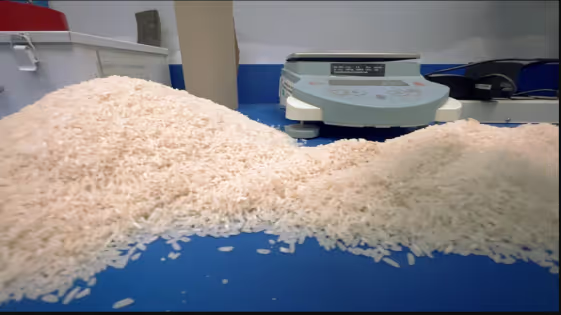
Why India's plan to sell rice for ethanol undermines food and water security
.svg)

.svg)

Agriculture
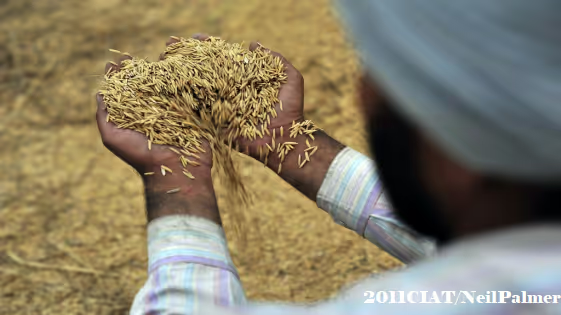
100 million tonnes of cereals are missing… every year
In an earlier I4I post, Drèze and Oldiges drew attention to India’s ‘cereal gap’ – a large difference between net availability of cereals and household consumption. In this post, they use recently released consumption survey data, and find that the gap is more than twice as large as their earlier estimate of 45 million tonnes for 2022-23. They discuss the possible reasons for this yawning gap.


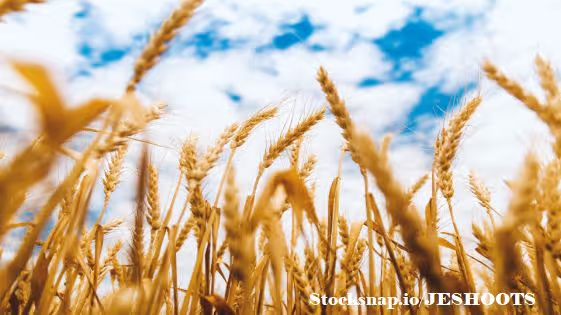
The ‘cereal gap’: Looming issues in India’s foodgrain policy
Cereal production in India recently crossed 300 million tonnes for the first time. In this post, Drèze and Oldiges point out that a major gap has emerged between the net availability of cereals and household consumption – and it is unclear where the balance goes. With cereal production expected to increase further, they argue that there is a looming inconsistency between pricing policy and the realities of cereal demand.

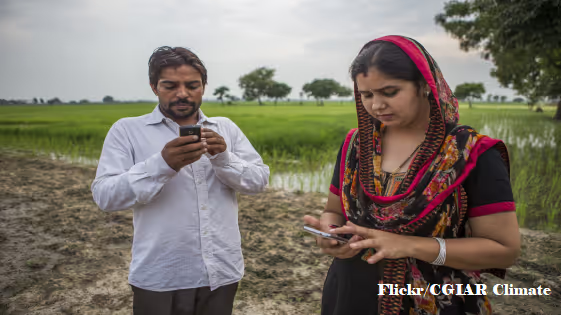
Exploring urban perceptions around freshness of vegetables
With urban Indians increasingly seeking healthy lifestyles, the demand for fresh produce has escalated. In this note, Raj, Purushothaman and Sadashiva discuss findings from their survey in Bengaluru, exploring perceptions around the ‘freshness’ of produce among different consumer groups, and factors influencing consumer choices. They contend that a relationship of trust between producers and consumers can enable convergence of quality, nutrition and food safety in farm produce
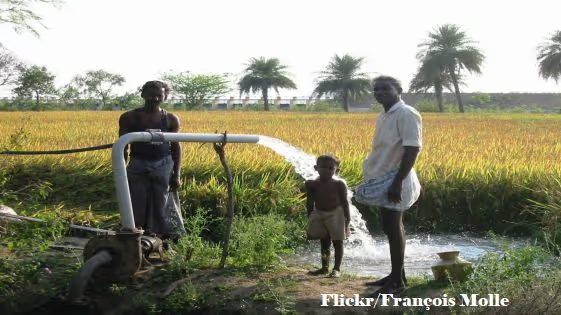
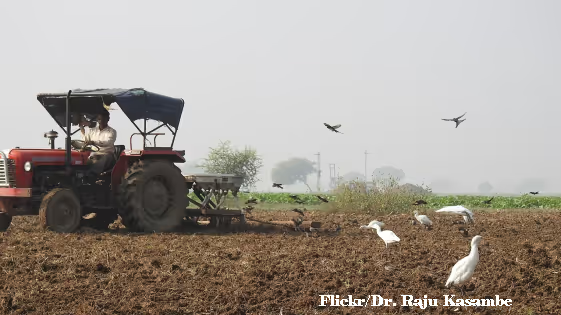
Watering the seeds of the rural economy: Evidence from groundwater irrigation in India
Over time, technological advancements accompanied with government energy subsidies have made groundwater the single largest source of irrigation in India. This study evaluates the impact of access to groundwater irrigation on the spatial and sectoral distribution of rural economic activity. It finds a significant improvement in agricultural production accompanied with modest consumption gains, as well as a substantial increase in population density. Access to groundwater also appears to provide additional employment opportunities for agricultural wage labour from surrounding non-irrigated villages.
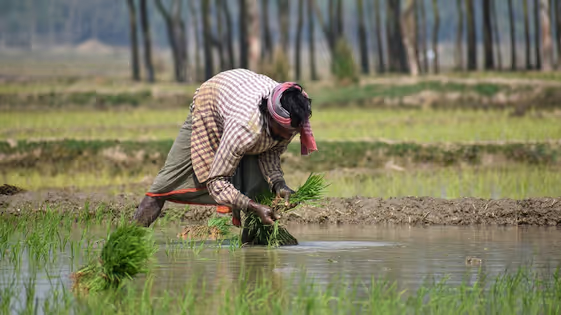
The role of caste in agricultural technology diffusion
Local social structures, such as the jati-caste system in India, can play an important role in the extent of diffusion of new and beneficial agricultural technologies. This article builds on an existing study of paddy farmers in Odisha and finds that village-level caste homogeneity supports the diffusion of a flood-resistant seed variety, while fragmentation deters it. De Janvry et al. note differences in diffusion rates based on the frequency of flooding, and the caste identity of the initial recipient.

Odisha Millets Mission: An update at the end of IYM 2023
In the sixth and final post of the e-Symposium on ‘Carrying forward the promise of International Year of Millets’, Banerjee and Kundu discuss the extent to which policies implemented as a part of the Odisha Millets Mission improved the production, processing and procurement of the crop. Building on previous work by the Bharat Rural Livelihoods Foundation, they also look at how the Mission was impacted by Covid-19 and other challenges including poor awareness and public perception. They highlight how Odisha's efforts, preceded the International Year of Millets 2023, and how its success can become a model for other Indian states to follow.

Sign up to our newsletter to be notified about the latest updates
.svg)
Just One Step Away!
Complete your signup to start getting the latest news, stories, and updates delivered straight to your inbox.