
.svg)
.svg)
%201.svg)
%201.svg)
.svg)

.svg)
.svg)
.svg)
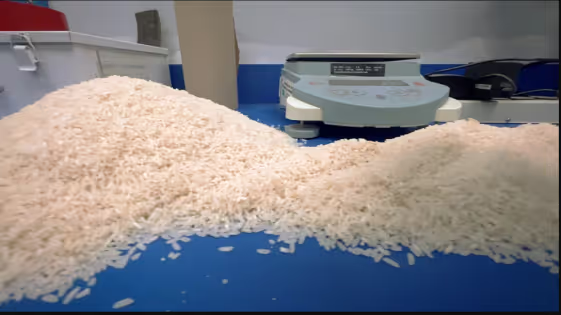
Why India's plan to sell rice for ethanol undermines food and water security
.svg)

.svg)

Agriculture
Going beyond the International Year of Millets to achieve decade-long action
In the third post of the e-Symposium on ‘Carrying forward the promise of International Year of Millets’, Ashwini Kulkarni considers how the increased focus on millets during this year is just the beginning. She reflects on existing efforts to promote millet consumption, and the need to plan for the decade ahead– by reforming the millets value chain, promoting lesser known millet varieties, providing incentives and support to small farmers during the production process, and increasing research and development into methods for improving productivity and processing of millets.


Farm to fork: An overview of millet supply chains in India
In the second post of the e-Symposium on ‘Carrying forward the promise of International Year of Millets’, Kumar, Das and Jat discuss the potential to increase cultivation of millets, and outline some of the factors contributing to low demand for millets, despite effects to increase awareness about their nutritional benefits, They highlight the need for coordinated efforts between various stakeholders to make millets affordable for consumers and economically viable for farmers, and suggest four strategies to promote production and create demand for millets.
Introduction to e-Symposium: Carrying forward the promise of International Year of Millets
Although millets were a staple food in many Indian diets, their consumption has declined over the last few decades. Taking into account their resilience to climate change and potential to contribute to nutritional security, the Indian government has vowed to increase millet production and consumption and successfully advocated the United Nations to declare 2023 as the International Year of Millets (IYoM). Starting from World Food Day on 16 October, Ideas for India will host six pieces from researchers and practitioners discussing how the promise of millets can be realised. Anchored by Bharat Ramaswami, this series will feature perspectives on increasing millets’ land under cultivation; investment in R&D and machinery for its production and processing; suggestions to revive demand by including millets in government food programmes; and increasing the scope for exports.
The impact of climate change on Indian crops
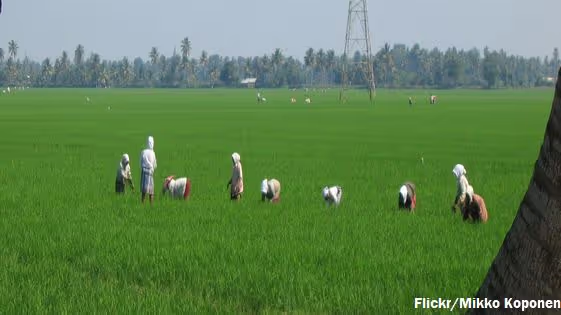
This article looks at deviations in the impact of short-term weather events and long-term climate change on yields of rice, maize and wheat, and finds that the negative impact of temperature is higher in the short run than in the long run, implying that farmers were able to adapt to long-term changes in climate. It also discusses the impact of precipitation on crop yields, and concludes by highlighting the need for customised farm management policies to adapt to climate change.

Long-run impacts of tube well irrigation in India
Increasing agricultural productivity may significantly and positively impact welfare, income and the pace of structural transformation. Using India’s Green Revolution and the corresponding self-sufficiency in food production as a natural experiment, this article discusses the long-run impacts of the productivity increase. Using an instrumental variable approach, it shows how tube well expansion since the mid-1960s led to a decrease in employment in the farming sector, and had a positive impact on living conditions and asset ownership.

Land misallocation and industrial development
Although a large share of land in India is used for cultivation, large tracts of this are unproductive and produce low crop yields. In this post, Dasgupta and Rao explain their calculations to determine the minimum amount of land that would be required to meet the outputs for a set of crops. They argue that optimising land allocation can release millions of hectares of land for non-agricultural purposes, while also ensuring that food security remains unaffected.

Sign up to our newsletter to be notified about the latest updates
.svg)
Just One Step Away!
Complete your signup to start getting the latest news, stories, and updates delivered straight to your inbox.