.svg)
.svg)
%201.svg)
%201.svg)
.svg)

.svg)
.svg)
Ashwini Kulkarni Kulkarni

Ashwini Kulkarni belongs to the Civil Society organisation Pragati Abhiyan based in Nashik. She has been associated with rural poverty related programmes for two decades. Pragati Abhiyan works with tribal villages of Nashik district and is also involved in research and policy work.
.svg)

Going beyond the International Year of Millets to achieve decade-long action
In the third post of the e-Symposium on ‘Carrying forward the promise of International Year of Millets’, Ashwini Kulkarni considers how the increased focus on millets during this year is just the beginning. She reflects on existing efforts to promote millet consumption, and the need to plan for the decade ahead– by reforming the millets value chain, promoting lesser known millet varieties, providing incentives and support to small farmers during the production process, and increasing research and development into methods for improving productivity and processing of millets.


Crop insurance scheme 2.0: Implementation issues and weaknesses
Launched in 2016 and revamped earlier this year, the Pradhan Mantri Fasal Bima Yojana is Government of India’s flagship crop insurance scheme. However, it has been riddled with implementation challenges and non-payment of dues to farmers. In this note, Ashwini Kulkarni highlights some of the key issues in the design of the scheme – particularly its use of ‘crop-cutting experiments’ – and makes recommendations to enhance its effectiveness.

In lieu of the Planning Commission: Part V
In this post, Ashwini Kulkarni, who works with the NGO Pragati Abhiyan in the state of Maharashtra, provides her perspective on some of the issues involved in replacing the Planning Commission. In her view, an institution such as the Planning Commission that is outside of the government ministries but committed to the government, has an important crosscutting role and should be given a statutory status.
India’s new National Water Policy: A paradigm shift
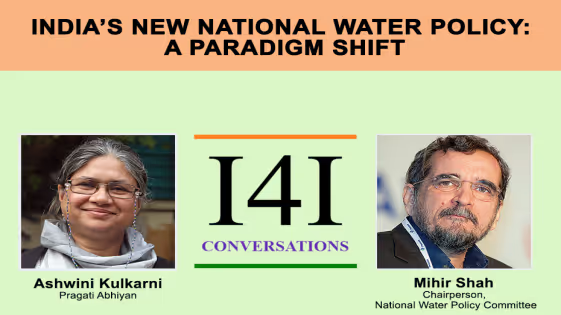
In 2019, the Ministry of Jal Shakti set up a committee of independent experts – led by Dr Mihir Shah – to draft a new National Water Policy. To examine the recommendations made by the Committee, Ashwini Kulkarni speaks with Mihir Shah, beginning with a discussion of the key issues constituting the water crisis facing India today – in terms of dichotomies such as agriculture and industry use, rural and urban issues, quality and quantity of water, and so on. Dr Shah explains how the new Policy is a shift away from a supply-centric approach involving dam construction and groundwater extraction, to the management of the demand and distribution of water. He emphasises the importance of weaving our interventions into the contours of nature, rather than having a “command and control” relationship with nature – a lesson that is especially relevant in Covid times. Within the wider context of climate change, drying rivers and falling water tables, Shah noted that the past is no longer a reliable
India’s new National Water Policy: A paradigm shift
In 2019, the Ministry of Jal Shakti set up a committee of independent experts – led by Dr Mihir Shah – to draft a new National Water Policy. To examine the recommendations made by the Committee, Ashwini Kulkarni speaks with Mihir Shah, beginning with a discussion of the key issues constituting the water crisis facing India today – in terms of dichotomies such as agriculture and industry use, rural and urban issues, quality and quantity of water, and so on. Dr Shah explains how the new Policy is a shift away from a supply-centric approach involving dam construction and groundwater extraction, to the management of the demand and distribution of water. He emphasises the importance of weaving our interventions into the contours of nature, rather than having a “command and control” relationship with nature – a lesson that is especially relevant in Covid times. Within the wider context of climate change, drying rivers and falling water tables, Shah noted that the past is no longer a reliabl

The state of the economy and mass perception
In this article, Ashwini Kulkarni of NGO Pragati Abhiyan contends that the media should tap into the knowledge of practitioners that are familiar with the ground realities of social sector schemes – rather than those outside the sector - with regard to budget-related and other discussions on the sector. This will help provide the masses with a real picture of the developmental problems plaguing the economy.
How a corruption scam brought MNREGA to a standstill in Nanded
Nanded district in Maharashtra demonstrated exemplary performance in MNREGA until 2012-13, when the exposure of a corruption scam brought the programme to a virtual standstill. In this note, researchers from the NGO Pragati Abhiyan show how the manner in which the incident was dealt with discouraged local authorities from actively implementing MNREGA and hence, adversely affected villagers that had earlier benefitted from the programme.
Assessing the quality and usefulness of MNREGA assets in Maharashtra
Questions have been raised regarding the quality and usefulness of assets created under MNREGA. To examine the validity of the scepticism, this column reports results from a study of MNREGA assets in Maharashtra. While the assets are largely found to be useful and durable, the study suggests that greater attention to design and maintenance, and local participation in the decision-making process can lead to further improvement.
The Mahatma Gandhi National Rural Employment Guarantee Act: is it working?
MNREGA is one of the government´s largest flagship schemes, and is the largest job creation programme of its kind in the world. Supporters believe that it is necessary to help rural workers smooth income in times of distress and increase labour market access for marginalised groups, whereas critics argue that it is taking labour from the troubled agricultural sector and doing more harm than good. What does the evidence really tell us - is MNREGA working or would resources be better spent elsewhere?
The impacts of linking NREGA payments to UID. A Study of Maharashtra
This project attempts to measure the impact of Universal Identification (UID)-linked wage payments on corruption in public works projects funded under MNREGA (National Rural Employment Guarantee Act).
उषारमुक्ति परियोजना: नदियों को पुनर्जीवित करने के लिए संस्थानों का संगम
पश्चिम बंगाल सरकार की एक परियोजना ‘उषारमुक्ति’ को राज्य के पश्चिमी हिस्से में नागरिक समाज संगठनों के सहयोग से क्रियान्वित किया जा रहा है, ताकि मिट्टी और पानी के संरक्षण के लिए मनरेगा के तहत जल विभाजक (जलग्रहण क्षेत्र) गतिविधियां की जा सकें। इस नोट में, अश्विनी कुलकर्णी ने परियोजना क्षेत्र में किए अपने दौरे के आधार पर इसके पीछे के मुख्य विचार और अभिनव कार्य प्रणाली का वर्णन किया है।
Usharmukti project: A confluence of institutions for rejuvenating rivers
Usharmukti, a project of the Government of West Bengal, is being carried out in collaboration with civil society organisations in the western part of the state, to carry out watershed activities under MNREGA to conserve soil and water. In this note, Ashwini Kulkarni describes the main idea behind and working of the innovative project from her visit to the project area.