
.svg)
.svg)
%201.svg)
%201.svg)
.svg)

.svg)
.svg)
Lakshmi Iyer Iyer

Lakshmi Iyer is an Associate Professor at the University of Notre Dame, where she holds a joint appointment in the Economics Department and the Keough School of Global Affairs. Her primary research fields are development economics and political economy. Her research has examined many dimensions of the distribution of political power within emerging market countries, including the legacy of colonial rule, the division of authority between politicians and bureaucrats, the determinants of conflict and the political participation of women. She has also studied historical and current property rights institutions in several developing countries including India, Vietnam, China, and the Philippines. Her work has been published in several leading academic journals in economics.

The growing wave of decentralisation: Comparative evidence from developing countries
Over the last few decades, decentralisation has been rapidly spreading in developing countries across the world, with around 35 countries announcing new or deepening decentralisation reforms in recent years. In a new I4I Conversation, Lakshmi Iyer (University of Notre Dame) joins Sarmistha Pal (University of Surrey) and Jean-Paul Faguet (London School of Economics), the editors of ‘Decentralised Governance: Crafting Effective Democracies Around the World’, to discuss the current global state of decentralisation. Over the conversation, they draw on theoretical and empirical insights from different chapters of the book, each featuring diverse countries – Pakistan, China, Indonesia, Kenya, India, Ghana, Bangladesh, and Colombia.



The growing wave of decentralisation: Comparative evidence from developing countries
Over the last few decades, decentralisation has been rapidly spreading in developing countries across the world, with around 35 countries announcing new or deepening decentralisation reforms in recent years. In a new I4I Conversation, Lakshmi Iyer (University of Notre Dame) joins Sarmistha Pal (University of Surrey) and Jean-Paul Faguet (London School of Economics), the editors of ‘Decentralised Governance: Crafting Effective Democracies Around the World’, to discuss the current global state of decentralisation. Over the conversation, they draw on theoretical and empirical insights from different chapters of the book, each featuring diverse countries – Pakistan, China, Indonesia, Kenya, India, Ghana, Bangladesh, and Colombia.
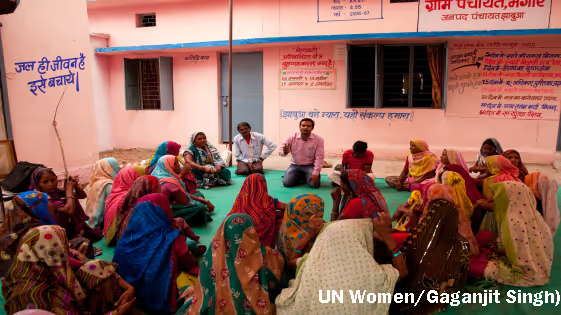
Does being local matter? Administrative decentralisation and human development
In this post, Chaudhary and Iyer discuss the administrative decentralisation reforms brought about by the Panchayati Raj Act, and measure the effect of decentralisation on the provision of public services and human development outcomes. States implemented these decentralisation reforms at different times, and to different extents. Their findings show that devolution of only functions to the local level, without a devolution of functionaries or funds, results in a decline in the quality of public service.

क्या मतदान का अधिकार राजनीतिक व्यवहार को प्रभावित करता है? भारत से ऐतिहासिक साक्ष्य
लोकतंत्र को लंबे समय से बेहतर आर्थिक विकास परिणामों के लिए जाना जाता है। हालांकि यह स्पष्ट नहीं है कि नागरिकों को मतदान का अधिकार देना, राजनीतिक भागीदारी या प्रतियोगिता को प्रभावी बनाए रखने को सुनिश्चित करने के लिए पर्याप्त है या नहीं। एक नए प्रयोग के तहत 1921-1957 के दौरान जिला-स्तरीय डेटासेट को आधार बनाते हुए यह लेख इस बात की जाँच करता है कि भारत में किस प्रकार दो वर्ग-आधारित विस्तार द्वारा राजनीतिक व्यवहार को आकार दिया गया है।

Does the right to vote affect political behaviour? Historical evidence from India
Democracies are known to have better economic development outcomes over the longer run. However, it is not clear whether giving citizens the right to vote is sufficient for ensuring an effective degree of political participation or competition. Creating a novel, district-level dataset from 1921-1957, this article examines how political behaviour is shaped by two class-based extensions of voting rights in India.
How leader identity impacts group coordination
In principle, leaders can facilitate group coordination towards a common goal but in diverse societies, their effectiveness may depend upon their social identity, and how citizens react to leader identity. Based on a lab-in-field experiment in India, this article investigates the role of leader religion in improving coordination, and the effectiveness of two policies that are often used to aid disadvantaged groups: intergroup contact, and affirmative action.

The Transfer Raj
When Chief Ministers come to power in India, they extensively reshuffle civil servants postings. This column asks why state politicians transfer bureaucrats, whether they favour loyalty over competence, what this means for the administrative efficiency of the Indian state, and what can be done about it.

Boosting shared prosperity in South Asia
Two-thirds of the poor in India and other South Asian countries live in the lagging regions. This column examines whether there are poverty traps that make it difficult to achieve shared prosperity, and if the current fiscal decentralisation arrangements in South Asia are working to the benefit of the poor regions. It highlights the need for shifting the locus of policy from the national to sub-national level, and from leading to lagging regions.
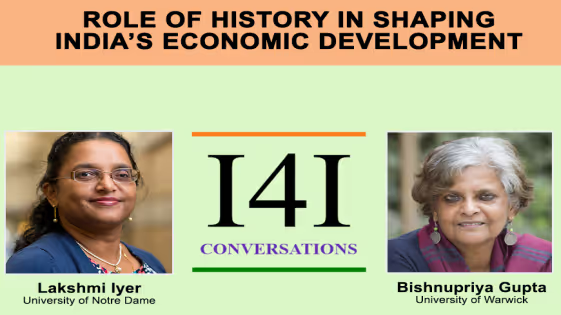
Role of history in shaping India’s economic development
As India is now completing 75 years of Independence, two big questions loom over the conversation around India’s economic development: How successful was the Indian economy before and during colonial rule, as compared to the postcolonial period? What is the role of history – historical events, actors, and institutions – in shaping India’s development trajectory? This is the focus of the sixth edition of I4I Conversations, with Bishnupriya Gupta and Lakshmi Iyer. Gupta and Iyer deliberate on how applying a historical lens may change our conclusions about India’s progress –particularlyhow demand-side estimates of GDP (gross domestic product) per capita date the beginning of India’s economic decline to a century before British colonial rule. Gupta also discusses the misperception that Indian industrialisation was stifled during colonial rule, how we should evaluate 20th century economic progress in light of the historical evidence, and the long-run effects of historical land-tenure .....