
.svg)
.svg)
%201.svg)
%201.svg)
.svg)

.svg)
.svg)
Aakash Dev

Aakash Dev is an Associate Fellow in the Center on Gender and the Macroeconomy (CGM) at the National Council of Applied Economic Research (NCAER). He holds a Ph.D. in Economics from the Shiv Nadar Institution of Eminence. His doctoral research is in the area of labour macroeconomics, particularly the computation of job search models. He did his Master’s in Economics from the Delhi School of Economics and Bachelor’s in Economics (Hons.) from University of Delhi.
He has research, teaching, and consulting experience in various capacities with organizations such as Shiv Nadar Institution of Eminence; National Centre for Financial Education; Amity University; and PricewaterhouseCoopers Private Limited.
.svg)

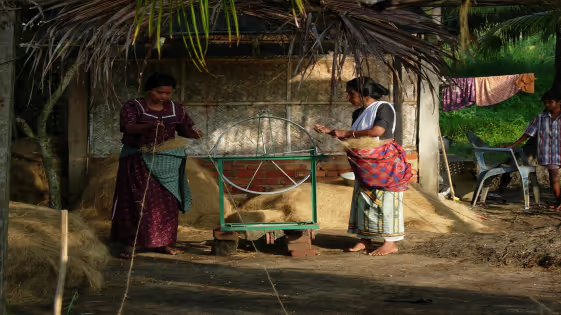
महिलाओं के कार्यबल की क्षमता को बढ़ाना
शैक्षिक उपलब्धि और स्वास्थ्य परिणामों में उल्लेखनीय प्रगति के बावजूद, महिलाओं की आर्थिक भागीदारी को बढाने में भारत पीछे है, जिसके चलते तेज़ और समावेशी आर्थिक विकास का लक्ष्य बाधित हो रहा है। इस लेख में दर्शाया गया है कि अंशकालिक रोज़गार को औपचारिक बनाने तथा पुरुषों और महिलाओं के बीच अवैतनिक देखभाल कार्य को पुनर्वितरित करने से श्रम-बल में महिलाओं की भागीदारी छह प्रतिशत अंकों से बढ़कर, 37% से 43% हो सकती है।


Unlocking women’s workforce potential
Despite significant progress in educational attainment and health outcomes, India lags in enabling women’s economic participation, which, in turn, impedes the goal of fast and inclusive economic growth. This article shows that formalising part-time employment and redistributing unpaid care work between men and women could raise female labour force participation by six percentage points, from 37% to 43%. This is the first post of a five-part series to mark International Women’s Day 2025.
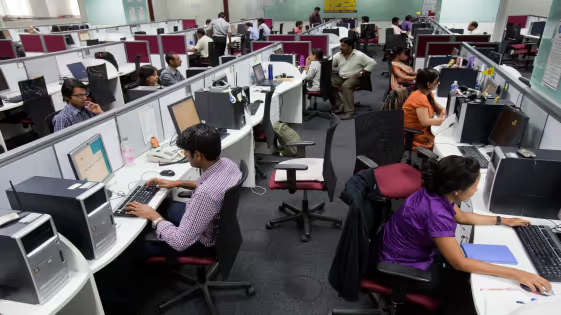
प्रौद्योगिकी में प्रगति तथा रोज़गार में बदलाव : भारत में हालिया रुझान
भारतीय अर्थव्यवस्था में तेज़ी से हो रही प्रौद्योगिकी प्रगति का क्या असर रोज़गार पर हो रहा है? इस सवाल का पता लगाने के लिए, कथूरिया और देव ने इस लेख में ‘उपभोक्ता पिरामिड पारिवारिक सर्वेक्षण’ के डेटा का विश्लेषण किया है। उन्होंने विशेष रूप से कोविड-19 के बाद के दौर में विभिन्न क्षेत्रों में कम कुशल श्रमिकों की हिस्सेदारी में लगातार गिरावट और रोज़गार की संभावनाओं में कमी को रेखांकित किया है। वे इन श्रमिकों, ख़ासकर महिलाओं को प्रशिक्षित करने पर बल देते हैं ताकि वे उच्च-कौशल, उच्च-भुगतान वाली नौकरियों तक पहुँच सकें।
Technological advancement and employment changes: Recent trends in India
What is the impact of rapid technological advancements on employment in the Indian economy? In this post, Kathuria and Dev analyse ‘Consumer Pyramids Household Survey’ data to explore this question. They note a consistent decline in the share of low-skilled workers across sectors, along with reduced employment prospects, particularly in the post-Covid-19 era. They advocate for training these workers – especially women – so that they can transition into higher-skill, higher-paying jobs.