
.svg)
.svg)
%201.svg)
%201.svg)
.svg)

.svg)
.svg)
Abhijeet Singh

Abhijeet is a applied microeconomist at the Stockholm School of Economics. Prior to this he was a Research Officer at Young Lives and a doctoral student in Economics at the University of Oxford. His current research focuses on issues of education, health and inequalities in childhood. Abhijeet has a B.A. (Hons) in Economics from the University of Delhi and an M.Sc. in Economics for Development from the University of Oxford. Before joining the D.Phil. programme at Oxford, Abhijeet worked as an Economist in South Sudan's statistical agency from October 2008 to September 2010 through the ODI Fellowship Scheme. https://sites.google.com/site/abhijeetsingh1/
.svg)

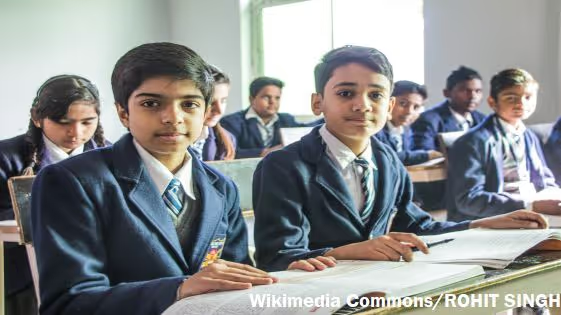
उच्च स्कोरिंग लेकिन गरीब: उच्च शिक्षा में प्रतिभा का गलत आवंटन
जैसे-जैसे कॉलेज शिक्षा में श्रम बाजार के लाभों में बढ़ोतरी हुई है, अब पहले से कहीं अधिक युवको को किसी न किसी प्रकार की उच्च शिक्षा प्राप्त हो रही है। फिर भी, गरीब सामाजिक आर्थिक स्थिति के बच्चों की कॉलेज में उपस्थिति कम रहती है। यह लेख उस असमानता की पड़ताल करता है। इस लेख में पाया गया है कि पारिवारिक पृष्ठभूमि कॉलेज में उपस्थिति के लिए अकादमिक तैयारी से अधिक महत्वपूर्ण है, क्योंकि अपनी कक्षा में शीर्ष स्थान पर रहने वाले गरीब छात्रों के कॉलेज में उपस्थित रहने की संभावना उतनी ही होती है जितनी उनकी कक्षा में सबसे नीचे स्थान पर रहने वाले अमीर छात्रों की होती है।


High scoring but poor: The misallocation of talent in higher education
As labour market returns to college education have increased, more young adults now receive some form of higher education than ever before. Yet, college attendance remains low for children from poor socioeconomic backgrounds. This article investigates that disparity. It finds that family background remains as, if not more, important than academic preparedness for college attendance–poor students at the top of their class are just as likely to attend college as rich students at the bottom of the class.

What can the private sector offer Indian education?
Do private schools in India really produce more learning, or do they deepen social and economic divides without adding much in terms of actual skills and education? Based on a review of the existing literature, this column sheds light on these questions, and discusses avenues for future research that may help understand how private players may be leveraged to address the learning crisis in the country.
Giving up too early on malnourished children? Catch-up growth and Midday Meals
It is widely believed that malnourishment in the first few years of childhood adversely affects cognition and adult economic outcomes. This column presents new research which shows that full recovery from early malnourishment is possible. Based on data from the state of Andhra Pradesh, it is found that the Midday Meals programme of the Government of India has been successful in compensating for early nutritional deprivation.

Improving School Governance at Scale: A Randomised Evaluation of the Madhya Pradesh School Quality Assessment Programme
Weak governance is a critical constraint in delivering quality education in developing countries. This project conducts a randomised evaluation of one of the most ambitious recent attempts by a develop