
.svg)
.svg)
%201.svg)
%201.svg)
.svg)

.svg)
.svg)
Abhijit Banerjee

Abhijit Vinayak Banerjee is the Ford Foundation International Professor of Economics at the Massachusetts Institute of Technology. In 2003 he co-founded the Abdul Latif Jameel Poverty Action Lab (J-PAL) with Esther Duflo and Sendhil Mullainathan, and he remains one of the Lab’s Directors. Banerjee is a past president of the Bureau for Research and Economic Analysis of Development, a Research Associate of the NBER, a CEPR research fellow, International Research Fellow of the Kiel Institute, and a fellow of the American Academy of Arts and Sciences and the Econometric Society. He has been a Guggenheim Fellow, an Alfred P. Sloan Fellow, and a winner of the Infosys Prize.
Banerjee is the author of a large number of articles and four books, including Poor Economics, which won the Goldman Sachs Business Book of the Year, and Good Economics for Hard Times, both co-authored with Esther Duflo. He is the editor of three more books and has directed two documentary films. Banerjee has served on the U.N. Secretary-General’s High-Level Panel of Eminent Persons on the Post-2015 Development Agenda. He is a co-recipient of the 2019 Sveriges Riksbank Prize in Economic Sciences in Memory of Alfred Nobel for his ground-breaking work in development economics research.
.svg)


The economic and political consequences of India's demonetisation
The ruling party at the centre won the Uttar Pradesh state election despite its demonetisation policy having some negative economic impacts on the Indian economy. By combining primary data from surveys of wholesale and retail traders, with secondary data on wholesale markets, this column seeks to analyse why this was so.


On India's latest GDP numbers
India’s latest GDP data shows that the economy grew at 7% in the previous quarter, despite demonetisation. In this article, Abhijit Banerjee discusses why the new numbers are likely to be an overestimation.
The new plan body must have a certain oomph
PM Modi has announced that his government plans to scrap the six-decade old Planning Commission and replace it with a more contemporary think tank. In this article, Abhijit Banerjee outlines the various functions that the Planning Commission has served over the years, and presents his view on the type of alternative that may be able to fit the role.
Promoting excellence in higher education in India
Over the years, the entire system of higher education in India has relentlessly bled talent. In this article, Abhijit Banerjee, Professor of Economics at MIT, discusses why this is so, and what can be done.

Power to the people: The impact of political report cards in India
How do Indian voters react to information on the qualifications and performance of politicians?

Intimidation, imitation, economics: Why youth are taking to terror
Men between the ages of 18 and 35 become terrorists, and it is the same demographic that supplies drug dealers, violent criminals, and foot soldiers of political parties. Abhijit Banerjee, Professor of Economics at MIT, contends that the pattern may be explained by factors such as the power of conformity, intimidation by the local big guy, finding the possibility of violence exciting, and frustration with economic prospects.
Breaking the silence on growing intolerance
Recent violent incidents in the country indicate a growing intolerance towards those whom we disagree with, as well as an unwillingness of politicians to defend the rights of people to speak and live as they wish. In this article, Abhijit Banerjee, Professor of Economics at MIT, contends that this is not just a Hindu problem or that of religion. There is a need for the political culture to imbibe our long intellectual tradition of liberal thought.
The need for police reform
The police in India are still mainly governed by the Police Act of 1861. In this article, Abhijit Banerjee, Professor of Economics at MIT, emphasises the need for police reform in order to check misuse of power by the State.
What's the plan for MNREGA?
The new government’s plans to scale back MNREGA have elicited a mixed response. In this article, Abhijit Banerjee contends that both supporters and critics, and indeed the entire nation, deserve to be told why this is the one programme of the previous government that has been singled out for the axe, if for no other reason than to inform our views about the design of future programmes.
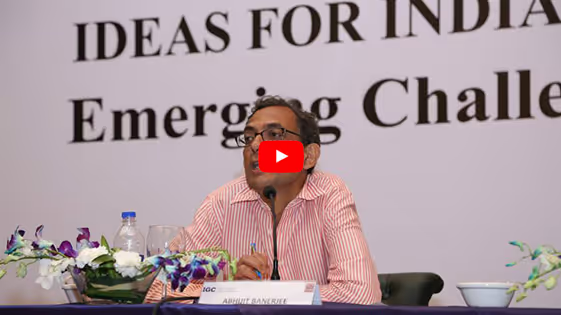
Emerging challenges: Economic and social
To mark the second anniversary of I4I in July 2014, we invited two eminent scholars – Abhijit Banerjee (MIT) and Mukul Kesavan (Jamia Milia) to discuss the emerging economic and social challenges in India, post the recent Parliamentary election. The discussion was moderated by Ashok Kotwal (Editor-in-Chief, Ideas for India). Take a look at a ‘highlights’ video of the discussion here!

Universal basic income: The best way to welfare
Abhijit Banerjee, Professor of Economics at MIT, suggests replacing welfare schemes of the government by a single universal basic income, which entitles every adult resident to a minimum weekly income as long as they verify their identity every week.

Right to Food: Let's get it right
The proposed inter-state resource allocation in the upcoming National Food Security Bill is anti-poor. It will result in unequal treatment of equally poor individuals across rich and poor states. This column explains why, and poses some questions for the way forward.

The Chit fund crisis: Should not put all financial intermediaries in the same bracket
The government has announced a bailout package for the participants of unregulated saving schemes that have been put at risk by the current Chit fund crisis in West Bengal. In this article, Banerjee and Ghatak caution against putting deposit-takers and micro-lenders in the same bracket while considering stricter financial regulation to prevent recurrence of such events.
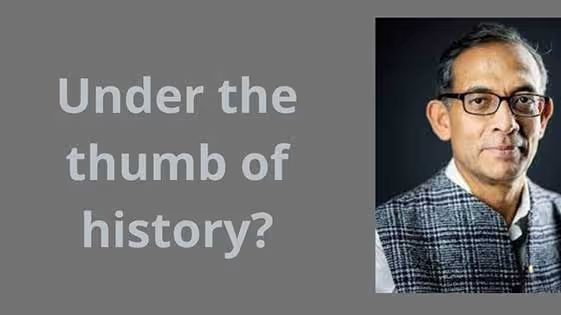
Under the thumb of history?
In June 2021, Nobel Laureate Abhijit Banerjee (Ford Foundation International Professor of Economics, MIT) delivered the inaugural Shaibal Gupta Memorial Lecture organised by Asian Development Research Institute, broadly discussing the role of history in development economics. An important body of recent work emphasises the idea of the ‘long arm of history’, that is, history cannot be escaped totally and has durable effects. For example, countries that were British colonies several years ago, continue to have British-style legal systems. However, Prof. Banerjee contends that there is no logical reason why persistence has to mean determinism – it could just be that things are slow to change due to inertia or coordination failures. Persistence does not necessarily guarantee that there will be no change; just that change takes place in unexpected ways, for instance, long-term consequences on a country’s economy on account of sudden death of the leader. At some level, one can never answer