
.svg)
.svg)
%201.svg)
%201.svg)
.svg)

.svg)
.svg)
Achyuta Adhvaryu

Achyuta Adhvaryu is Professor of Economics, UC San Diego School of Global Policy and Strategy and Director, UC San Diego 21st Century India Center. Prior to this he was Assistant Professor of Business Economics and Public Policy at the University of Michigan. He pursues a research agenda at the intersection of business economics, development, and health. His current work has focused on understanding determinants of worker productivity and measuring the impacts of interventions that increase productivity while improving key aspects of worker welfare. His work is funded by grants from the National Institutes of Health, the International Growth Centre, the Centre for Economic Policy Research, and the UK Government’s Department For International Development. In addition to this work, he also studies business models for healthcare delivery in very low-income contexts.
.svg)


कोविड-19 और मानसिक स्वास्थ्य: "इन्फोडेमिक" से लड़ाई, एक समय में एक फोन कॉल
भारत में कोविड-19 के बारे में जानकारी संप्रेषित करने की नीतियों में मुख्य रूप से टेक्स्ट संदेश और फोन कॉल की शुरुआत में रिकॉर्ड किए गए वॉयस मैसेज शामिल हैं। कर्नाटक में गारमेंट श्रमिकों के किये गए एक दूरस्थ सर्वेक्षण के आधार पर यह लेख दर्शाता है कि महामारी से संबंधित जानकारी देने के लिए फोन कॉल का उपयोग टेक्स्ट संदेश और वॉयस रिकॉर्डिंग के जरिये ज्ञान प्रदान करने जितना ही प्रभावी है- और साथ ही यह मानसिक स्वास्थ्य पर सकारात्मक प्रभाव भी डालता है।


Covid-19 and mental health: Fighting the “infodemic”, one phone call at a time
COVID-19 information communication strategies globally have been dominated by SMS and voice recording based campaigns. The most pervasive Indian government campaign was a pre-recorded message that played before phone calls. We conducted a randomised controlled trial in 2020 using phone surveys and found in-person phone calls are at least as effective as text messages and voice recordings at providing knowledge, in addition to having a positive impact on mental health. We find a reduction in anxiety and depression from in-person phone calls along with a small increase in knowledge levels, when compared with the aforementioned modes. We think this could have implications for large scale information delivery campaigns. Meta description: Strategies to communicate information regarding Covid-19 in India have predominantly included text messages and recorded voice messages at the start of phone calls. Based on a remote survey of garment workers in Karnataka, this article shows that using pho
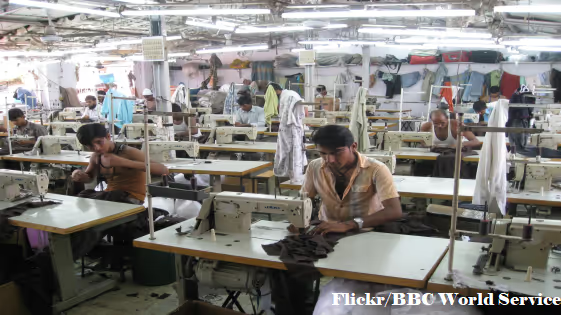
भारत के विनिर्माण क्षेत्र के श्रमिकों में निवेश और उत्पादकता
पहली मई को दुनिया भर में श्रम दिवस मनाया जाता है और आधुनिक विश्व की अर्थ व्यवस्था और प्रगति में श्रम, श्रम बाज़ार व श्रमिकों की महत्वपूर्ण भूमिका है। इसी सन्दर्भ में आज के इस लेख में, अध्वर्यु एवं अन्य भारत में घटती विनिर्माण उत्पादकता तथा राज्यों और उद्योगों में व्याप्त भिन्नता से सम्बंधित कुछ तथ्यों का संकलन प्रस्तुत करते हैं। वे श्रमिक उत्पादकता बढ़ाने की क्षमता वाले चार प्रमुख क्षेत्रों- सॉफ्ट स्किल्स, आवाज़ यानी उनका मत, भौतिक वातावरण और प्रबन्धकीय गुणवत्ता में निवेश के बारे में मौजूदा साहित्य की जाँच करते हैं, जिसमें भारतीय और वैश्विक दोनों सन्दर्भों में किए गए अध्ययनों पर प्रकाश डाला गया है। वे सम्भावित कारणों के साथ यह निष्कर्ष निकालते हैं कि क्यों कम्पनियाँ श्रमिकों में पर्याप्त निवेश नहीं कर रही हैं।

How worker investments can fuel productivity in India’s manufacturing sector
In the second article in the Ideas@IPF2023 series, Adhvaryu et al. synthesise some facts on India’s declining manufacturing productivity and variations across states and industries. They examine existing literature on investments in four key areas with the potential to increase worker productivity – soft skills, voice, physical environment, and managerial quality – highlighting studies conducted in both the Indian and global context. They conclude with possible reasons why firms may not be adequately investing in workers.
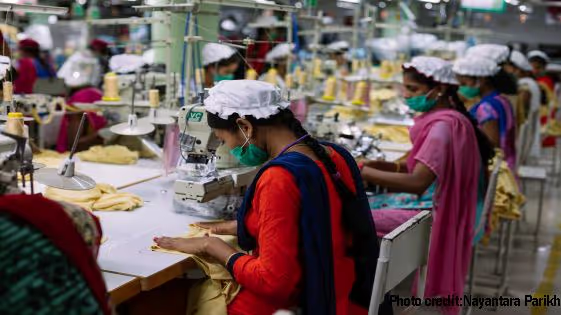
श्रम-प्रधान उद्योगों में श्रमिकों की अनुपस्थिति का सामना करना
श्रम-प्रधान उद्योगों में श्रमिकों की अनुपस्थिति फर्मों की उत्पादकता में हानि का कारण बनती है, जिसके चलते श्रमिकों के लिए उत्पादकता-आधारित प्रोत्साहन की संभावना कम होती है। कर्नाटक में किये गए एक अध्ययन के आधार पर, यह लेख इस बात की जाँच करता है कि अपनी लाइनों पर श्रमिकों की विशेष रूप से कम उपस्थिति का सामना करते समय फैक्ट्री लाइन-मैनेजर किस प्रकार से आपस में श्रमिकों का अदल-बदल करते हैं, और यह लेख लाइनों में अपने श्रमिकों की तैनाती में सुधार करने पर फर्मों को मिलने वाले वित्तीय लाभों का अनुमान भी लगाता है।
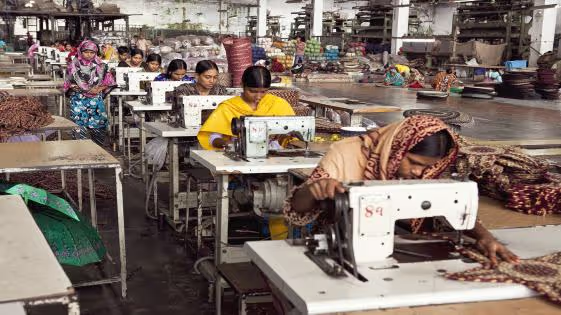
Dealing with worker absenteeism in labour-intensive industries
Worker absenteeism in labour-intensive industries causes productivity losses for firms, and reduced potential for productivity-based incentives for workers. Based on a study in Karnataka, this article investigates how factory line-managers trade workers amongst themselves when facing particularly low attendance on their lines, and estimates the financial gains that firms can make when they improve the distribution of workers across lines.

Expectations, wage hikes, and worker voice
Understanding how exit decisions of workers are affected by their ability to voice their concerns, is a central question in labour economics. Based on an experiment in 12 garment factories in Karnataka around the time of a wage hike, this article shows that providing workers a channel to express grievances – through an anonymous employee satisfaction survey – reduces quit rates, especially for those most disappointed with the wage hike.
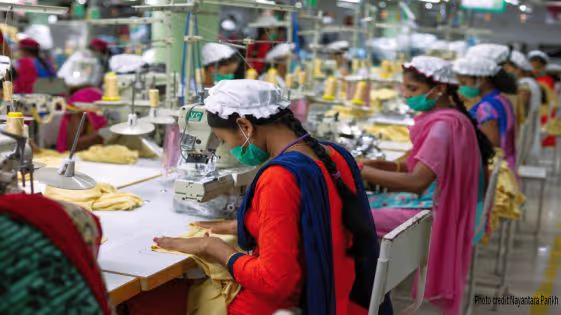
No line left behind: How firms match workers and managers
Various studies consistently affirm the importance of strong worker-manager dynamics in driving productivity. Based on analysis of worker-level productivity data, information on orders, and interviews with managers of a large garment manufacturing firm in India, this article suggests that when it comes to labour-allocation decisions, productivity sometimes takes a back seat to managing complex relationships with buyers, who can take their business to the factory down the road.

Managerial quality and productivity dynamics
It is well known that managerial quality impacts firm productivity and growth. Which managerial skills, traits, and practices contribute most to productivity? Are all such traits easily observable? Are such traits appropriately rewarded in pay? Based on two years of daily, line-level production data from a large Indian garment firm and rich survey data on line managers, this article seeks to address these questions.
Role of private sector in the holistic skilling of India’s workforce
Low skill levels of workers are a key reason for low labour productivity in developing countries. In this article, Adhvaryu et al. discuss research that centres around two important questions in this context: who should conduct and pay for skilling, and what kind of skills does the workforce need?
The hidden productivity benefits of energy-saving technology: Evidence from LEDs in Indian factories
Energy-efficient technologies are an increasingly relevant policy priority, given growing consensus on the need to tackle climate change. This column examines the productivity benefits of adopting one such technology – LED lighting – for manufacturing firms in India. It finds that improved productivity resulting from LED lighting’s lower heat emissions makes adopting such technology far less costly than previous anticipated, particularly for labour-intensive firms in hot climates.
The Impact of Climate and Pollution on Worker Productivity: Evidence from a Garment Factory in India
This project aims to answer the following research questions: i) What is the impact of air pollution on worker productivity and other labour outcomes (attendance, tardiness, and attrition)? ii) What is the impact of climate conditions (temperature and humidity) on worker productivity and other labour outcomes?