
.svg)
.svg)
%201.svg)
%201.svg)
.svg)

.svg)
.svg)
Adam Auerbach

Adam Auerbach is an assistant professor in the School of International Service, American University. His first book project examines informal community governance and development in India’s urban slums. The project draws on twenty months of ethnographic fieldwork, archival and survey research conducted in Jaipur and Bhopal. His research has been supported by the American Institute of Indian Studies, the Social Science Research Council, Fulbright-Hays, and the National Science Foundation. He received the 2013 Best Fieldwork Award from the Comparative Democratization Section of APSA (American Political Science Association), the 2014 Best Dissertation Award from the Urban Politics Section of APSA, and the 2015 Gabriel A. Almond Award for best dissertation in comparative politics. His work appears or is forthcoming in Contemporary South Asia, World Development, and World Politics.
.svg)

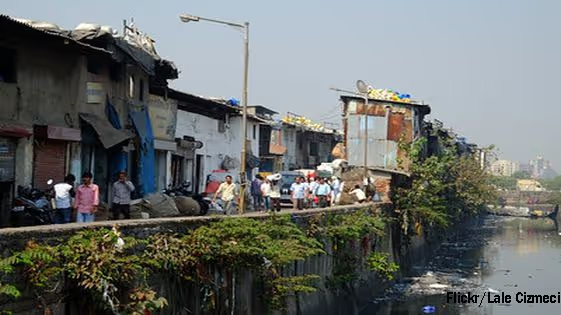
Citizen-State relations: Countryside and city
To what extent do citizens expect officials to respond to local problems, and how do they make demands on the State to advance their well-being? Based on surveys in Madhya Pradesh and Rajasthan, this article finds that urban slum residents are less likely to believe that they will get a direct response from an official, and more likely to report the presence of ‘political brokers’ – as compared to similarly poor rural residents.



India's slum leaders - II
The second part of the two-part column on slum leaders discusses who these leaders are - their age, professions, and relationships with political parties - and how they build support within their communities.
India's slum leaders - I
India’s demographic shift to cities has been accompanied by a number of pressing governance and developmental challenges, among the most serious of which is the rampant spread of slum settlements. Within these poor urban neighbourhoods, certain residents rise to prominent positions of local authority. Based on resident and leader surveys conducted during 2015-2016 in Jaipur and Bhopal, this two-part column provides insights on these informal slum leaders.