
.svg)
.svg)
%201.svg)
%201.svg)
.svg)

.svg)
.svg)
Advaita Rajendra

Advaita Rajendra is a Ph.D. student at the Indian Institute of Management, Ahmedabad in the Public Systems Group. Her doctoral research focuses on the governance of waste and waste work in India. Her earlier work includes the understanding of gender, caste and how they manifest in skewed sex ratios and in the reproduction of social hierarchies in government run residential schools. Her research interests lie in policy issues at the intersection of labour, social hierarchies, and the environment.
.svg)

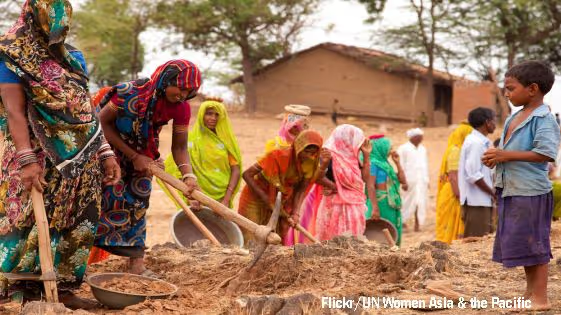
कोविड-19: बिहार की सरकारी योजनाएँ कमजोर आबादी की सहायता कितने अच्छे से कर रहीं हैं?
कोविड-19 महामारी और उससे जुड़े लॉकडाउन का तत्काल प्रतिकूल प्रभाव ऐसे प्रवासी श्रमिकों और उनके परिवारों पर काफी अधिक देखा गया जिनकी अपने मूल गांवों में सरकारी योजनाओं तक पहुंचने की क्षमता अनिश्चित थी। जून-जुलाई 2020 में बिहार के ग्रामीण क्षेत्रों में किये गए एक सर्वेक्षण से प्राप्त आंकड़ों का विश्लेषण करते हुए सरीन एवं अन्य यह पाते हैं कि प्रवासियों के परिवारों को भोजन में कटौती करने और मानसिक स्वास्थ्य के मुद्दों से पीड़ित होने की संभावना अधिक थी, भले ही उन्होंने गैर-प्रवासी परिवारों की तुलना में अधिक आय होने की जानकारी दी हो।


Covid-19: How well are government schemes supporting Bihar’s vulnerable populations?
The immediate adverse impact of the Covid-19 pandemic and associated lockdown was visibly greater for migrant workers and their households, whose ability to access government schemes in their villages of origin was uncertain. Analysing data from a survey in rural Bihar in June-July 2020, Sarin et al. find that household with migrants were more likely to cut down on food and suffer from mental health issues – even as they reported higher incomes than non-migrant households.