
.svg)
.svg)
%201.svg)
%201.svg)
.svg)

.svg)
.svg)
Akshaya Jha

Akshaya Jha is Assistant Professor of Economics and Public Policy, Carnegie Mellon University, Heinz College of Information Systems and Public Policy. His research interests lie at the intersection of energy and environmental economics and industrial organisation. His research uses a combination of economic modelling and causal inference techniques to quantify the economic and environmental costs and benefits of a wide range of policies affecting the electricity and coal sectors. In recent work, he has examined the introduction of financial trading to California’s wholesale electricity market, the phase-out of nuclear power in Germany, the dramatic growth of rooftop solar capacity in Western Australia, and the determinants of electricity blackouts in India.
He received a Bachelors in Economics and Statistics from Carnegie Mellon University, and a Ph.D. in Economics from Stanford University.
.svg)

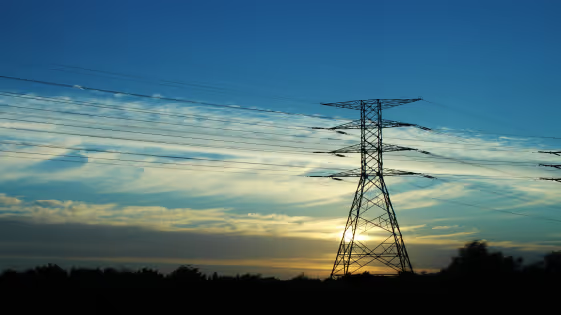
बिजली की कटौती को कम करने हेतु बिजली संयंत्रों की प्रोत्साहन राशि निश्चित करना
भारत में अपेक्षाकृत उच्च गुणवत्ता वाले बुनियादी ढांचे और बिजली संयंत्रों की पर्याप्त आपूर्ति के बावजूद, उपभोक्ताओं को लगातार बिजली की कटौती का सामना करना पड़ता है। यह लेख भारत में ब्लैकआउट के सन्दर्भ में एक नए स्पष्टीकरण को सामने लाता है: जब बिजली की खरीद लागत बढ़ जाती है, तो उपयोगिताएं बिजली संयंत्रों से कम बिजली खरीदना पसंद करती हैं, जिससे अंतिम उपयोगकर्ताओं तक पहुंचने वाली बिजली की मात्रा सीमित हो जाती है। थोक मूल्य लागत में कमी लाने वाले ‘थोक आपूर्ति सुधार’ ब्लैकआउट को प्रभावी तरीके से कम करने में सहायक हो सकते हैं।


Fixing incentives for power plants to reduce outages
Consumers in India face frequent power outages despite relatively high-quality infrastructure and ample supply of power plants. This article identifies a novel explanation for India’s blackouts: when the cost of purchasing electricity rises, utilities choose to buy less from power plants, thereby restricting the amount of power that reaches end-users. Reforms in wholesale supply that lower wholesale prices may help reduce blackouts in a cost-effective manner.