
.svg)
.svg)
%201.svg)
%201.svg)
.svg)

.svg)
.svg)
Alp Sungu

Alp Sungu is an Assistant Professor of Operations, Information, and Decisions at Wharton School, University of Pennsylvania. He holds a Ph.D. in Management Science and Operations from London Business School.
His research uses field experiments and data-driven analytics methods to propose new ways of addressing policy questions in underserved societies. He is interested in studying and advancing technology-enabled interventions to alleviate global poverty.
.svg)

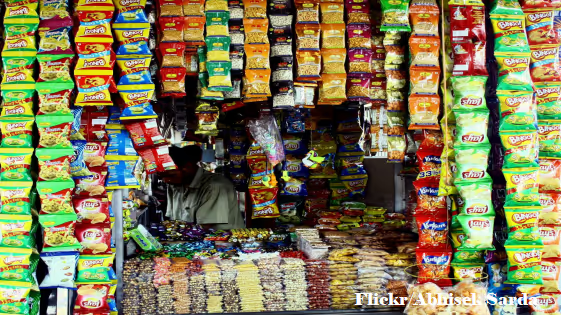
निम्न आय वाले व्यक्तियों को अनाज सब्सिडी और उनके द्वारा ‘जंक फूड’ की खरीद
सरकारें कम आय वाले समुदायों में कुपोषण को दूर करने के लिए महंगे खाद्य सब्सिडी कार्यक्रमों पर निर्भर हैं, हालाँकि उनका प्रभाव स्पष्ट नहीं है क्योंकि खाद्य खरीद निर्णयों के सम्बन्ध में केवल स्व-रिपोर्ट किए गए डेटा ही उपलब्ध हैं। इस लेख में, ‘पॉइंट-ऑफ़-सेल’ स्कैनर से उपलब्ध डेटा का उपयोग करके मुम्बई में किए गए एक प्रयोग के आधार पर पाया गया है कि कम आय वाले व्यक्ति, विशेष रूप से वे लोग जिनके परिवारों में बच्चे हैं, जिन्हें गेहूँ और चावल की सब्सिडी मिलती है, उन्होंने ‘जंक फूड’ यानी बाहर के कम पोषक आहार पर कम खर्च किया तथा घर में खाना पकाने में अनाज के पूरक मसालों और अन्य खाद्य पदार्थों पर अधिक खर्च किया।


Grain subsidies and junk food purchases among low-income individuals
While governments rely on expensive food subsidy programmes to address malnutrition among low-income communities, their impact is unclear as only self-reported data on food purchase decisions are available. Based on an experiment in Mumbai using data from point-of-sale scanners, this article finds that low-income individuals – especially those living in households with children – who received a wheat and rice subsidy spent less on junk food and more on spices and accompaniments that complement grains in home cooking.