
.svg)
.svg)
%201.svg)
%201.svg)
.svg)

.svg)
.svg)
Aman Srivastava

Aman Srivastava is a Fellow with the Initiative on Climate, Energy, and the Environment at the Centre for Policy Research. Aman’s research interests are in the areas of climate and energy policy, specifically the interlinkages between emissions and development pathways, socioeconomic impacts of climate actions, climate finance, and energy consumption behaviours. He is also serving as visiting faculty at the School of Public Policy, Indian Institute of Technology, Delhi.
Aman has previously spent over six years at the World Resources Institute, as a Research Associate (Climate Finance) and subsequently Lead Economist (Climate). He served as a chapter author for the UNFCCC Standing Committee on Finance’s 2016 Biennial Assessment and Overview of Climate Finance Flows report. He has also worked with Indicus Analytics and Kotak Mahindra Bank, and served as a consultant to Vivid Economics, the World Trade Organization, and Ergo.
Aman holds a PhD in energy and behavioural economics from the University of Antwerp, an MSc in finance and development from the University of London, an MBA in finance from the Indian Institute of Management, Lucknow, and a BA (Honours) in economics from the University of Delhi.
.svg)

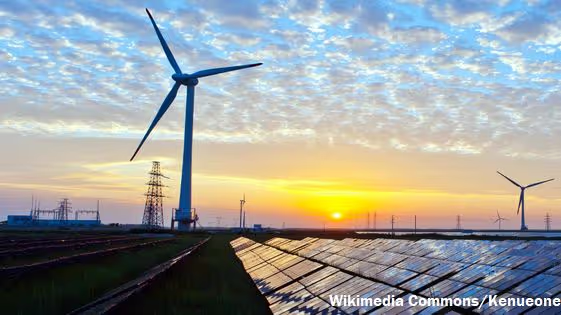
Keeping development at the forefront of India’s long-term climate strategy
India’s Long Term Low Emissions Development Strategy (LT-LEDS) sets out multiple low-carbon transitions, highlighting that climate action will be intimately tied to developmental processes. In this article, Chandra et al. identify some of the challenges and opportunities embedded within these transitions, and reflect on how these will impact developmental priorities such as employment and energy security. To operationalise the LT-LEDS effectively, they argue that India will benefit from planning now to minimise the trade-offs between low-carbon futures and development.


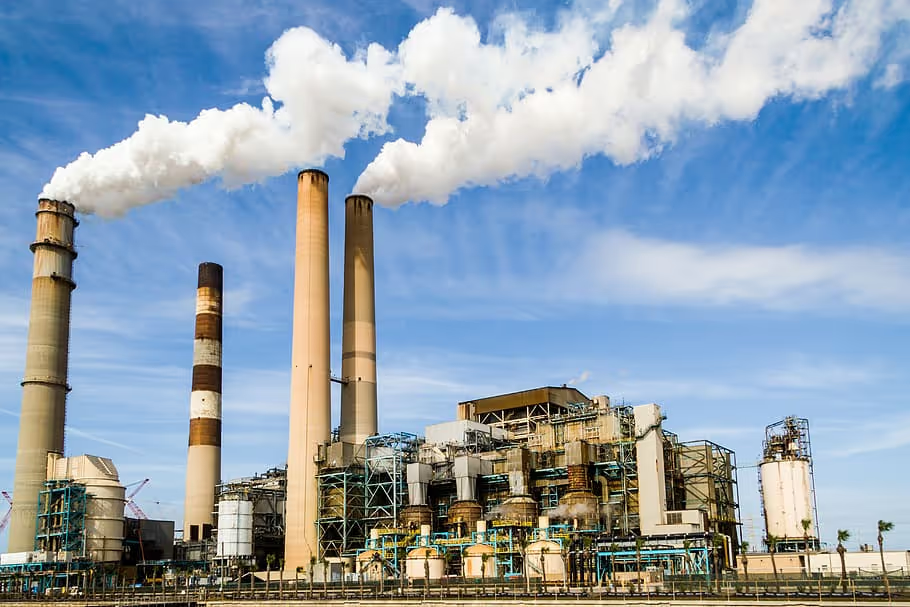
Trade-offs in carbon trading: Can a carbon market yield benefits for India?
The creation of a national carbon market in India, depending on its institutional setup, policy integration, and design could offer a mechanism for reducing emissions, or it could result in serious economic costs. Srivastava and Swain put forth seven key considerations for its design – including India's growth objectives, trade balance, fiscal revenues, and the effect on its MSMEs. To ensure its success, they highlight the need to integrate it with a comprehensive policy package to quell broader political economy challenges.
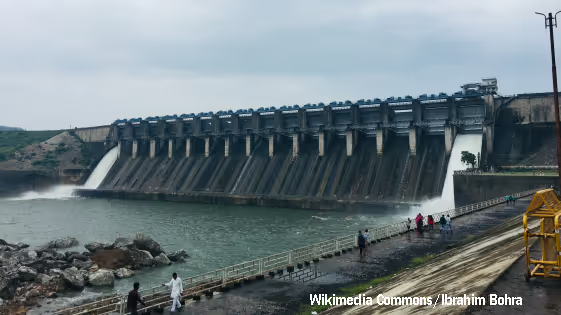
Pledges, plans, and actions: An analysis of India’s Panchamrit pledges
In anticipation of India updating its Nationally Determined Contributions (NDCs), Aman Srivastava and Ashwini Swain evaluate the climate pledges made by Prime Minister Modi at COP26. In the context of historical trends and growth and development objectives, they discuss the feasibility and implications of reducing India’s emissions intensity and increasing the share of renewables in its energy mix. They use this analysis to suggest potential ways forward towards ensuring greater clarity and cohesion among these pledges.