
.svg)
.svg)
%201.svg)
%201.svg)
.svg)

.svg)
.svg)
Amartya Lahiri

Amartya Lahiri is the Director of CAFRAL (Centre for Advanced Financial Research and Learning) in Mumbai, India and Professor of Economics at the University of British Columbia (UBC). Prior to this, he has held appointments at the University of California at Los Angeles (UCLA) and the Federal Reserve Bank of New York. His primary areas of research are macroeconomics, international economics, and development economics. Lahiri has worked on inflation stabilisation programmes, exchange rate management, policy responses to balance of payments crises, financial crisis, economic growth theory, and cross-country differences in income and productivity levels.
.svg)


Transforming Indian agriculture: The role of credit policy
Despite various policy attempts at priority sector lending to poor farmers, very little progress has been made on the ground, suggesting problems in the design and implementation of these policies. In this article, Amartya Lahiri and Dilip Mookherjee and explore where the problem really lies and what can be done to address the issues.


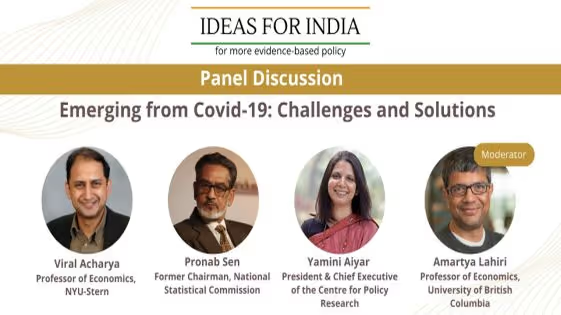
I4I@10 | Emerging from Covid-19: Challenges and solutions
As India emerges from the Covid-19 pandemic, economists will have to rethink how they understand the Indian economy in context of global volatilities. In this panel, moderated by Amartya Lahiri, Viral Acharya, Yamini Aiyar and Pronab Sen discuss both the macroeconomic implications of growth, infrastructure and public policy, and the microeconomic concerns of whether we are creating enough good jobs, ensuring welfare, and reducing income inequality.

India’s asset monetisation plan
In August 2021, Government of India announced an asset monetisation plan wherein existing public assets worth Rs. 6 trillion would be monetised by leasing them out to private operators for fixed terms, and the proceeds would be used for new infrastructure investment. In this post, Amartya Lahiri examines the revenue potential of this plan, and whether it is likely to enhance the efficiency of the economy.
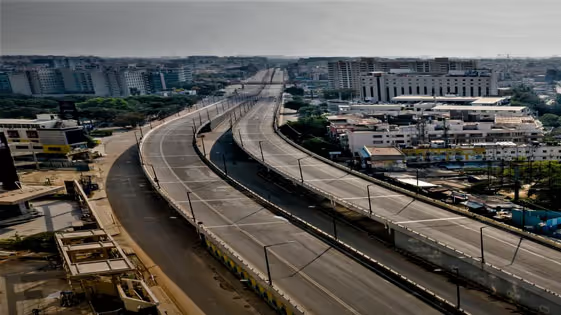
Covid-19: The infected economy
India, along with much of the world, is now in a lockdown. But the cost of locking down the country is particularly high for the urban poor in India. Besides, the reality of urban living reduces the efficacy of a lockdown in containing the spread of Covid-19. In this post, Amartya Lahiri explains why a bigger fiscal package is needed to approach the direct cost of the lockdown, and how it can be financed.
India's Monetary Policy Committee: Formation blues
The government and RBI are in the process of finalising the structure of India’s Monetary Policy Committee. In this article, Amartya Lahiri, Professor of Economics at the University of British Columbia, makes recommendations for the composition of the committee that would help preserve the independence of the RBI in monetary policy oversight and conduct in form and spirit.
Searching for the soul of monetary policy in India
What is the thinking behind the current policy of the Reserve Bank of India? This column argues that its rules for deciding on India’s interest rates are based on assumptions that hold in developed economies – but not necessarily in India. Indeed, in many cases this leads to precisely the wrong policy decisions.
Macroeconomic Takeoff and Distributional Churning in India
The past 25 years have witnessed a remarkable economic catch-up by the historically discriminated against scheduled castes and tribes (SC/STs) in India towards non-SC/ST levels in terms of their education attainment levels, their occupation choices as well as their wage and consumption levels.

Indian economy: High performer or Potemkin village?
The recent schizophrenic commentary on the health of the Indian economy raises questions on the true state: Is India doing really well or are we just seeing an impressive facade? In this post, Amartya Lahiri contends that the last four years blessed India with a wonderful external climate along with widespread domestic support for reforms to free up private enterprise. Having missed that opportunity we are reduced to parading ‘Potemkin villages’.
Bank and its critics
There has been a lot of commentary in recent weeks on the Reserve Bank of India, around its capital base, performance, and autonomy. In this post, Amartya Lahiri contends that RBI has a more coherent case on these issues than its critics. Central banks need to be adequately capitalised in order to perform their core functions, which include being the lender of last resort for the banking system.

The 'urban sprawl' and declining rural-urban inequality
India has experienced rapid urbanisation in the past three decades. Has urbanisation impacted the economic wellbeing of rural and urban workers? This column finds that the rural-urban wage gap has shrunk dramatically over this period. This is largely explained by the process of ‘urban sprawl’, which involves assimilation of rural areas into adjoining urban areas, and the resulting relative increase in urban labour supply.

The demonetisation boondoggle
In this article, Amartya Lahiri, Professor of Economics at the University of British Columbia, argues that all public policy must rely on a clear-headed cost-benefit analysis and the recent demonetisation move fails the test.

Banks, finance and the 2022 Economics Nobel Prize
This year the Nobel Prize in Economics was awarded to Ben Bernanke, Douglas Diamond and Philip Dybvig for their work on the role of banks in the economy, particularly during financial crises. In this piece, Amartya Lahiri summarises their seminal works – Diamond and Dybvig on the essence of traditional banks, and Bernanke on the financial crisis during the Great Depression – and describes their impact on the understanding of modern-day financial crises, and the Laureates’ contribution to the field of economics.