
.svg)
.svg)
%201.svg)
%201.svg)
.svg)

.svg)
.svg)
Ambrish Dongre

Ambrish Dongre is an Assistant Professor at Ravi J. Mathai Centre for Innovation in Education at Indian Institute of Management (IIM) Ahmedabad. His research interests include education and health. Prior to joining IIM-A, he was a fellow at Centre for Policy Research (CPR), New Delhi. He holds a Ph.D. in economics from the University of California, Santa Cruz (UCSC), and a Masters in economics from University of Mumbai.
.svg)


Understanding school choices under RTE’s 25% mandate
Section 12(1)(c) of the Right To Education Act mandates non-minority status private schools to reserve at least 25% seats for the disadvantaged and weaker sections of the society. This article analyses the impact of the mandate on changing school choices of relatively disadvantaged households based on a sample of over 1,600 households in urban Ahmedabad. It finds that the mandate expanded choice of schools for the participating eligible households.


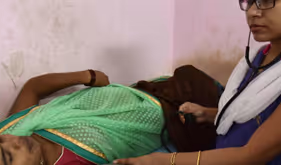
C-section deliveries and the role of the private health sector in India
India, like the rest of the world, is witnessing an upward trend in caesarean-section (C-section) deliveries – with the proportion of C-section deliveries rising even faster in private health facilities. Using data from the latest round of the National Family Health Survey, this article investigates the probability of C-section delivery in private facilities vis-à-vis those in the public sector.
Barriers in accessing applications under RTE quota in Gujarat
In the school year 2017-18, Gujarat shifted from a paper-based system at the district level to an online system at the state level, for applications under the Right to Education Act. In this note, researchers at IIM Ahmedabad demonstrate that unless the required technological infrastructure is adequately developed, a complete shift to digitisation adversely affects the most vulnerable populations.
Reservation under RTE: Status of implementation and way forward
Section 12(1)(c) of the Right to Education Act, 2009, mandates that non-minority private unaided schools should reserve at least 25% of seats in entry-level grades for children from economically weaker and disadvantaged backgrounds. This column analyses the current status of implementation of this provision, and suggests ways to overcome hindrances in effective implementation and make the education system more inclusive.
Education reform and frontline administrators: A case study from Bihar - II
The frontline administration in India is infamous for corruption and patronage, indifference towards citizens, low effort and high absenteeism. This column reports findings from a year-long qualitative study on frontline education administrators in Bihar. Part 1 captured perspectives of frontline administrators on their role in the education hierarchy and how organisational design and culture shapes everyday behaviour. This part offers insights into how the frontline responds to reform efforts, and how this impacts institutionalisation and scaling up of reforms.
Education reform and frontline administrators: A case study from Bihar - I
The frontline administration in India is infamous for corruption and patronage, indifference towards citizens, low effort and high absenteeism. This column reports findings from a year-long qualitative study on frontline education administrators in Bihar. It captures perspectives of frontline administrators on their role in the education hierarchy and how organisational design and culture shape everyday behaviour.
How much does India spend on elementary education?
There has been a significant policy focus on expanding elementary education in India in recent years. Yet, estimates of public and private expenditure on elementary education are not available. This column seeks to fill this gap by estimating annual public expenditure per student in government schools, and annual private expenditure per student for those enrolled in private schools, for 16 selected states in India.
Do private tuitions improve learning outcomes?
About a fourth of the students enrolled in elementary schools in rural India attend private tuitions. This column analyses the impact of private tuition on learning outcomes, and finds that it has a large, positive effect on math and language test scores. The impact is greater for those who are more disadvantaged in terms of learning levels, household’s socio-economic status, and education of parents.

Outlays to Outcomes: Understanding pathways to improving learning outcome
This project responds to a specific Government of Bihar request to assess the effectiveness of its "Mission Gunvatta" programme, which aimed at improving the learning outcomes of children attending elementary schools. This project tracks one component of the programme, an initiative to develop student progress cards, examining the quality of these progress cards and developing a set of recommendations on the kinds of incentive structures and monitoring tools that could be designed from the information generated by these report cards.