
.svg)
.svg)
%201.svg)
%201.svg)
.svg)

.svg)
.svg)
Amey Sapre

Amey Sapre works as an Associate Professor at the National Institute of Public Finance and Policy (NIPFP), New Delhi. He has worked as a teaching assistant in economics at Indian Institute of Management (IIM) Ahmedabad, IIM Indore, and as a UGC–SAP (University Grants Commission–Special Assistance Programme) Research Fellow for sponsored research programmes in the areas of development and agriculture in Madhya Pradesh. He studied at the Symbiosis International University, Pune and has a Ph.D. in economics from the Indian Institute of Technology (IIT) Kanpur. His research interests include measurement issues in National Accounts Statistics, GDP computation, public finance, macroeconomics, and agriculture.
.svg)


The challenge of identifying economic activities of firms
The reliability of India’s GDP estimates has been debated extensively. A key challenge in the construction of macro-aggregates lies in the proper identification of firms’ economic activities as firms can have multiple activities across industries. In this post, Radhika Pandey, Amey Sapre, and Pramod Sinha demonstrate the extent of the identification problem, which is a major challenge in the estimation of value addition in the manufacturing sector.


Communicating uncertainties in GDP data
In recent times there has been a lot of controversy around the accuracy and reliability of Indian GDP estimates. In this article, Amey Sapre and Rajeswari Sengupta contend that much of this confusion stems from the lack of publicly available information about the sources and margins of errors and data quality. Communicating the limitations of official data to the public in a credible and transparent manner may mitigate the extent of uncertainty around GDP estimates.
What does the new IIP series tell us about the state of manufacturing in India?
In May 2017, the Central Statistics Office released the new series of the Index of Industrial Production with 2011-12 as the base year, after a comprehensive revision of computation methods. The series almost entirely reverses the performance picture of Indian manufacturing, showing sharp upward revisions in the growth of activity. This column finds that the new index is likely to show inflated growth during times of falling inflation. Thus, deciphering the actual change in production continues to be difficult.
Studying revisions in Indian GDP data
The GDP numbers for a given year undergo a sequence of revisions based on data availability. The periodic revisions are meant to reveal the true picture of the economy, and affect macroeconomic forecasting and policymaking. Large, frequent, and uncertain data revisions can raise questions of data credibility and lead to imprecise inputs for policymaking. In this article, Sapre and Sengupta highlight several issues in the revisions in India's GDP series.
GDP conundrum: Some areas of concern around growth overestimation in Indian manufacturing
Based on the new GDP series, large upward revisions in manufacturing growth rates were made – from 1.1% to 6.2% in 2012-13, and from -0.7% to 5.29% in 2013 – 14 that were not reflective of the actual performance of the sector during the period. In this article, Amey Sapre, doctoral student in Economics at IIT Kanpur, analyses some of the methodological issues in measuring growth in the manufacturing sector.
Moving towards a principles-based drug retail policy in India?
The health ministry has proposed a new e-platform for tracking the country’s entire drug supply chain, including online sales. In this article, Smriti Sharma and Amey Sapre contend that the e-platform is a step in the right direction, but imposing the requirement of brick-and-mortar facilities on e-pharmacies is incorrect. Regulators should adopt an approach that promotes the principles of competition, innovation, and customer protection and responsibility in the drugs market.
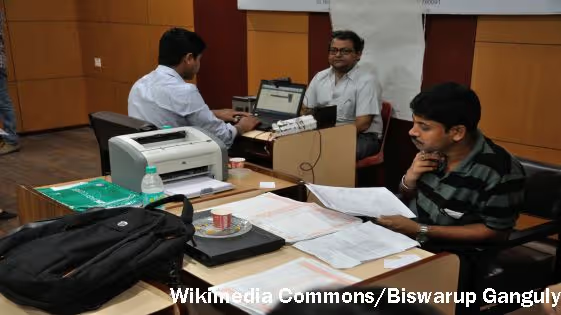
Potential to further strengthen the Census Act
In reference to the Census (Amendment) Rules introduced in March 2022, Garhwal and Sapre outline the scope to further strengthen the Census Act and its administration. With the introduction of self-enumeration and increased digitisation in data collection, authors make suggestions to address two issues – the delay in release of census tables and challenges that census operations may face with digital form filling.