
.svg)
.svg)
%201.svg)
%201.svg)
.svg)

.svg)
.svg)
Amit Basole

Amit Basole is Associate Professor of Economics at the School of Liberal Studies, Azim Premji University where he teaches development economics and political economy. He has previously taught at Bucknell University, Lewisburg, PA and University of Massachusetts, Boston, MA. His research has been published in various edited volumes and in journals such as Economic and Political Weekly, World Development, Development and Change, Rethinking Marxism, International Journal of Hindu Studies, and International Review of Applied Economics. Amit has recently edited a book called 'Lokavidya Perspectives: A Philosophy of Political Imagination for the Knowledge Age'. His writings and lectures are available at https://amitbasole.wordpress.com/
.svg)

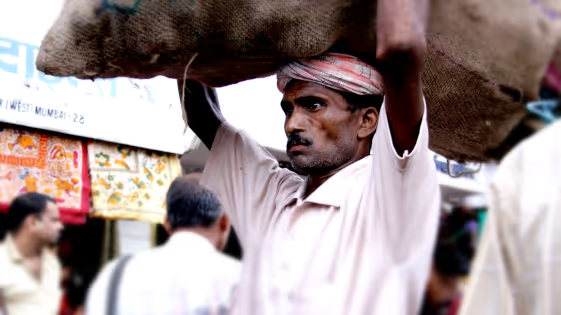
Estimating changes in India’s workforce during 2011-2018
Prior to the 2017-18 Periodic Labour Force Survey, there was paucity of official, labour-market data since the last nationally representative survey was from 2011, and other surveys in the intervening period indicated varying estimates. In this post, Basole and Nath identify the main factors driving these differences, and highlight the most salient feature of employment during 2011-2018 – massive withdrawal of women from subsidiary agricultural work.



What explains declining calorie consumption in India?
It is puzzling to note that while real household expenditures and incomes in rural India have been on the rise, average calorie intake has declined. Analysing data from the National Sample Survey, this column finds that this is an outcome of a food-budget squeeze; rapidly rising expenses on non-food essentials such as cooking fuel are absorbing all the increases in real total expenditures
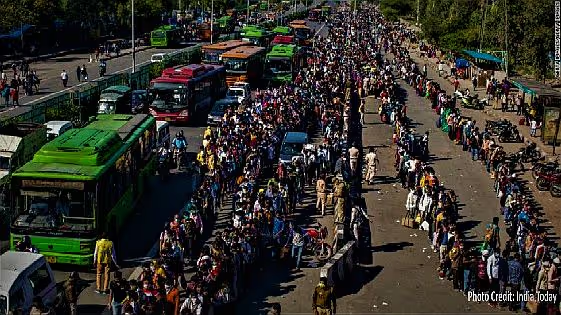
Pandemic as a lens: Identifying and addressing livelihood vulnerabilities
Based on the findings from a phone survey of around 5,000 Indian workers, the authors explore the impact of the Covid-19 economic lockdown on two forms of livelihood vulnerabilities: employment insecurity and food insecurity. They argue that the policy response needs to go beyond addressing the immediate consequences of this specific shock; this juncture posits the need for structural reforms that seek to address and fill these gaps concretely rather than suturing temporarily.