
.svg)
.svg)
%201.svg)
%201.svg)
.svg)

.svg)
.svg)
Amit Thorat

Amit Thorat is Assistant Professor of economics, at the Center for the Study of Regional Development at the Jawaharlal Nehru University (JNU), New Delhi. Prior to this he worked as an Associate Fellow at the National Council for Applied Economics Research (NCAER), New Delhi, where he was part of the India Human Development Survey (IHDS) team. He obtained his Ph.D. Degree in economics from the Centre for Economic Studies and Planning (CESP), JNU. His research has been on issues of income, educational and health inequalities in general and across social, ethnic, and religious groups in particular, in the context of India. At present, he is working on understanding people's beliefs around personal and social identity in India and its implications for social behaviour, individual distress, and economic outcomes. His earlier work includes examining gains for small and marginal farmers from high-value production as well as from farmer owned-cooperative farming.
.svg)


Using phone surveys to measure mental health
The public health and humanitarian crises caused by Covid-19 have led to greater recognition of the issue of poor mental health. Although mental health can affect work and quality of life much like physical health, it remains under-researched. In this article, Coffey et al. show that mobile phone surveys can be a valuable medium for incorporating mental health measurement into population-level health surveys.


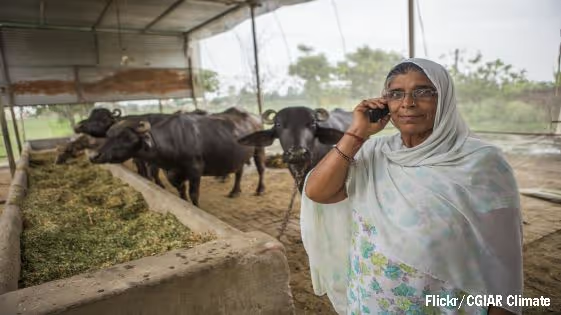
भारत में सामाजिक और आर्थिक अनुसंधान के लिए फोन सर्वेक्षण पद्धति
कोविड-19 के प्रसार को रोकने हेतु लगाई गई पाबंदियों और सामाजिक दूरी के दिशानिर्देशों के मद्देनजर फेस-टू-फेस सर्वेक्षणों के माध्यम से डेटा संग्रह करने में बड़ी बाधाओं का सामना करना पड़ा है। इस पोस्ट में कॉफ़ी एवं अन्य ने उनके द्वारा सामाजिक नज़रिया, भेदभाव, और सार्वजनिक राय पर वर्ष 2016 के बाद भारत के सात राज्यों एवं शहरों में किए गए मोबाइल फोन सर्वेक्षण करने के अपने अनुभव को साझा किया है।
Phone survey methodology for social and economic research in India
Data collection using face-to-face surveys has faced a roadblock in the wake of restricted mobility and social distancing guidelines to contain the spread of Covid-19. In this post, Coffey et al. describe their experience of conducting a mobile phone survey about social attitudes, discrimination, and public opinion, which has been carried out in seven states and cities in India since 2016.