
.svg)
.svg)
%201.svg)
%201.svg)
.svg)

.svg)
.svg)
Anant Sudarshan

Anant Sudarshan is a faculty member at the Department of Economics at the University of Warwick and a Senior Fellow at the Energy Policy Institute at the University of Chicago (EPIC). Before joining the University of Warwick, he was the South-Asia Director of the Energy Policy Institute at the University of Chicago (EPIC).
Prior to this he was a Giorgio Ruffolo Post-doctoral Fellow in the Sustainability Science Program at Harvard's Kennedy School of Government. He works at the intersection of energy policy, behavioral science, environmental economics, and engineering. He holds undergraduate and masters degrees in Mechanical Engineering from the Indian Institute of Technology (Delhi) and Stanford University respectively. He received his Ph.D. in Management Science and Engineering, focusing on energy economics, from Stanford University in March 2011. His doctoral research explored the determinants of residential energy consumption and the role California efficiency policies had in reducing energy intensity in the state. He has also carried out field trials to understand the effects of providing real time electricity consumption feedback to households. This work is part of a broader agenda aimed at understanding how different incentive structures - both financial and behavioral - can be used to change household energy behaviors. His present research includes an ambitious project to design and evaluate a pilot emissions trading program for Indian industry in partnership with India’s Ministry for Environment and Forests.
.svg)


Lighting Up Bihar: Electrification to Sustain Economic Growth
This project looks at incentivising consumers to pay for the electricity consumed by the area in Bihar. The intervention specifically links the duration of supply to the payment performance of a group against electricity supplied in the previous month. Through a randomised controlled experiment, the researchers measure that doing so improves payment behaviour and reduces the percentage of pilfered power consumption in Bihar. Also, an extension of this project was also undertaken which expands the study sample, at the request of the Bihar government, from a planned 4 districts to 8 districts (increasing the overall sample, while reducing the number of units sampled per district).


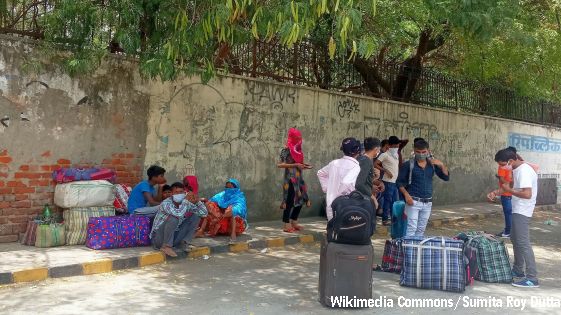
Examining Covid-19 travel restrictions in developing countries
At the outset of the Covid-19 pandemic, the developing world took many of the same policy steps as developed nations to contain the spread, including lockdowns. This article uses evidence from India to show that domestic travel bans may actually have increased Covid-19 cases in developing countries with large urban-rural migrant populations. While travel bans are in place, spread is temporarily stopped, but when travel is finally permitted, migrants return home possibly carrying many more infections than if they had been allowed to leave early.

Let Them Buy Light: The Welfare Benefits of Electricity for Rural Households and Enterprises
This project measured the welfare effects of increased access to electricity for rural households and micro-enterprises by letting them buy light. The research design experimentally offers off-grid, solar connections through a randomized - controlled trial and measures both the willingness to pay for connections and the welfare benefits of a connection once adopted, with special focus on the productivity and education effects that bear on economic growth. Findings inform the formulation of sensible rural electrification policies and inform implementation issues.

मानव और पारिस्थितिकी तंत्र स्वास्थ्य किस प्रकार से आपस में जुड़े हुए हैं: भारत में गिद्धों की संख्या में गिरावट से साक्ष्य
भारत के किसान परंपरागत रूप से अपने मृत मवेशियों के शवों के निपटान हेतु गिद्धों पर भरोसा करते आये हैं। किन्तु आकस्मिक विषाक्तता के चलते भारत में गिद्धों की संख्या कम हो जाने के कारण मृत मवेशियों के शवों की सफाई रूक-सी गई है और स्वच्छता का माहौल बिगड़ गया है। फ्रैंक और सुदर्शन इस लेख में, गिद्धों की संख्या में गिरावट के कारण सार्वजनिक स्वास्थ्य पर हो रहे नुकसान के परिणामों का अनुमान लगाते हुए दर्शाते हैं कि गिद्धों की संख्या के सबसे निचले स्तर पर आ जाने की अवधि के दौरान मनुष्य की मृत्यु-दर में वृद्धि हुई है, और वे यह भी दर्शाते हैं कि पारिस्थितिकी तंत्र में गिद्धों की भूमिका को आसानी से पुनर्स्थापित नहीं किया जा सकता है।
How human and ecosystem health are intertwined: Evidence from vulture population collapse in India
Livestock farmers in India have historically relied on vultures to dispose of dead animals. However, the collapse of vulture populations in India due to accidental poisoning has prevented the scavenging of carcasses, worsening sanitation. In this post, Frank and Sudarshan estimate the consequences of the loss of vultures on public health and estimate that human mortality increased during the period when vultures reached their new collapsed population level, and note that vultures’ role in the ecosystem cannot be easily replicated.

Learnings from emissions trade in India
India, and many developing nations in other parts of the world take solace in the U-shaped Kuznets curve: a belief in this inverse relationship between income and environmental quality results in not enough efforts being made to tackle pollution and environmental degradation in these countries. There is an urgent need for policy which can protect societies and people from the adverse effects of climate change. In this edition of I4I Conversations, Anant Sudarshan and Michael Greenstone discuss their work as environmental economists, and the many ways in which they have been able to use research to help guide policy. This includes their work on emissions trading in Surat, the cap-and-trade market in Gujarat, and clean cookstoves in Orissa. In that context, they list some of the difficulties with environmental regulation, such as the reluctance to install emissions monitors and falsification of the readings. They also delve into the trade-off between finding energy sources that are ...
Learnings from emissions trade in India
India, and many developing nations in other parts of the world take solace in the U-shaped Kuznets curve: a belief in this inverse relationship between income and environmental quality results in not enough efforts being made to tackle pollution and environmental degradation in these countries. There is an urgent need for policy which can protect societies and people from the adverse effects of climate change. In this edition of I4I Conversations, Anant Sudarshan and Michael Greenstone discuss their work as environmental economists, and the many ways in which they have been able to use research to help guide policy. This includes their work on emissions trading in Surat, the cap-and-trade market in Gujarat, and clean cookstoves in Orissa. In that context, they list some of the difficulties with environmental regulation, such as the reluctance to install emissions monitors and falsification of the readings. They also delve into the trade-off between finding energy sources that are ...
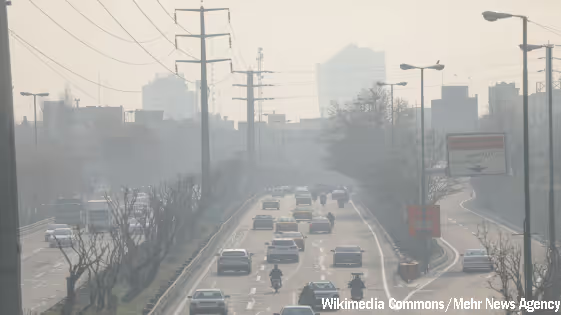
भारत में पर्यावरणीय क्षरण में सुधार लाने में नियामक नवाचार की भूमिका
येल पर्यावरण प्रदर्शन सूचकांक की 180 देशों की सूची में भारत अंतिम स्थान पर है। अनंत सुदर्शन भारत में पर्यावरणीय क्षरण के व्यापक आर्थिक और विकासात्मक प्रभावों की जांच करते हैं। इस विषय पर उपलब्ध साहित्य और अपने स्वयं के अनुभव-जन्य कार्यों के आधार पर,वे तर्क देते हैं कि नियामक गतिरोध के चलते इसका समाधान पाना कठिन हो गया है, साथ ही अपनी पर्यावरण नीति में आशाजनक नवाचारों को पर्याप्त रूप से लागू करने में भारत विफल रहा है। उनका सुझाव है कि इस बारे में अधिक अनुसंधान-नीति सहयोग और व्यापक अनुशासनात्मक विशेषज्ञता से भारत में पर्यावरण नियमन को लाभ होगा।
The role of regulatory innovation in reversing India’s environmental degradation
In the Yale Environmental Performance Index, India ranked last out of 180 countries. Anant Sudarshan examines the broader economic and developmental costs of environmental degradation. Based on the literature and his own empirical work he argues that regulatory stagnation has made it harder to find solutions, with India failing to sufficiently engage with promising innovations in environmental policy. He suggests that environmental governance in India would benefit from more research-policy collaboration and broader disciplinary expertise.
Clearing the air: The effects of transparency on plant pollution emissions
Of the 20 cities in the world with the worst fine particulate air pollution, 13 are in India. If good information on who pollutes is available, then traditional environmental regulation can bring down emissions somewhat, but regulators may lack the will or resources to penalise every polluter. What more can government due to contain such widespread damages? This project measuring the effect of information disclosure on emissions in a large-scale plant-level randomised controlled trial in India. In collaboration with the Maharashtra Pollution Control Board, it develops a star-rating programme that assigns plants to categories based on their recent air pollution emissions, which are either privately shared with the plant alone or publicly disclosed.
Star power: Rating industries in Maharashtra by emission levels
Maharashtra Pollution Control Board recently launched a programme to rate industries based on their emission levels – the first such initiative by a government regulator. An easy and accessible way to inform residents about industry emissions around where they live and work, Greenstone, Pande, Ryan and Sudarshan contend that the programme can infuse transparency and accountability into the system, and instil healthy competition among industries.
Solar micro-grids in India: A reality check
Much of India’s strategy to reduce the use of fossil fuels relies on a transition to solar energy. Based on a survey of potential solar micro-grid customers in Bihar, this column highlights the challenges associated with solar electricity becoming a sustainable and scalable solution, and the need for a new approach.
Building Environmental Regulation that Enables Growth
This project is linked to a broader research-policy collaboration with India’s Ministry of Environment and Forests (MoEF), Central Pollution Control Board (CPCB), and State Pollution Control Boards of Gujarat, Maharashtra, and Tamil Nadu to design, implement and evaluate an emissions market for particulate matter (PM) emissions in India, a pollutant of serious concern.
Emissions Trading as an Environmental Innovation in India: Measuring the Policy Impact on Emissions and Abatement Costs
Growth in developing countries has improved living standards of millions, but has led to high pollution concentrations and serious public health damages. Market-based environmental regulation can reduce the costs of pollution reduction and thus transform the trade-off between environmental quality and growth.

Electricity demand in urban Indian households: Influencing consumer behaviour
The huge and fast growing urban middle class of India uses a significant amount of electricity at their homes. This column argues that there is a need to focus on managing demand of electricity, and demonstrates how social norms can be used to encourage households to consume less electricity.