
.svg)
.svg)
%201.svg)
%201.svg)
.svg)

.svg)
.svg)
Anindya Chakrabarti
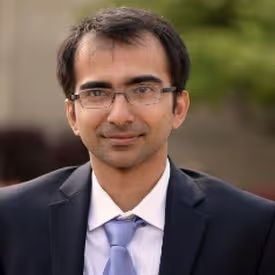
Anindya Chakrabarti is an assistant professor of economics at Indian Institute of Management (IIM), Ahmedabad. His main research interest is in characterisation and modeling of large-scale economic and financial networks, analysing the role of big data in economic policies, learning and coordination in multi-agent systems, and macroeconomic dynamics. He received his Ph.D. in economics from Boston University in 2015.
.svg)


Only germs this time, no guns and steel (yet)?
The first round of globalisation over the previous centuries was associated with a transmission of diseases between continents. With Covid-19, history seems to be repeating itself, but this time in the form of a global pandemic fuelled by increased human connectivity. Chakrabarti and Chatterjee discuss how globalisation may itself be set back by Covid-19, as countries have stopped production, and supply chains have been disconnected, disrupting the gains made by mankind over the past two centuries.


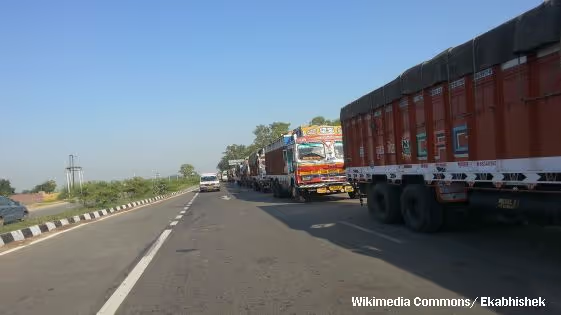
Lockdown-induced trade disruptions and adaptations by firms
In the face of trade disruptions, firms can reorient their trade to minimise risk. This article documents a fall in inter-state trade in India during the Covid-19 lockdown, that continues until December 2020. This is explained by ‘reshoring’, as plants more dependent on inter-state sales (and input-sourcing) shifted to intra-state sales (and input-sourcing). The extent of reshoring is determined by a new measure – Scope for Home Expansion – that captures excess home production which can be diverted within the state
How movies impact stigma and choice: Evidence from the pharmaceutical industry
Recently educational entertainment is emerging as a platform for addressing public health issues. In this article, Aggarwal, Chakrabarti, and Chatterjee investigate whether movies can destigmatise accessing healthcare and increase consumer choice in the Indian pharmaceutical market. They explore the impact of the release of the Bollywood movie ‘My Name is Khan’ on the market for antipsychotic drugs in India by analysing firm-level market responses, and find an increase in supply of drug varieties due to the destigmatisation caused by the movie.

Stewardship as the way forward in fighting global antimicrobial resistance
With the World Health Organization's emphasis on stewardship and working together against antimicrobial resistance (AMR), the authors consider the importance of certain agents in preventing AMR. Looking at the 2010 super bug crisis in India, they find that the withdrawal of multinational firms from the carbapenem market caused Indian firms to fill the void and physicians to switch their product preferences. They highlight the importance of scientific publications in reporting and monitoring outbreaks, and the need to incentivise antibiotic innovation.