
.svg)
.svg)
%201.svg)
%201.svg)
.svg)

.svg)
.svg)
Anirudh Krishna

Anirudh Krishna is Professor of Public Policy and Political Science at Duke University. His research investigates how poor communities and individuals in developing countries cope with the structural and personal constraints that result in poverty and powerlessness. Recent research projects have examined poverty dynamics at the household level for 35,000 households in India, Kenya, Uganda, Peru, and North Carolina, USA (www.sanford.duke.edu/krishna), examining both how people escaped poverty – and more important, how some came to be poor in the first place. A recent book, One Illness Away: How People Escape Poverty and Become Poor (Oxford University Press, 2010) presents these findings. Krishna is author or co-author of five other books and more than fifty journal articles and book chapters. He received an honorary doctorate from Uppsala University, Sweden in 2011; the Olaf Palme Visiting Professorship from the Swedish Research Council in 2007; the Dudley Seers Memorial Prize in 2005; and the Best Article Award of the American Political Science Association, Comparative Democratization Section in 2002. Before returning to academia, Krishna spent 14 years with the Indian Administrative Service, managing diverse rural and urban development initiatives.
.svg)


The root of poverty: Ruinous healthcare costs
While natural disasters and political turmoil rightly grab our attention, this column shows that it is everyday events that drag most people into poverty. For many, the first of these is illness and this column argues that this is where the first battle lines against poverty must be drawn. People need more affordable, accessible, and higher quality healthcare.


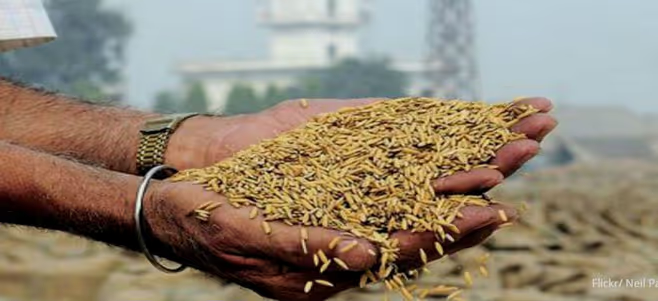
Food subsidy – PDS, cash, or both?
Should food subsidies – currently availed in the form of subsidised cereals – be given out in the form of cash instead? In this post, Krishna and Agrawal contend that rather than asking this binary question, it might be more cost-effective and welfare-enhancing to consider: where is PDS, and where might cash be, the better policy response for serving the same need?

Social Networks, Property Rights and Public Services in the Slums of Patna and Jaipur
This project provides important original insight into the factors that condition the capacity of the urban poor to achieve formal recognition of slums, private property rights, and better public services. This knowledge will help inform donor, government, and civil society programming.
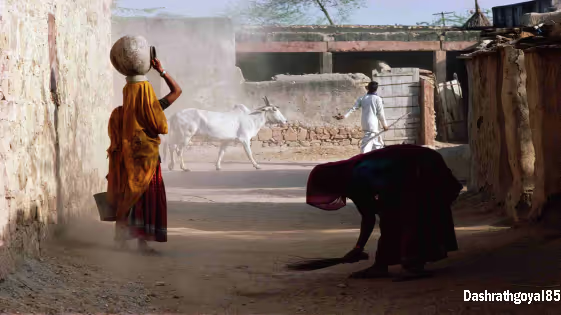
कोविड-19 और दीर्घकालिक गरीबी: ग्रामीण राजस्थान से साक्ष्य
प्रारंभिक गणना के आधार पर, भारत में कोविड-19 के कारण 7.7 से 22 करोड़ लोग गरीबी में आ गए हैं, जिसके अनुसार अब शहरी आबादी में गरीब 60% और ग्रामीण आबादी में 70% हो गए हैं। वर्ष 2002 में ग्रामीण राजस्थान में किए गए सर्वेक्षण के 2021 में किये गए फॉलोअप के आधार पर, यह लेख दर्शाता है कि परिवारों को मार्च 2020-अगस्त 2021 के दौरान अपनी नकद आय का एक-तिहाई और दो-तिहाई के बीच नुकसान हुआ, जबकि उन्होंने अपनी दीर्घकालीन गरीबी में बहुत कम बदलाव देखा या किसी बदलाव का अनुभव नहीं किया।
Covid-19 and long-term poverty: Evidence from rural Rajasthan
Based on preliminary calculations, it is being reported that 77-220 million have fallen into poverty in India on account of Covid-19, with the poor now accounting for 60% of urban, and 70% of rural residents. Based on a 2021 follow-up to a 2002 survey conducted in rural Rajasthan, this article shows that while households lost between one-third and two-thirds of their cash incomes during March 2020-August 2021, they experienced little to no change in long-term poverty.
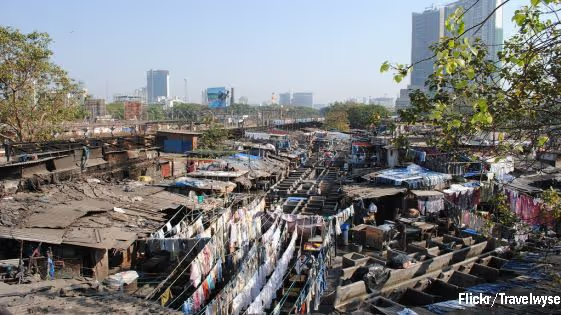
कोविड-19: भारत की झुग्गी-बस्तियों में स्वास्थ्य तथा आर्थिक प्रभाव
प्रारंभिक अनुमानों में यह कहा गया था कि कोविड-19 से झुग्गी-बस्तियों में रहने वाले लोग सबसे बुरी तरह प्रभावित होंगे क्योंकि वे अत्यधिक घनी बसी आबादी में रहते हैं, वहां साझा नल होते हैं और वहां सामाजिक दूरी का पालन करना असंभव होता है। इस लेख में, डाउन्स-टेपर, कृष्णा और रेन्स, इन कमजोर समुदायों पर महामारी के स्वास्थ्य और आर्थिक प्रभावों का पता लगाने, और इससे निपटने के लिए निवासियों द्वारा समय के साथ अपनाई गई रणनीतियों को समझने के लिए, बेंगलुरु और पटना में 40 झुग्गी-बस्तियों में सर्वेक्षण डेटा का उपयोग करते हैं।
Covid-19: Health and economic impacts in Indian slums
Initial predictions suggested that slum communities – densely packed, with shared water taps, and an impossibility of social distancing – would be particularly hard-hit by Covid-19. In this note, Downs-Tepper, Krishna and Rains, use data from surveys in 40 slums across Bengaluru and Patna, to track the health and economic impacts of the pandemic on these vulnerable communities, and to understand the strategies employed by residents to cope with these impacts over time.

Rags to riches? Understanding social mobility in India
To what extent is an individual’s status in society determined by the position of his or her parents? Analysing data from the Indian Human Development Survey, 2011-2012, this column finds that the probability of large intergenerational, occupational ascents in India is very low, and in fact, many face high risk of downward mobility.
The resurgence of poverty
Policymakers who aim only at lifting people out of poverty miss an essential fact: even as many people move out of poverty, many others fall back into it. This column argues that tackling poverty requires not only helping the existing poor, but also preventing the growth of future poverty