
.svg)
.svg)
%201.svg)
%201.svg)
.svg)

.svg)
.svg)
Anjini Kochar
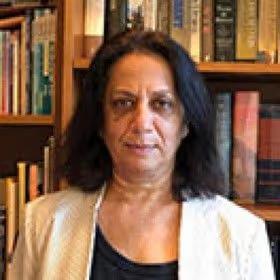
Anjini Kochar is a Senior Research Fellow at the International Initiative for Impact Evaluation (3ie). Prior to joining 3ie in 2022, she was the Director of the India Program at the Stanford Center for International Development (SCID), Stanford University and an Assistant Professor in the Department of Economics, Stanford University. Her research focuses on the micro-economics of development, and specifically on issues related to education, health, credit, population, inequality and the effectiveness of government programs.
Dr Kochar received her PhD in Economics from the University of Chicago.
.svg)

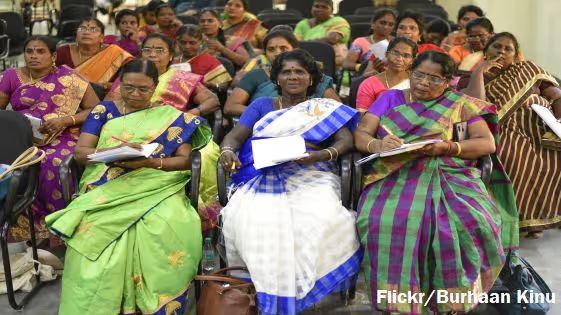
वित्तीय पहुंच परिवारों में महिलाओं की निर्णय लेने की भूमिका को कैसे प्रभावित करती है
महिलाओं को वित्तीय सहायता तक पहुंच प्रदान करने वाले सरकारी कार्यक्रमों द्वारा दी जाने वाली सहायता अक्सर इतनी कम होती है कि जिससे महिलाओं की उनके परिवार में आर्थिक स्थिति में कोई महत्वपूर्ण बदलाव नहीं हो पाता है। इस लेख में एनआरएलपी स्वयं-सहायता समूहों के सदस्यों को दिए गए ऋणों से संबंधित डेटा का उपयोग किया गया और यह पाया गया कि वित्तीय संसाधनों तक महिलाओं की पहुंच बढ़ने से परिवार में उनकी निर्णय लेने की भूमिका में वृद्धि होती है। हालाँकि, केवल बड़े ऋणों के बारे में ही यह प्रभाव दिखता है, जबकि महिलाओं को छोटे ऋण प्रदान करने से परिवार की वित्तीय स्थिति में सुधार के समान परिणाम दिखाई देते हैं।



अपेक्षित आय समर्थन तथा शिशु स्वास्थ्य
भारत सरकार के मातृत्व सहायता कार्यक्रम - प्रधानमंत्री मातृ वंदना योजना- का उद्देश्य ग्रामीण भारत में गर्भवती महिलाओं और स्तनपान कराने वाली माताओं को आय सहायता मुहैया कराना है। इस लेख में बिहार में चलाए गए इस कार्यक्रम का मूल्यांकन किया गया है, जिसमें पाया गया कि भुगतान में देरी होने के बावजूद इस योजना की वजह से पहले बच्चे के स्वास्थ्य में महत्वपूर्ण सुधार हुआ। इसकी संभावित वजह है पहले और दूसरे जन्म के बीच अंतराल में बढ़ोतरी।
Expected income support and child health
Government of India’s maternity support programme – Pradhan Mantri Matru Vandana Yojana – seeks to provide income support to pregnant women and lactating mothers in rural India. Evaluating the programme in Bihar, this article finds that even though payments are delayed, the programme leads to significant improvement in the first child’s health. The likely channel is an increase in the interval between the first and second birth
Maternal Hours of Work during Pregnancy: An Evaluation of a CCT Programme in India
The Indira Gandhi Matritva Sahyog Yojana (IGMSY) is a conditional cash transfer (CCT) aimed at expectant mothers in the informal sector, aiming to provide the income to enable a reduction in work hours in late pregnancy and immediately following delivery. This project studied the effect of IGMSY on maternal hours of work and the causal effect of hours of work on maternal and child health.
Teacher accountability and assessment of student learning levels
Research has found that holding teachers accountable to the local community has scant impact on student learning. Based on a survey of government schools in Karnataka, this column suggests that this need not signal a failure of local accountability. Rather, the issue is that schools are held accountable for student performance on tests that teachers themselves design and administer, and which do not adequately capture learning.
Delivering health services through schools in rural India
Given that India has better infrastructure for schooling relative to healthcare, and near universal primary school enrolment rates, many believe that providing basic health services through schools rather than clinics may be more cost effective. This column finds that coverage achieved by health programmes administered through schools is also low, even lower than the average school attendance rates. The key constraint on coverage is shortage of healthcare personnel.
Improving Child Health and Schooling
This project collected information on whether the child received a health report card (and checkup), as well as attendance data for that child for each month of the school year. Combining this with information on the month of the school visit by the Public Health Centre team, the project assess whether the programme affected absenteeism, and how the design of the programme affected the relationship between attendance rates and programme coverage.
Misguided policy and school inequality in rural India
Despite government efforts, stark inequality in India’s schools persists, particularly in rural areas. This column argues that the failure may lie in policy design – rather than helping the worst schools catch up, policies are helping the better ones get further ahead.
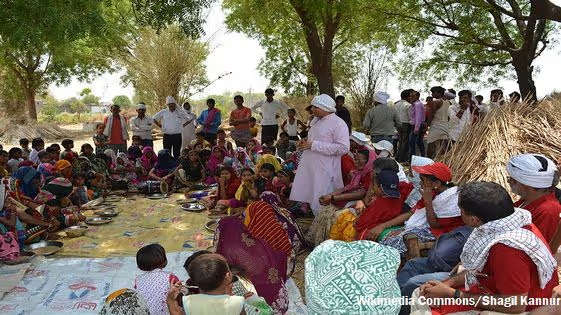
बिहार में स्वयं-सहायता समूहों के माध्यम से जोखिम साझा करने की सुविधा
यह देखते हुए कि बिहार में स्वयं सहायता समूह (एसएचजी) कार्यक्रम से महिलाओं की कम ब्याज़-दर वाले ऋण तक पहुँच में सुधार हुआ है, इस लेख में उपभोग वृद्धि के गाँव-स्तरीय भिन्नता में अंतर की जांच करके इस बात का मूल्याँकन किया गया है कि क्या इससे जोखिम-साझाकरण में सुधार हुआ है। यह पाया गया कि जोखिम-साझाकरण में सुधार केवल उन ब्लॉकों में हुआ है, जहाँ एसएचजी पहले से ही बड़ी संख्या में मौजूद थे। इससे 'समुदाय कैडर' के रूप में इस कार्यक्रम की प्रशासनिक क्षमता का महत्व सामने आता है, जिसमें मौजूदा एसएचजी के सदस्यों की सक्रिय भूमिका है और वे नए समूहों के गठन के लिए ज़िम्मेदार भी हैं।
Facilitating risk-sharing through self-help groups in Bihar
While the self-help group (SHG) programme in Bihar has improved access to low-cost credit for women, this article evaluates whether it improves risk-sharing by examining differences in village-level variance of consumption growth. It finds that improvements in risk-sharing occurred only in blocks with significant numbers of pre-existing SHGs. This suggests the importance of the programme’s administrative capacity in the form of a ‘community cadre’, that comprises members of existing SHGs and is responsible for the creation of new groups.

How financial access impacts women’s decision-making role in households
Government programmes which grant women access to financial support often provide assistance which is too small to significantly impact women’s economic position within the household. This article uses data on loans granted to members of NRLP self-help groups and finds that increasing women's access to financial resources enhance their decision-making role within the household. However, only large loans have this effect, while providing women with small loans yields similar results to improving the financial position of the household.