
.svg)
.svg)
%201.svg)
%201.svg)
.svg)

.svg)
.svg)
Ankur Sarin

Ankur Sarin is an Assistant Professor in the Public Systems Group and Ravi J Mathai Center for Innovation in Education at the Indian Institute of Management, Ahmedabad. His past works include investigations of the effects of social and economic inequality on welfare outcomes of children and understanding the influence of technology on the social and economic life of the marginalised. Recently, he has been working on making the Right to Education an instrument not only for increased access to education, but also one that promotes a more inclusive education system as part of the institute’s Right to Education Resource Center (www.rterc.in). He has a Ph.D. in Public Policy from the University of Chicago and prior to joining IIM-Ahmedabad, was a Researcher at Mathematica Policy Research, Princeton.
.svg)

Understanding school choices under RTE’s 25% mandate
Section 12(1)(c) of the Right To Education Act mandates non-minority status private schools to reserve at least 25% seats for the disadvantaged and weaker sections of the society. This article analyses the impact of the mandate on changing school choices of relatively disadvantaged households based on a sample of over 1,600 households in urban Ahmedabad. It finds that the mandate expanded choice of schools for the participating eligible households.


Barriers in accessing applications under RTE quota in Gujarat
In the school year 2017-18, Gujarat shifted from a paper-based system at the district level to an online system at the state level, for applications under the Right to Education Act. In this note, researchers at IIM Ahmedabad demonstrate that unless the required technological infrastructure is adequately developed, a complete shift to digitisation adversely affects the most vulnerable populations.
Reservation under RTE: Status of implementation and way forward
Section 12(1)(c) of the Right to Education Act, 2009, mandates that non-minority private unaided schools should reserve at least 25% of seats in entry-level grades for children from economically weaker and disadvantaged backgrounds. This column analyses the current status of implementation of this provision, and suggests ways to overcome hindrances in effective implementation and make the education system more inclusive.
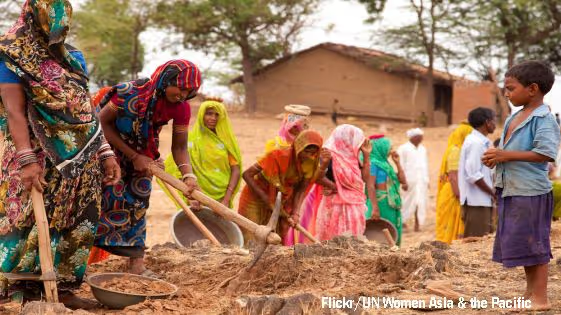
कोविड-19: बिहार की सरकारी योजनाएँ कमजोर आबादी की सहायता कितने अच्छे से कर रहीं हैं?
कोविड-19 महामारी और उससे जुड़े लॉकडाउन का तत्काल प्रतिकूल प्रभाव ऐसे प्रवासी श्रमिकों और उनके परिवारों पर काफी अधिक देखा गया जिनकी अपने मूल गांवों में सरकारी योजनाओं तक पहुंचने की क्षमता अनिश्चित थी। जून-जुलाई 2020 में बिहार के ग्रामीण क्षेत्रों में किये गए एक सर्वेक्षण से प्राप्त आंकड़ों का विश्लेषण करते हुए सरीन एवं अन्य यह पाते हैं कि प्रवासियों के परिवारों को भोजन में कटौती करने और मानसिक स्वास्थ्य के मुद्दों से पीड़ित होने की संभावना अधिक थी, भले ही उन्होंने गैर-प्रवासी परिवारों की तुलना में अधिक आय होने की जानकारी दी हो।
Covid-19: How well are government schemes supporting Bihar’s vulnerable populations?
The immediate adverse impact of the Covid-19 pandemic and associated lockdown was visibly greater for migrant workers and their households, whose ability to access government schemes in their villages of origin was uncertain. Analysing data from a survey in rural Bihar in June-July 2020, Sarin et al. find that household with migrants were more likely to cut down on food and suffer from mental health issues – even as they reported higher incomes than non-migrant households.