
.svg)
.svg)
%201.svg)
%201.svg)
.svg)

.svg)
.svg)
Anup Malani

Professor Malani is the Lee and Brena Freeman Professor at the University of Chicago Law School and Professor at the Pritzker School of Medicine. He is also a university scholar at Resources for the Future in Washington, a research associate at theNational Bureau of Economic Research in Boston, a senior Fellow at the Schaeffer Center at University of Southern California, an editor at the Journal of Law and Economics, and on the board of the University of Chicago Press. Malani has a PhD in economics and a JD, both from University of Chicago. He clerked for Judge Stephen Williams on the U.S. Court of Appeals for District of Columbia and Justice Sandra Day O’Connor on the U.S. Supreme Court. Malani conducts research in law and economics and health economics. His law and economics research focuses on models of judicial behavior measuring the welfare impact of laws. His health economics research focuses on the value of medical innovation and insurance, control of infectious diseases, and placebo effects. He is the principal investigator on the Indian Health Insurance Experiment, a 12,000 household study of health insurance in Karnataka, India. Malani’s research has been published in journals from a number of different fields, including the Proceedings of the National Academy of Sciences, the Journal of Political Economy, the Harvard Law Review, the Archives of Internal Medicine, and Theoretical Population Biology. Malani teaches courses in commercial law and health law in the Law School and a PhD law and economics course in the Economics Department. He is also the co-founder of the International Innovation Corps, a social service program that sends teams of University of Chicago and Indian university graduates to work on innovative development projects with government officials in India.
.svg)

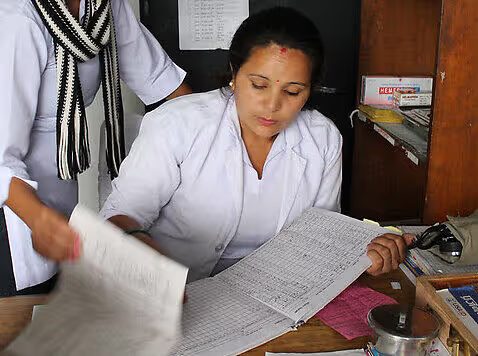
भारत में स्वास्थ्य बीमा तक पहुंच: प्रत्यक्ष और स्पिलओवर प्रभाव
भारत में स्वास्थ्य देखभाल की उच्च लागत के चलते कई कम आय वाले परिवार गरीबी में आ जाते हैं | गरीबी रेखा से नीचे के परिवारों के लिए सरकार द्वारा संचालित राष्ट्रीय स्वास्थ्य बीमा कार्यक्रम - राष्ट्रीय स्वास्थ्य बीमा योजना का लाभ इष्टतम से कम है। यह लेख कर्नाटक में गरीबी रेखा से ऊपर के परिवारों के एक नमूने के लिए अस्पताल बीमा की पेशकश के प्रभाव की जांच करता है। यह बीमा के उपयोग को बढ़ाने में महत्वपूर्ण समकक्ष प्रभाव पाता है; जबकि अस्पताल बीमा का स्वास्थ्य परिणामों पर कोई महत्वपूर्ण प्रभाव नहीं पड़ता है।


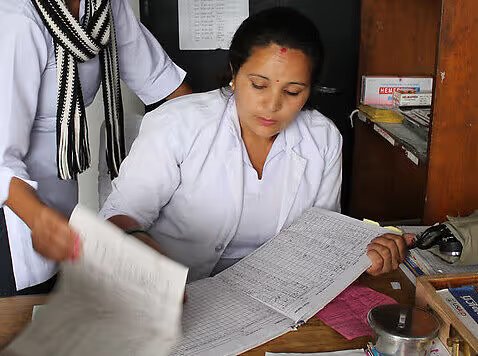
Access to health insurance in India: Direct and spillover effects
Many low-income households in India have been pushed into poverty by high healthcare costs. Uptake of the Rashtriya Swasthya Bima Yojana, the government-run national health insurance programme for below poverty line households, has been less than optimal. This article examines the impact of offering hospital insurance to a sample of above poverty line households in Karnataka. It finds significant peer effects in increasing insurance utilisation; hospital insurance however doesn’t have any significant effect on health outcomes.

मोदीकेयर के सफल आरंभ का रोडमैप
पिछले साल घोषित की गई नेशनल हेल्थ प्रोटेक्शन स्कीम पहले मौजूदा राष्ट्रीय स्वास्थ्य बीमा योजना (रएसबीवाई) को अपने अंदर शामिल करती है, जिसने सबसे गरीब 30 करोड़ भारतीयों को अल्पकालिक अस्पताल के दौरे के लिए स्वास्थ्य बीमा प्रदान किया था। कर्नाटक में आरएसबीवाई पर अपने बड़े पैमाने पर किये गए अध्ययन के आधार पर, मलानी और कीनन ने नए कार्यक्रम के लिए कुछ महत्वपूर्ण सबक दिए हैं।
Modicare: Getting universal health coverage in India right
The recently announced National Health Protection Scheme succeeds Rashtriya Swasthya Bima Yojana (RSBY), which provided health insurance for short-term hospital visits to the poorest 300 million Indians. Based on their large-scale study of RSBY in Karnataka, Malani and Kinnan put forth some important lessons for the new programme.
Impact Evaluation of a Public Health Insurance Plan in India: Post Health Event Survey Pilot
This project pilots a Post Health Event Survey (PHES). The PHES is a potentially more efficient survey strategy than conducting one annual survey of all households. The PHES pilot was conducted in two stages. First, a random sample of households is called to ascertain if the household experienced a serious health event in the last two months.