
.svg)
.svg)
%201.svg)
%201.svg)
.svg)

.svg)
.svg)
Anupma Mehta

Anupma Mehta is Head of Publications and Senior Editor at NCAER. She leads the editorial and content writing team at the institution, overseeing the writing, editing, and production of diverse company literature, including digital content, newsletters, reports, working papers, press releases, and project briefs. She is Managing Editor of the in-house journals, the India Policy Forum, and Margin: The Journal of Applied Economic Research. She also publishes updates and opinion articles on NCAER research in national dailies and other media.
She has earlier worked as Associate Editor for the social science journals, The Indian Journal of Labour Economics, Indian Journal of Human Development, and Journal of Social Inclusion Studies, and has editing experience across research organisations, publishing houses, UN bodies, public sector units, and the social sector. She has published articles and syndicated columns in various dailies, including Hindustan Times, Business Standard, Financial Express, The Pioneer, Mid-Day, and The Tribune. She has Bachelor’s and Master’s degrees in English Literature from Lady Shri Ram College, and University of Delhi, and a Post-graduate Diploma in Communications from the Indian Institute of Mass Communication, New Delhi.
.svg)

जलवायु परिवर्तन और नदी प्रदूषण : भारत में उच्च गुणवत्ता के पर्यावरण डेटा की आवश्यकता
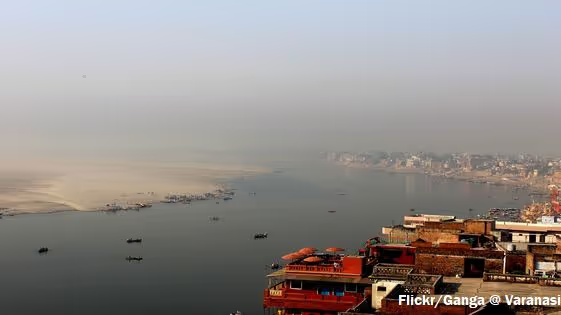
भारत में जल प्रदूषण को नियंत्रित करने और जल संसाधनों की सुरक्षा के लिए गहन डेटा संग्रह और निगरानी की आवश्यकता है। पोहित और मेहता इस लेख में, एनसीएईआर और टीसीडी की एक परियोजना का वर्णन करते हैं, जिसमें उत्तर प्रदेश और पश्चिम बंगाल में गंगा नदी के प्रमुख स्थानों पर पानी की गुणवत्ता मापदंडों से संबंधित आंकड़े एकत्र करने के लिए नावों से जुड़े स्वचालित सेंसरों का उपयोग किया गया। वे इस बात पर ज़ोर देते हैं कि कैसे इन निष्कर्षों से प्रदूषण के स्रोतों को समझने में मदद मिल सकती है ताकि प्रभावी नीतिगत हस्तक्षेप और प्रदूषकों द्वारा नियामक अनुपालन सुनिश्चित किया जा सके।


Climate change and riverine pollution: The need for high-quality environment data in India
Controlling water pollution and protecting water resources in India requires comprehensive collection and monitoring of data. In this article, Pohit and Mehta describe a project undertaken by NCAER and TCD, which used automated sensors attached to boats to collect data on water quality parameters at key points along the Ganga river in Uttar Pradesh and West Bengal. They emphasise how these findings can help understand the sources of pollution to ensure effective policy interventions and regulatory compliance by polluters.

Ideas@IPF2023 series: NCAER’s India Policy Forum– where research meets policy
Every year, the National Council of Applied Economic Research (NCAER) hosts the India Policy Forum (IPF), a platform where economists and policymakers dissect five research ideas for their utility to public policy. To commemorate the 20th anniversary of the conference, Ideas for India launches the Ideas@IPF2023 series, introduced in this anchor by NCAER’s Anupma Mehta. Across this week, from 10-14 July, we host the five articles summarising cutting-edge empirical work at the intersection of economics and policy.