
.svg)
.svg)
%201.svg)
%201.svg)
.svg)

.svg)
.svg)
Aparajita Dasgupta

Aparajita Dasgupta is Assistant Professor in Economics at Ashoka University. Previously, she worked as the Bixby Postdoctoral Research Fellow at the Population Council based in New Delhi. She completed her Ph.D. at the Department of Economics at University of California Riverside in 2013. She is an applied micro-economist by training and her research mainly deals with policy-relevant questions in development economics, health, education and public policy. Her primary research interest has been to understand the dynamics of early childhood environment in shaping long-term human capital outcomes in the context of developing countries. Some of her other current work includes understanding the biases in measurement of health, examining the role of decentralisation of health and family planning services on evolution of long-term health, and exploring the sorting behaviour in school choice decision among Indian households. She has extensive field work experience in Andhra Pradesh and West Bengal. She has presented at several international conferences including the American Economic Association, University of Oxford, IZA-World Bank Conference among others.
.svg)


कोविड-19: क्या हम लंबी दौड़ के लिए तैयार हैं? - भाग 2
इस आलेख के पहले भाग में, लेखकों ने भारत में कोविड-19 के प्रति सरकार की प्रतिक्रिया का मार्गदर्शन करने हेतु व्यापक सिफारिशें कीं। इस भाग में, वे पांच ऐसे समूहों की पहचान करते हैं जिनके वर्तमान संकट से उत्पन्न आर्थिक एवं स्वास्थ्य संबंधी झटकों की चपेट में आने की आशंका ज्यादा है, और ऐसे क्षेत्र जहां राहत प्रयासों को केंद्रित करने की आवश्यकता है।


कोविड-19: क्या हम लंबी दौड़ के लिए तैयार हैं? - भाग 1
कोविड-19 के प्रसार की संभावित पुनरावृत्ति को रोकने के लिए यह लॉकडाउन, संभवतः भविष्य में किए जाने वाले कई लॉकडाउन में से पहला हो सकता है, इसलिए नीति निर्माताओं को इससे प्रतिकूल रूप से प्रभावित व्यक्तियों को राहत प्रदान करने के लिए तैयार रहना होगा। इसे ध्यान में रखते हुए, लेखक एक व्यापक दृष्टिकोण का प्रस्ताव करते हैं जिसमें अगले 24 महीनों में होने वाले किसी भी लॉकडाउन के दौरान राशन कार्ड धारक सभी परिवारों को प्रदान किए जाने वाले वस्तु रूपी अंतरणों और नकद सहायता के एक संयोजन के लिए तर्क दिया गया है।
Covid-19: Are we ready for the long haul? - Part II
In Part I of this piece, the authors made broad recommendations to guide the government’s response to Covid-19 in India. In this part, they identify five salient population groups that are particularly vulnerable to the economic and health shocks arising from the current crisis, and regions where relief effort needs to be concentrated.
Covid-19: Are we ready for the long haul? - Part I
As this may be the first of many future lockdowns to stamp out possible repeated outbreaks of Covid-19, policymakers must be prepared to provide relief to adversely affected individuals. With this in mind, the authors propose a comprehensive approach that argues for a combination of in-kind transfers and cash support to be provided to all households with ration cards during any lockdown that takes place over the next 24 months.
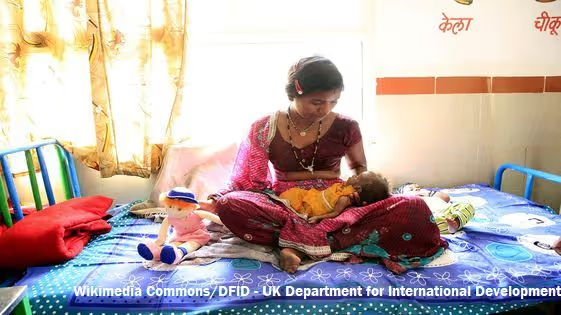
How does a ban on sex-selective abortions affect child health?
Widespread access to sex selection technologies has further skewed the male-biased sex ratio in India. However, this article suggests that the ban on prenatal sex determination may have adverse consequences on the health and mortality outcomes of the surviving children. Looking at children born between in the decade before and after the ban, it finds that the ban led to an increase in the proportion of unwanted girls, and increased competition for resources among children in large families.
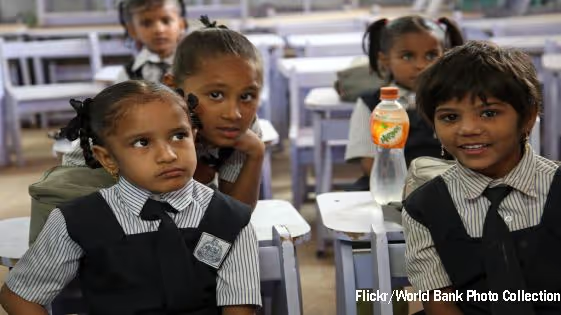
Teacher-student gender matching and learning outcomes
Studies have found positive effects of teacher-student gender matching on students’ learning outcomes in certain countries. Based on a theoretical model – tested empirically with survey data from Andhra Pradesh – this article shows that the positive effect in the Indian context seems to be a consequence of higher quality female teachers and more competent female students ‘self-selecting’ into urban, private schools on account of gender norms and institutional structures of teacher hiring.
Child health, fertility, and sex ratio: India vs. Bangladesh
Despite having lower per capita income, Bangladesh has superior performance over India on key welfare indicators. This article compares the experiences of India and Bangladesh on several key indicators during 1990-2015 using two different datasets. It finds better performance of Bangladesh on infant mortality rate with a lower boy-girl sex ratio at birth than India. While both countries record an impressive decline in fertility rates, this was accompanied by a worsening of the sex ratio in India but not in Bangladesh.
Self-reported health data: Issues and solutions
Health data from the National Sample Survey shows an increase in morbidity in India over the years. However, given that the data is self-reported, it is difficult to ascertain whether this indeed reflects higher actual illness burden or an enhanced perception of morbidity. This column shows that reporting behaviour varies systematically with socio-demographic characteristics, and this can be used to disentangle perceived and actual morbidity.

वर्ग और जाति किस प्रकार से स्कूल के चुनाव को प्रभावित करते हैं
माता-पिता द्वारा अपने बच्चों की शिक्षा के सम्बन्ध में लिए जाने वाले निर्णयों पर परिवार की सामाजिक-आर्थिक स्थिति प्रभाव डालती है। जाति और वर्ग की परस्पर-क्रिया को ध्यान में रखते हुए, यह लेख दर्शाता है कि परिवार जब बहुत अमीर या बहुत गरीब होते हैं, तब उनकी जाति की पहचान स्कूल के चुनाव के उनके निर्णयों को प्रभावित नहीं करती है। लेकिन, संपत्ति-वितरण के बीच में आने वाले वर्गों के लिए, जाति की पहचान बहुत मायने रखती है- वंचित जातियों के छात्र, जिनके माता-पिता श्रम बाज़ार में अच्छी तरह से जुड़े नहीं होते, उन्हें शिक्षा के रिटर्न कम मिलते हैं।

How class and caste influence school choice
Families' socioeconomic status impacts how parents make decisions regarding their children's education. Taking into account the interplay of caste and class, this paper finds that when families are too rich or too poor their caste identity does not affect their decisions about school choice. However, it is in the middle of the wealth distribution that caste identity matters most – students from disadvantaged castes whose parents are not as well connected in the labour market see lower returns to education.

Can MNREGA buffer negative shocks in early childhood?
Exposure to negative shocks such as drought during early childhood is known to have lasting, detrimental effects on human development outcomes. This column examines whether a household’s access to MNREGA, later in the life of the child, can offset the impact of early childhood shocks. It finds that programme access, although incapable of correcting for past deficiencies, does mitigate the impact of recent shocks.