
.svg)
.svg)
%201.svg)
%201.svg)
.svg)

.svg)
.svg)
Arindam Banerjee

Arindam Banerjee is a partner at the Policy and Development Advisory Group (PDAG), New Delhi and has previously worked with J-PAL South Asia and Ministry of Rural Development as a PMRDF (Prime Minister's Rural Development Felllow). He holds a M.P.P. from the Blavatnik School of Government, University of Oxford as a Chevening Scholar and an M.A. in Media and Cultural Studies from the Tata Institute of Social Sciences (TISS), Mumbai.
.svg)

वह जीतती है: जातीय आधार पर विभाजित समाजों में महिलाओं का चुनाव
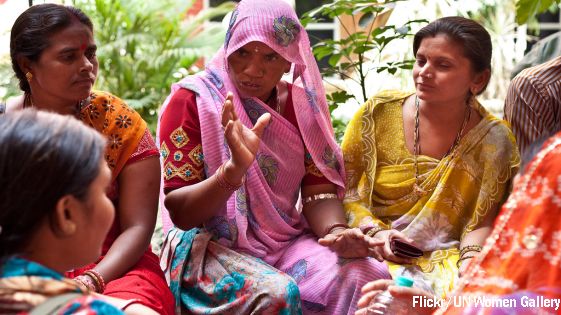
भारतीय संविधान के अनुसार ग्रामीण स्थानीय सरकारों में महिलाओं के लिए कम से कम 33% सीटें आरक्षित हैं, और बिहार उन नौ राज्यों में से है जिन्होंने 50% आरक्षण का विकल्प चुना है। हालांकि, राज्य और केंद्र स्तर पर महिलाओं का प्रतिनिधित्व बहुत कम है। यह लेख पता लगाता है कि बिहार में राज्य-स्तरीय चुनावों को आकार देने के लिए लैंगिक स्थिति (स्त्री-पुरुष) का किस प्रकार से जाति, राजनीतिक अभियानों और भेदभाव के अनुभवों के साथ परस्पर-प्रभाव है।


She wins: Electing women in ethnically divided societies
The Indian Constitution reserves a minimum of 33% of village council head positions for women, and Bihar is among the nine states that have opted for 50% reservation. This note investigates how gender, caste, political campaigns, and experiences of discrimination intersect in the state-level democratic process in Bihar. In particular, it seeks to identify the key factors that impact the electoral success of women candidates.

Heart of darkness: Misplaced priorities of Jharkhand’s District Mineral Foundation
In 2015, the central government launched District Mineral Foundations in the districts affected by mining, which are mandated to collect royalty from all mining activities and use the funds for the welfare of the local population. In this note, Banerjee and Ranjan give an account of how lack of political commitment and misplaced bureaucratic priorities have led to dismal planning and implementation of the programme in the mineral-rich state of Jharkhand.

Lost in transition
As part of a special three part series, the Prime Minister’s rural development fellows bring us voices from the field about what development means to women in some of the most remote parts of the country. What is the impact of government programmes on the day to day lives of the people they are supposed to help? The first account in this series is of Kajalmani Soren in Lalgarh, West Bengal. Coming from a family of landless labourers, she talks about her experience with the National Rural Health Mission, the Employment Guarantee Scheme and the Public Distribution System.