
.svg)
.svg)
%201.svg)
%201.svg)
.svg)

.svg)
.svg)
Ashish Sedai

Ashish Sedai is a Ph.D. Candidate in Economics at Colorado State University (CSU). He specialises in labour, gender, and development research, and has received the prestigious Warren Samuel’s prize from the Association for Social Economics for his research on “Gendered effects of piped water in India”. Prior to joining CSU in 2017, he completed his Masters from Jawaharlal Nehru University, Delhi, and worked as an Assistant Professor of Economics at the University of Delhi from 2012-2017. His research papers have been published in Journal of Economic Behavior and Organization, Energy Economics, World Development, The Energy Journal, and Economic and Political Weekly. He has also worked as a consultant, specialising in applied economic development research for the World Bank, United Nations, and 2M Research.
.svg)

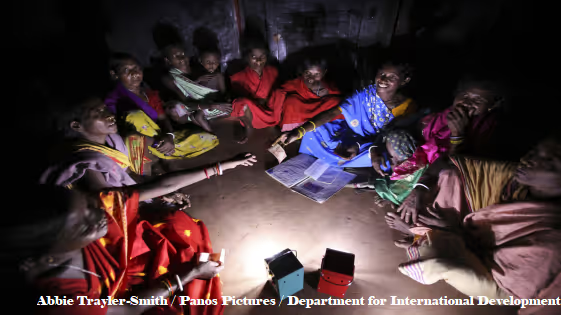
Powering progress: How reliable community electrification boosts women’s autonomy
While there has been significant progress in expanding access to grid electricity in India, the reliability of electricity remains a concern. Based on five national-level datasets spanning over a period of almost two decades., this article shows that improved reliability of electricity at the community level is beneficial for women’s empowerment in terms of mobility, participation in household decision-making, health autonomy, and safety.


इनडोर पाइप से पेय जल की आपूर्ति से किसे लाभ होता है? लैंगिक आधार पर विश्लेषण
भारत में, घरों में इनडोर पाइप से पेय जल (आईपीडीडब्ल्यू) की आपूर्ति बहुत सीमित है, और महिलाओं पर इसका प्रतिकूल प्रभाव पड़ता है क्योंकि उन्हें बाहर से पानी लाने का बोझ उठाना पड़ता है। यह लेख 2005-2012 के भारत मानव विकास सर्वेक्षण डेटा का उपयोग करते हुए दर्शाता है कि परिवारों को इनडोर पाइप से पेय जल मिलने से रोजगार में- विशेष रूप से ग्रामीण क्षेत्रों में कृषि और गैर-कृषि रोजगार- दोनों के मामले में लैंगिक अंतर को कम करने में मदद मिल सकती है।
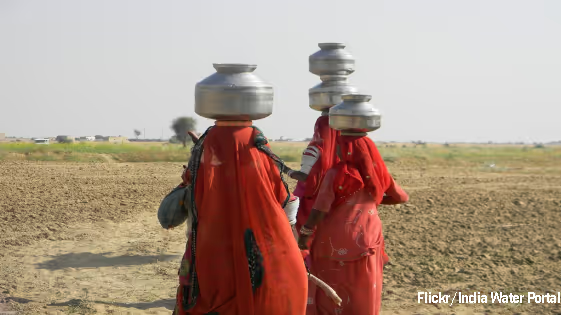
Who benefits from indoor piped drinking water supply? A gender analysis
In India, there is limited access to indoor piped drinking water (IPDW) in households, and this has a disproportionate impact on women as they bear the burden of fetching water. Using 2005-2012 India Human Development Survey data, this article shows that household access to IPDW can help reduce gender differences in employment, especially in rural areas and both in terms of farm and non-farm employment.