.svg)
.svg)
%201.svg)
%201.svg)
.svg)

.svg)
.svg)
Ashwini Deshpande
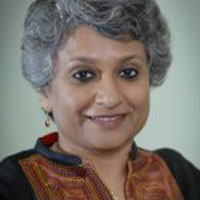
Ashwini Deshpande is Professor of Economics at Ashoka University. Prior to this she was at the Delhi School of Economics, University of Delhi, India. Her Ph.D. and early publications have been on the international debt crisis of the 1980s. Subsequently, she has been working on the economics of discrimination and affirmative action issues, with a focus on caste and gender in India, as well as on aspects of the Chinese economy: poverty, inequality, regional disparities and gender discrimination. She has published extensively in leading scholarly journals and has edited several books. She is the author of "Grammar of Caste: economic discrimination in contemporary India", OUP, 2011 and "Affirmative Action in India", OUP, Oxford India Short Introductions series, 2013. She received the EXIM Bank award for outstanding dissertation (now called the IEDRA Award) in 1994, and the 2007 VKRV Rao Award for Indian economists under 45.
.svg)


कोविड-19: क्या हम लंबी दौड़ के लिए तैयार हैं? - भाग 2
इस आलेख के पहले भाग में, लेखकों ने भारत में कोविड-19 के प्रति सरकार की प्रतिक्रिया का मार्गदर्शन करने हेतु व्यापक सिफारिशें कीं। इस भाग में, वे पांच ऐसे समूहों की पहचान करते हैं जिनके वर्तमान संकट से उत्पन्न आर्थिक एवं स्वास्थ्य संबंधी झटकों की चपेट में आने की आशंका ज्यादा है, और ऐसे क्षेत्र जहां राहत प्रयासों को केंद्रित करने की आवश्यकता है।


कोविड-19: क्या हम लंबी दौड़ के लिए तैयार हैं? - भाग 1
कोविड-19 के प्रसार की संभावित पुनरावृत्ति को रोकने के लिए यह लॉकडाउन, संभवतः भविष्य में किए जाने वाले कई लॉकडाउन में से पहला हो सकता है, इसलिए नीति निर्माताओं को इससे प्रतिकूल रूप से प्रभावित व्यक्तियों को राहत प्रदान करने के लिए तैयार रहना होगा। इसे ध्यान में रखते हुए, लेखक एक व्यापक दृष्टिकोण का प्रस्ताव करते हैं जिसमें अगले 24 महीनों में होने वाले किसी भी लॉकडाउन के दौरान राशन कार्ड धारक सभी परिवारों को प्रदान किए जाने वाले वस्तु रूपी अंतरणों और नकद सहायता के एक संयोजन के लिए तर्क दिया गया है।
Covid-19: Are we ready for the long haul? - Part II
In Part I of this piece, the authors made broad recommendations to guide the government’s response to Covid-19 in India. In this part, they identify five salient population groups that are particularly vulnerable to the economic and health shocks arising from the current crisis, and regions where relief effort needs to be concentrated.
Covid-19: Are we ready for the long haul? - Part I
As this may be the first of many future lockdowns to stamp out possible repeated outbreaks of Covid-19, policymakers must be prepared to provide relief to adversely affected individuals. With this in mind, the authors propose a comprehensive approach that argues for a combination of in-kind transfers and cash support to be provided to all households with ration cards during any lockdown that takes place over the next 24 months.
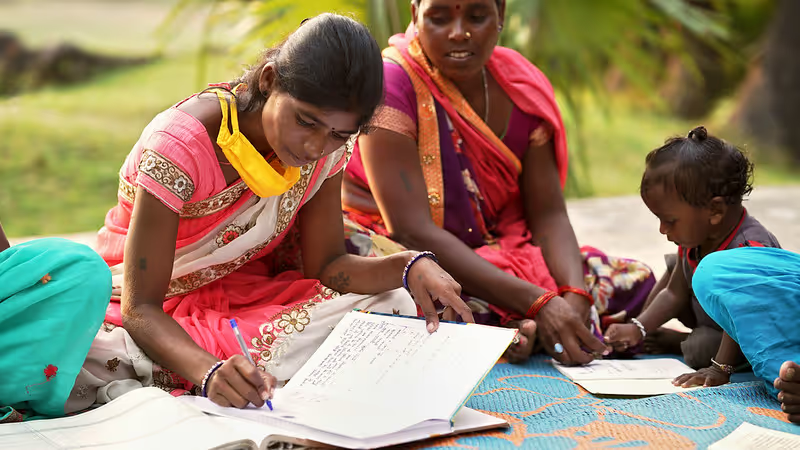
Adult education, knowledge and confidence
Illiteracy, in India and elsewhere, is largely a female phenomenon. This column analyses a literacy programme aimed at adult women in India and finds that it has impacts beyond increasing literacy and numeracy. The general knowledge of participants improved and they were less likely to be over-confident about what they know – attributes that may contribute to better educating their children and absorbing new information.
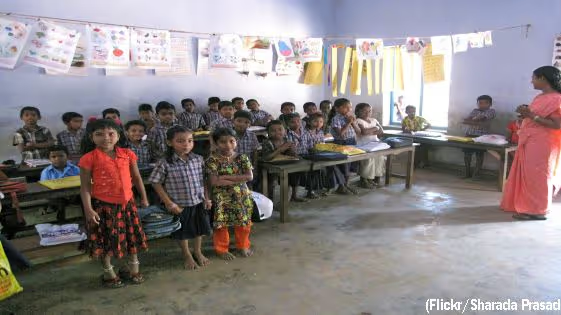
Nakusha: Son preference, ‘unwanted’ girls, and gender gaps in schooling
Indian society is commonly associated with a strong cultural preference for sons. Using nationally representative data from 1986-2017, this article examines parental investment in the education of sons vis-à-vis daughters. It finds that while gender gaps in the quantity of schooling have declined significantly for all children, those in the quality of education have increased – especially in families with unwanted girls.
Nakusha: Son preference, ‘unwanted’ girls, and gender gaps in schooling
Indian society is commonly associated with a strong cultural preference for sons. Using nationally representative data from 1986-2017, this article examines parental investment in the education of sons vis-à-vis daughters. It finds that while gender gaps in the quantity of schooling have declined significantly for all children, those in the quality of education have increased – especially in families with unwanted girls.