
.svg)
.svg)
%201.svg)
%201.svg)
.svg)

.svg)
.svg)
Avinash Kishore

Avinash Kishore joined IFPRI in September 2012 as a Post-Doctoral Fellow after completing his PhD in Public Policy from Harvard University. He obtained Masters in Public Affairs from Princeton University before joining the PhD program. Avinash studied at IRMA and worked for four years with International Water Management Institute (IWMI) before going to the US for higher studies. Avinash is interested in agriculture, environment, and development economics. At IFPRI, he will work on projects that seek to bridge the gap between laboratories and farms in Indian agriculture using action research in collaboration with agricultural universities, agribusiness firms and farmers.
.svg)

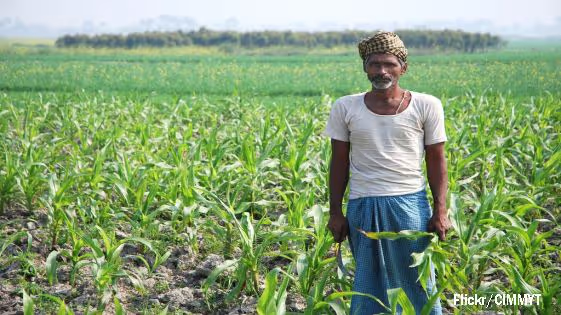
Impact of agricultural reforms in Bihar: Test case for new farm laws
The 2020 farm laws have been opposed by several farmers due to their possible use for corporate takeover of agriculture, removal of APMC mandis, and dilution of minimum support price and public procurement. This article examines the impact of repealing the Agricultural Produce Marketing Committee Act in Bihar in 2006 on the state’s agricultural indicators – as a test case for the potential impact of the Farmers’ Produce Trade and Commerce (Promotion and Facilitation) Act.



Adoption of Balanced Use of Chemical Fertilisers: Farmer's Response to Scientific Evidence and Social Learning
Government of India has launched a massive program of individualized soil tests and customized fertilizer recommendation, with the hope that scientific information will lead farmers to optimize the fertilizer mix. This porject conducted a randomized control trial in Bihar to provide evidence on the effectiveness of the program, as implemented currently. The findings suggests that lack of confidence is the main factor inhibiting farmers’ response.

A Novel, Market Based Mechanism to Incentivize Efficient Groundwater/Energy use in Indian Agriculture – Setting Up a Field Experiment in Gujarat
This project documents patterns of rural-urban migration and employment shifts in a region that is facing ongoing depletion of groundwater resources in northern Gujarat in India. Given that migration typically does not occur due to one singular risk, this study assesses the multifactoral drivers of migration.