
.svg)
.svg)
%201.svg)
%201.svg)
.svg)

.svg)
.svg)
Ben Pasquale

Benjamin Pasquale is an independent researcher. Ben received his Ph.D. in Politics from New York University in 2015. Ben was the Hayward R. Alker Postdoctoral Research Fellow at the Center for International Studies at University of Southern California, also in 2015. Ben’s research, which has been supported by a National Science Foundation grant, focuses on the intersection of political violence, economic development and minority representation, with a regional focus on South Asia. This research has been published or is forthcoming in the American Journal of Political Science and the American Political Science Review.
.svg)

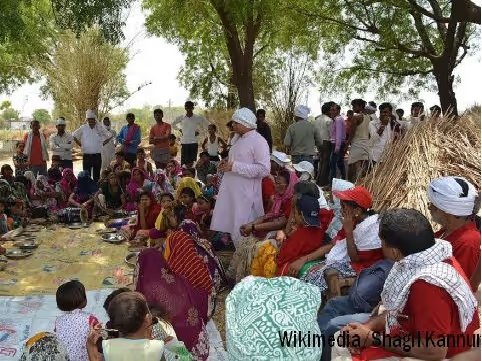
क्या राजनीतिक आरक्षण कारगर है? यदि हाँ तो किसके लिए?
क्या राजनीतिक आरक्षण विकास को कमजोर करता है या उसे बढ़ावा देता है, तो किसके लिए? यह लेख भारत के 'अनुसूचित क्षेत्रों' का विश्लेषण प्रस्तुत करता है, जहाँ ऐतिहासिक रूप से वंचित अनुसूचित जनजातियों के लिए राजनीतिक पद आरक्षित हैं। मनरेगा पर पड़ने वाले प्रभावों पर ध्यान देने से ज्ञात होता है कि आरक्षण का समग्र रूप से कोई बुरा परिणाम नहीं निकलता है। लक्षित अल्पसंख्यकों के लिए इसके कई लाभ हैं, जो अन्य अल्पसंख्यकों के बजाय अपेक्षाकृत विशेषाधिकार प्राप्त लोगों की कीमत पर आते हैं।


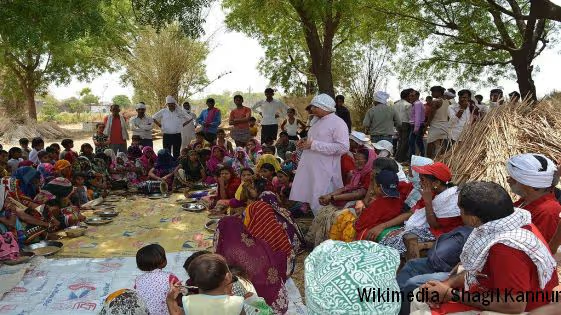
Does political reservation work, and for whom?
Does political reservation undermine or promote development, and for whom? This article presents an analysis of India’s Scheduled Areas, which reserve political office for the historically disadvantaged Scheduled Tribes. Focusing on the effects on MNREGA, it shows that reservation delivers no worse outcomes overall. There are large gains for targeted minorities, which come at the cost of the relatively privileged rather than other minorities.

When does politics work for development?
Political interference in the bureaucracy is generally viewed with suspicion. Yet, in a democracy, should we not expect politicians to push bureaucrats to work for the best interests of citizens? This column shows that bureaucrats implement MNREGA much better in places where politicians are able to claim credit for improvements. This is good news for democratic accountability, and carries important implications for the design of development programmes.