
.svg)
.svg)
%201.svg)
%201.svg)
.svg)

.svg)
.svg)
Bishnupriya Gupta

Bishnupriya Gupta is a Professor of economics, and Deputy Coordinator of Economic Development and History Research Group at the University of Warwick. In the past, she has held positions at the London School of Economics. the Delhi School of Economics and the University of St. Andrews, and visiting positions at the Center of Economic Research in Tilburg and the University of Alicante. Her research interests are mainly in economic history and development economics. She has worked on industrial organisation in colonial India, in particular on cartel behaviour and on demographic change and the sex ratio in 20th century India. She has done comparative work on long-run development, focusing on the “Great Divergence” of productivity and living standards between Europe and Asia.
.svg)


Catching up: India’s transition from a colonial economy
The decline and stagnation of the Indian economy was reversed after independence. This column suggests although productivity in agriculture and industry rose after 1947, it was the service sector that led Indian growth. A strong focus on higher education under colonial policy created an advantage for the service sector, but slow expansion in primary education was a disadvantage relative to the high-growth East Asian economies.


Community origins of industrial entrepreneurship: Theory and historical evidence from India
The transition from agriculture to trade and the subsequent transition from trade to manufacturing are key stages in the development process. In countries where a substantial manufacturing sector exists, a few small communities often dominate it.
The historical roots of India's booming service economy
India stands out from other emerging economies because its growth has been led by the service sector rather than labour-intensive manufactures. This column summarises recent research showing that India has a long history of strength in services, and its service-led development may play to historical strengths rather than hindering its progress.
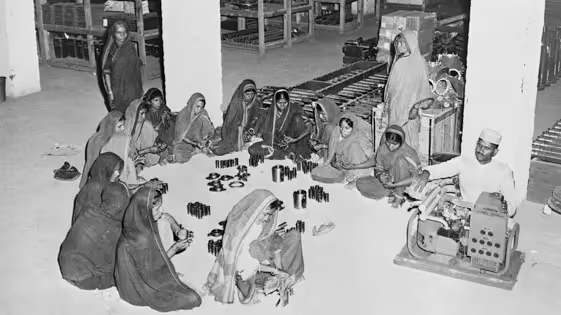
Demographic shocks and female labour force participation: Evidence from 1918 flu pandemic
The Influenza pandemic of 1918 killed about 5% of India’s population. This article finds that districts most adversely affected by influenza mortality saw a temporary increase in the country’s female labour force participation in 1921, driven in part, by distress labour supply by widows and higher wages. The increase was concentrated in the service sector, and had been reversed by 1931.

Demographic shocks and female labour force participation: Evidence from 1918 flu pandemic
The Influenza pandemic of 1918 killed about 5% of India’s population. This article finds that districts most adversely affected by influenza mortality saw a temporary increase in the country’s female labour force participation in 1921, driven in part, by distress labour supply by widows and higher wages. The increase was concentrated in the service sector, and had been reversed by 1931.
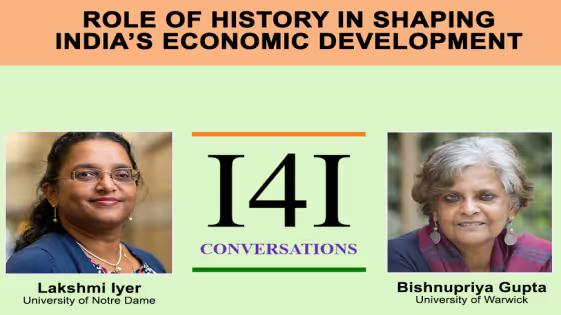
Role of history in shaping India’s economic development
As India is now completing 75 years of Independence, two big questions loom over the conversation around India’s economic development: How successful was the Indian economy before and during colonial rule, as compared to the postcolonial period? What is the role of history – historical events, actors, and institutions – in shaping India’s development trajectory? This is the focus of the sixth edition of I4I Conversations, with Bishnupriya Gupta and Lakshmi Iyer. Gupta and Iyer deliberate on how applying a historical lens may change our conclusions about India’s progress –particularlyhow demand-side estimates of GDP (gross domestic product) per capita date the beginning of India’s economic decline to a century before British colonial rule. Gupta also discusses the misperception that Indian industrialisation was stifled during colonial rule, how we should evaluate 20th century economic progress in light of the historical evidence, and the long-run effects of historical land-tenure .....