
.svg)
.svg)
%201.svg)
%201.svg)
.svg)

.svg)
.svg)
Bornali Bhandari

Bornali Bhandari is a Fellow at NCAER with a background in international economics and macroeconomics, specifically focussing on the impact of globalisation on development. Currently she is working on analysing the shortcomings of the Indian FDI statistical system and calculating the GSDP of Daman and Diu and Dadra and Nagar Haveli. Her wider research interests include analysis of states, infrastructure, particularly the roads and ICT sectors, G-20 issues like climate change, finance and reserve currency and trade-related issues. She is also co-ordinating NCAER’s macro publications – the Quarterly Review of the Economy, Quarterly Business Expectations Survey, and Macrotrack.
.svg)

Business sentiments and labour markets
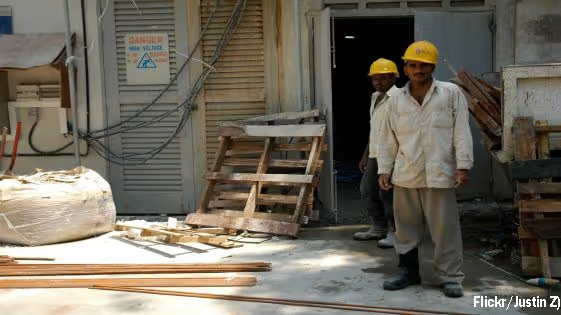
The Covid-19 pandemic and associated lockdowns have had a significant adverse impact on jobs and livelihoods. Using 2006-2021 data from a survey on business sentiments, this article examines fluctuations in firms’ hiring of temporary/casual and permanent workers across three major economic events – the Global Financial Crisis, demonetisation, and the Covid-19 crisis. It shows that firms use temporary workers to adjust to changes in the demand of their products in response to macroeconomic uncertainty – increasing vulnerability among workers.



Forecasting growth in times of transition
As per official data released on 31 August 2017, the Indian economy grew at 5.6% in the first quarter of the current fiscal year – in congruence with forecasts of National Council of Applied Economic Research. Based on the quarterly and annual models of NCAER, Bornali Bhandari discusses recent trends in key economic indicators, and future growth forecasts.
Do firms in India perceive themselves to be e-ready?
Government of India’s ‘Digital India’ programme seeks to transform the country into a digitally-empowered society and knowledge economy. This column presents region-wise findings of a perception-based survey of the e-readiness of firms. While firms in west India seem to be more e-ready than those in other regions, there is tremendous scope across all firms to increase the use of information and communications technology in business activities to improve productivity.

Tripura’s bamboo sector: Potential and challenges
About a third of the total area of Tripura is covered by bamboo, and bamboo has emerged as a key thrust area for the state’s industrial development. Based on a field visit that was undertaken to study skill development in Tripura’s bamboo sector, Bornali Bhandari discusses the livelihood-based approach of Tripura Bamboo Mission vis-à-vis a market-based approach adopted by a private bamboo wood manufacturing unit.