
.svg)
.svg)
%201.svg)
%201.svg)
.svg)

.svg)
.svg)
Brian Blankespoor

Brian Blankespoor is a Senior Geographer in the Development Data Group of the World Bank. Over the past 15 years at the World Bank, his work focusses on the production of spatial data, integration of large data with automation, and spatial models for economic analysis. He is a coauthor of peer reviewed articles on issues of environment, transportation, and economic geography. He is the co-chair of the World Bank Geospatial Community of Practice, an alternate World Bank representative to United Nations Geospatial Network, and a contributor to the POPGRID Data Collaborative. Prior to the World Bank, he held analytical positions in the private sector and World Wildlife Fund. He is a certified GISP (Geographic Information System Professional) and holds an MSc in Applied Economics from The Johns Hopkins University, an MSc in Geography from Oregon State University and a BSc in Computer Science from Calvin College.
.svg)

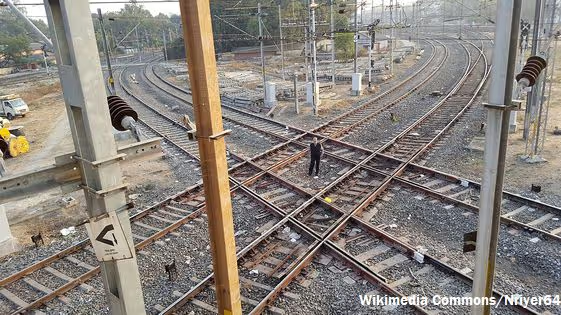
क्या परिवहन में ढाँचागत विकास से ग्रामीण भूमि असमानता बढ़ती है?
परिवहन से जुड़े आधारभूत संरचना में निवेश से व्यापार लागत कम होती है और गांव शहरी बाज़ारों के साथ जुड़ जाते हैं। यह लेख दर्शाता है कि इस स्थानिक एकीकरण के कारण ग्रामीण भारत में भूमि असमानता बढ़ने का अनपेक्षित परिणाम भी निकल सकता है। यह लेख, औपनिवेशिक रेलमार्ग स्थानों और स्वर्णिम चतुर्भुज राजमार्ग नेटवर्क से गांव की दूरी के आधार पर बाज़ार तक पहुँच के प्रभावों को पृथक करके देखता है। अध्ययन से पता चलता है कि एकीकरण से भूमिहीन परिवारों की संख्या में और उत्पादक कृषि प्रौद्योगिकी को अपनाने में वृद्धि होती है, जिससे बड़े खेत और भी बड़े हो जाएंगे और भूमि असमानता बढ़ जाएगी।


Does development of transport infrastructure increase rural land inequality?
Investments in transport infrastructure reduce trade costs and lead to integration of villages with urban markets. This article suggests that this spatial integration could have the unintended consequence of increasing land inequality in rural India. It isolates the effects of market access using colonial railroad locations and the distance of a village from the Golden Quadrilateral highway network. The study finds that integration also increases the share of landless households and the adoption of productive farming technology, which would lead to large farms getting bigger and increase land inequality