
.svg)
.svg)
%201.svg)
%201.svg)
.svg)

.svg)
.svg)
Charity Troyer Moore

Charity Troyer Moore is Director for South Asia Economics Research at Yale University's MacMillan Center, where she provides strategic direction and oversight of research, policy, and capacity-building engagements in India, and other countries in South Asia for Inclusion Economics at Yale University. Charity's research examines public service delivery and governance in the bureaucracy; the drivers and potential solutions to India’s low female labour force participation, with a focus on the ways in which current policy initiatives can put women on better footing as economic agents; land rights; and social protection programmes – notably public works and cash transfer programmes. Prior to her current position at Yale, she held multiple roles at Harvard Kennedy School's Evidence for Policy Design, most recently as India Research Director, where she co-founded EPoD India at IFMR. Charity holds a Masters in Economics and Ph.D. in Agricultural, Environmental, and Development Economics from The Ohio State University.
.svg)

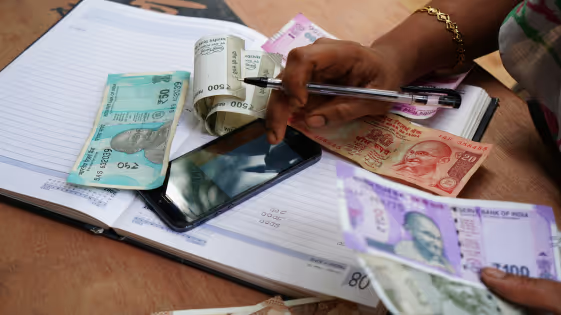
Improving public service delivery by fixing payment systems
Fixing how funds flow through the government systems grabs far fewer headlines than malnutrition, problems in the education sector, or crumbling infrastructure. In this post, Charity Troyer Moore contends that payment systems are fundamental to improving these development outcomes, and challenges to them pervade government functioning across sectors, programmes, and locations. She examines the key issues, and what Budget 2022-23 can do to fix them.



Asking the right question to get the right policy
There is consensus in the development community on the importance of bridging the gap between researchers and practitioners; however, misaligned incentives underlie this gap. In this article, Pande, Moore and Dodge of Harvard Kennedy School, explain how bringing policymakers together with researchers to work more iteratively ensured that data from MNREGS - the world’s largest public works programme - became accessible and relevant to those who use it.
Smart data: Can visualised administrative data help inform and hold public stakeholders accountable?
The project examined how interactive data visualisations can be used to present administrative data in a way that is easily digestible, lends itself to exploration and provides a clear link to required action for administrators. The findings from the project showed that government officials responded more to visualised data as compared to plain tabular data.