
.svg)
.svg)
%201.svg)
%201.svg)
.svg)

.svg)
.svg)
Chirantan Chatterjee

Chirantan Chatterjee is a Professor of Development Economics, Innovation & Global Health at the Department of Economics in University of Sussex Business School. He is also a Visiting Professor at MIPLC, Max Planck Institute of Innovation & Competition and Visiting Fellow at Hoover Institution, Stanford University and former full time and visiting faculty of IIMB, ISB and IIMA. His research interests are in the economics of innovation, applied microeconomics, empirical industrial organisation, and global health.
.svg)


Only germs this time, no guns and steel (yet)?
The first round of globalisation over the previous centuries was associated with a transmission of diseases between continents. With Covid-19, history seems to be repeating itself, but this time in the form of a global pandemic fuelled by increased human connectivity. Chakrabarti and Chatterjee discuss how globalisation may itself be set back by Covid-19, as countries have stopped production, and supply chains have been disconnected, disrupting the gains made by mankind over the past two centuries.


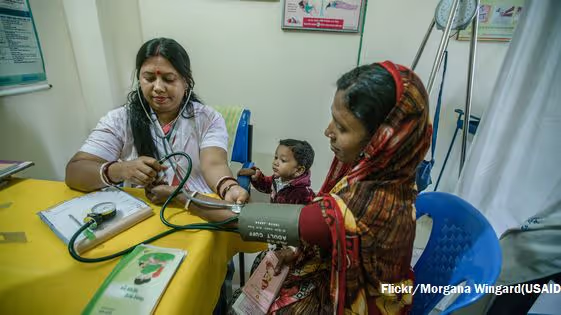
‘स्वीट कैश’- विकासशील देशों में महिलाओं की स्वास्थ्य देखभाल सम्बन्धी ज़रूरतें
अग्रवाल एवं अन्य, स्वास्थ्य देखभाल की मांग के संदर्भ में लिंग-आधारित प्राथमिकताओं की भूमिका का पता लगाते हैं। सीपीएचएस डेटा का उपयोग करते हुए वे पाते हैं कि ईपीएफ में योगदान की अनिवार्य दरों में बदलाव से उत्पन्न सकारात्मक आय-झटके के कारण चिकित्सा परामर्श और दवाओं पर खर्च कम होने से, स्वास्थ्य देखभाल के खर्चों में 11.6% की गिरावट आती है। पर यह गिरावट स्पष्ट रूप से महिलाओं के बेहतर स्वास्थ्य परिणामों को इंगित नहीं करती है। यह दर्शाती है कि महिलाएँ, विशेष रूप से विवाहित महिलाएँ, अपनी बढ़ी हुई आय का उपयोग घरेलू सामान की खरीद पर करने को प्रमुखता देती हैं।
Sweet cash: Women’s demand for healthcare in developing countries
Agrawal et al. explore the role of gender-based preferences for demand of healthcare. Using CPHS data they find that the positive income shock – generated by a change in the mandated rates of contribution to the EPF – leads to a 11.6% decline in healthcare expenses driven by less expenditure on consultations and medications. However, this decline is not explained by women having better health outcomes and suggests that women, especially married women, prefer using the increased income on household goods

How do private players respond to public entry in pharmaceutical markets?
In 2012, the government of West Bengal outsourced the operation of key public pharmacies to private players – creating fair-price shops for selected generic medicines. How has the private sector responded to this policy intervention? Analysing the impact on prices of different categories of medicines, this article finds that the private sector response hinges on the extent to which consumer preferences are ‘sticky’.

Intellectual property rights and wage inequality
Technology has become central to most everyday activities. But will incentives for technological change – such as those induced by Covid-19 – cause deeper distortions in the global economy, especially through wage inequality? To examine this issue, this article analyses data on Indian manufacturing firms during 1990-2006, and shows that stronger incentives for innovation through intellectual property resulted in inequality across virtually the entire economy.

फिल्में किस तरह से नकारात्मकता (स्टिग्मा) और पसंद को प्रभावित करती हैं- भारतीय फार्मास्युटिकल उद्योग से साक्ष्य
हाल ही में, शैक्षिक मनोरंजन सार्वजनिक स्वास्थ्य मुद्दों के समाधान के लिए एक मंच के रूप में उभरा है। इस लेख में, अग्रवाल, चक्रवर्ती और चैटर्जी जांच करते हैं कि क्या फिल्में स्वास्थ्य देखभाल के प्रति नकारात्मकता या स्टिग्मा को दूर कर सकती हैं और क्या भारतीय फार्मास्युटिकल बाज़ार में उपभोक्ता के लिए औषधियों के विकल्प और पसंद को बढ़ा सकती हैं? वे फर्म-स्तरीय बाज़ार की प्रतिक्रियाओं का विश्लेषण करके भारत में मनोविकार नाशक दवाओं के बाज़ार पर बॉलीवुड फिल्म ‘माई नेम इज़ ख़ान’ की रिलीज़ के प्रभाव का पता लगाते हैं। शोधकर्ता फिल्म के कारण पैदा हुई सकारात्मकता के कारण बाज़ार में दवाओं की किस्मों की आपूर्ति में वृद्धि पाते हैं।
How movies impact stigma and choice: Evidence from the pharmaceutical industry
Recently educational entertainment is emerging as a platform for addressing public health issues. In this article, Aggarwal, Chakrabarti, and Chatterjee investigate whether movies can destigmatise accessing healthcare and increase consumer choice in the Indian pharmaceutical market. They explore the impact of the release of the Bollywood movie ‘My Name is Khan’ on the market for antipsychotic drugs in India by analysing firm-level market responses, and find an increase in supply of drug varieties due to the destigmatisation caused by the movie.

Stewardship as the way forward in fighting global antimicrobial resistance
With the World Health Organization's emphasis on stewardship and working together against antimicrobial resistance (AMR), the authors consider the importance of certain agents in preventing AMR. Looking at the 2010 super bug crisis in India, they find that the withdrawal of multinational firms from the carbapenem market caused Indian firms to fill the void and physicians to switch their product preferences. They highlight the importance of scientific publications in reporting and monitoring outbreaks, and the need to incentivise antibiotic innovation.