
.svg)
.svg)
%201.svg)
%201.svg)
.svg)

.svg)
.svg)
Christopher Udry

Christopher Udry is the Robert E. and Emily King Professor of Economics at Northwestern University. He is a development economist whose research focuses on rural economic activity in Sub-Saharan Africa. His current research includes directing the first long-term, nationwide socioeconomic panel survey of individuals across Ghana (in collaboration with the University of Ghana); randomized evaluations of a variety of governmental and NGO-led development programs in West Africa; work on household organization, risk, information flows and agriculture in Mali and Ghana; and the role of psychological well-being on economic decision-making.
Udry spent two years as a secondary school teacher in northern Ghana, and has been a visiting scholar at Ahmadu Bello University in Nigeria and at the University of Ghana at Legon. Udry spent 19 years as a Professor of Economics at Yale University, serving as chair of Department of Economics, Director of the Economic Growth Center, and Chair of the Council of African Studies. He moved to Northwestern in 2017, where he co-founded and co-directs the Global Poverty Research Lab. Udry is a Fellow of the Econometric Society and of the American Academy of Arts and Sciences.
.svg)

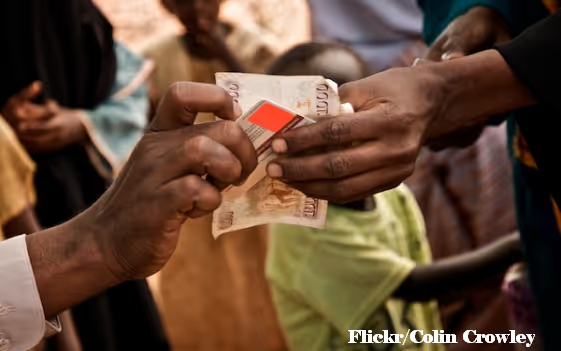
What broad lessons have we learned from 115 studies on unconditional cash transfers?
Globally, around 700 million people currently live in extreme poverty, and in recent years, unconditional cash transfers have emerged as a popular tool for poverty alleviation in low- and middle-income countries. This article presents findings from a meta-analysis of 115 studies, which shows that unconditional cash transfers have positive impacts on a range of key economic and social outcomes, including consumption, income, labour supply, and child health and education.


