
.svg)
.svg)
%201.svg)
%201.svg)
.svg)

.svg)
.svg)
Clément Imbert

Clément Imbert is Associate Professor of Economics at the University of Warwick. Clément was educated at the Ecole Normale Supérieure (Cachan) and the Paris School of Economics, where he received his Ph.D. in 2012. He was also a Postdoctoral Research Fellow at the University of Oxford and Nuffield College from 2012 to 2015. His areas of research are development economics, labour economics, public economics, and political economy, and he has undertaken extensive research on the Mahatma Gandhi National Rural Employment Guarantee Act (MNREGA). Clément is a research affiliate at the Bureau for Research and Economic Analysis of Development (BREAD), Centre for Economic Policy Research (CEPR), and J-PAL.
.svg)

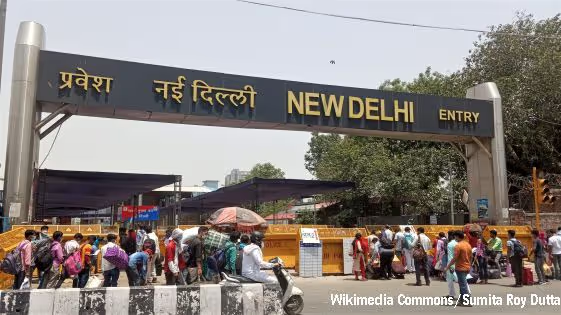
कोविड-19 लॉकडाउन और प्रवासी श्रमिक: बिहार एवं झारखंड के व्यावसायिक प्रशिक्षुओं का सर्वेक्षण
भारत में हुए राष्ट्रव्यापी लॉकडाउन के कारण विशेष रूप से प्रवासी मजदूर बुरी तरह प्रभावित हुए। जब यात्रा प्रतिबंध हटा दिए गए तब 1.1 करोड़ अंतरराज्यीय प्रवासी अपने घर लौट गए। इस आलेख में चक्रवर्ती एवं अन्य बिहार और झारखंड के युवाओं (‘दीनदयाल उपाध्याय ग्रामीण कौशल्य योजना’ के पूर्व प्रशिक्षु) के साथ किए गए फोन सर्वेक्षण से प्राप्त प्रमुख निष्कर्षो को प्रस्तुत करते हैं। इस सर्वेक्षण के जरिए अंतरराज्यीय प्रवासी श्रमिकों पर लॉकडाउन के प्रभाव का आकलन करने और भविष्य में उनके द्वारा फिर से प्रवासन की उनकी इच्छा का अनुमान लगाया गया है।


Covid-19 lockdown and migrant workers: Survey of vocational trainees from Bihar and Jharkhand
The nationwide lockdown in India hit migrant workers particularly hard and once travel restrictions were lifted, 11 million interstate migrants returned home. In this note, the authors present key findings from a phone survey of youth from Bihar and Jharkhand who were previous trainees of ‘Deen Dayal Upadhyay Grameen Kaushalya Yojana’. The survey seeks to assess the impact of the lockdown on interstate migrant workers, and to gauge their willingness to migrate again in the future.

Covid-19: Expected migrant movement as lockdown eases
Since the lockdown was announced in India, many migrants have undertaken the difficult journey to their place of origin. However, millions of them are still in cities, and some are expected to return home when the lockdown is lifted. Using past data on seasonal and permanent migration, Imbert shows that they will mostly come from a few manufacturing clusters where Covid-19 prevalence is high, and return to poor rural areas where healthcare capacity is low.
Labour market effects of workfare programmes: Evidence from MNREGA
India’s Mahatma Gandhi National Rural Employment Guarantee (MNREGA), the world’s largest workfare programme, provided employment to 51 million households in 2016. Assessing the impact of MNREGA on the private sector and labour markets, this article shows that the programme has crowded out private sector employment, lowered rural-to-urban migration in the states that implemented it well, and increased wages in both rural and urban India.
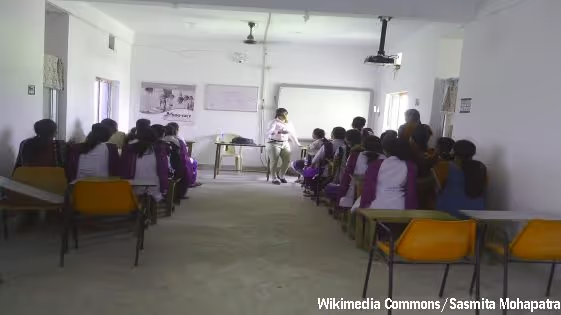
प्रशिक्षण कार्यक्रमों को और अधिक प्रभावी बनाने के लिए युवाओं को नौकरी के अवसरों की जानकारी देना
केंद्र सरकार द्वारा 2014 में शुरू की गई दीनदयाल उपाध्याय ग्रामीण कौशल योजना ग्रामीण, साधनहीन युवाओं को कौशल आधारित प्रशिक्षण प्रदान करने और उन्हें वेतनभोगी नौकरियां दिलवाने का प्रयास करती है। बिहार और झारखंड में किए गए एक प्रयोग के आधार पर, इस लेख में बताया गया है कि प्रशिक्षुओं को कार्यक्रम और भावी नौकरियों के बारे में विस्तृत जानकारी प्रदान करने से उनकी उम्मीदों को वास्तविकताओं के अनुरूप रखने में मदद मिलती है और साथ ही इससे उन्हें नौकरियों में बनाए रखने में भी वृद्धि होती है।
Informing youth about job opportunities to make training programmes more effective
Launched in 2014 by the central government, Deen Dayal Upadhyaya Grameen Kaushalya Yojana seeks to provide skills-based training to rural, marginalised youth, and to place them in salaried jobs. Based on an experiment conducted in Bihar and Jharkhand, this article shows that providing detailed information about the programme and prospective jobs to the trainees, helps align their expectations with realities, and enhances job retention.

Political Change and Crime Reduction in Bihar
The aim of this project was to understand the mechanisms through which the political changes in 2005 contributed to the dramatic subsequent reduction in violent crimes. This project is an extension of the previous project on 'Political change and crime reduction in Bihar'. This study finds out the role the role of infrastructure construction in the concomitant crime reduction and surge in economic growth, in parallel, or in conjunction with policing efforts. The findings of this project provide a unique perspective on the dynamics and factors of law and order and economic growth in Bihar over the last 15 years.

Impact of MNREGA on labour markets
There is an active, ongoing debate on whether MNREGA should be retained in its current form. This column reports on research which suggests that MNREGA increased rural and urban wages and reduced seasonal rural-to-urban migration. It argues that the effect of MNREGA on labour markets should play a role in the discussion on whether and how to reform the scheme.
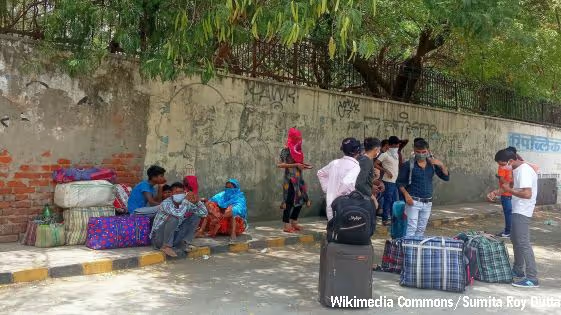
कोविड -19 लॉकडाउन और प्रवासी श्रमिक: बिहार और झारखंड के व्यावसायिक प्रशिक्षुओं का सर्वेक्षण – II
कोविड -19 और इससे संबंधित लॉकडाउन के कारण बड़े पैमाने पर लोगों की नौकरियां चली गई, जिसके फलस्वरूप शहरों से प्रवासी श्रमिकों का पलायन हुआ। इस लेख में, चक्रवर्ती एवं अन्य, उनके द्वारा ग्रामीण बिहार और झारखंड के युवा व्यावसायिक प्रशिक्षुओं पर किये गए सर्वेक्षण से निकाले गए निष्कर्षों जैसे रोजगार पर पड़े गंभीर प्रभाव, अनौपचारिकीकरण में वृद्धि, पुन:प्रवासन की कमी और महिलाओं पर पड़े प्रतिकूल प्रभाव पर प्रकाश डालते हैं । वे युवाओं को नौकरी खोजने में मदद करने के लिए एक डिजिटल हस्तक्षेप की भी जाँच करते हैं।
Covid-19 lockdown and migrant workers: Survey of vocational trainees from Bihar and Jharkhand - II
Covid-19 and the associated lockdowns have led to widespread job losses, and a subsequent exodus of migrant workers from the cities. In this note, Chakravorty et al. discuss findings from their survey of young vocational trainees from rural Bihar and Jharkhand. They highlight the severe impact on employment, increased informalisation, lack of re-migration, and disproportionate adverse effects on women.