
.svg)
.svg)
%201.svg)
%201.svg)
.svg)

.svg)
.svg)
Cynthia Kinnan

Cynthia Kinnan is Assistant Professor at Tufts University. Her research focuses on how households and small firms in developing countries use financial products (e.g., credit, insurance, savings) and informal insurance networks to finance investments, save, and cope with risk. She is particularly interested in the causes of missing markets, in the interaction between risk and household investment, in social networks, and in microfinance.
She is a faculty research fellow at the National Bureau of Economic Research (NBER), an affiliate of the Bureau for Research and Economic Analysis of Development (BREAD), and an affiliate of the Jameel Poverty Action Lab. She was a visiting scholar at Harvard University’s Kennedy School of Government for the 2013–14 academic year.
.svg)

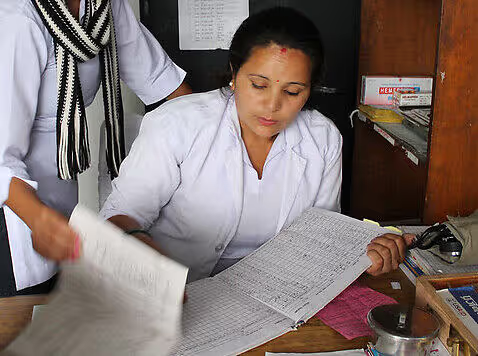
भारत में स्वास्थ्य बीमा तक पहुंच: प्रत्यक्ष और स्पिलओवर प्रभाव
भारत में स्वास्थ्य देखभाल की उच्च लागत के चलते कई कम आय वाले परिवार गरीबी में आ जाते हैं | गरीबी रेखा से नीचे के परिवारों के लिए सरकार द्वारा संचालित राष्ट्रीय स्वास्थ्य बीमा कार्यक्रम - राष्ट्रीय स्वास्थ्य बीमा योजना का लाभ इष्टतम से कम है। यह लेख कर्नाटक में गरीबी रेखा से ऊपर के परिवारों के एक नमूने के लिए अस्पताल बीमा की पेशकश के प्रभाव की जांच करता है। यह बीमा के उपयोग को बढ़ाने में महत्वपूर्ण समकक्ष प्रभाव पाता है; जबकि अस्पताल बीमा का स्वास्थ्य परिणामों पर कोई महत्वपूर्ण प्रभाव नहीं पड़ता है।


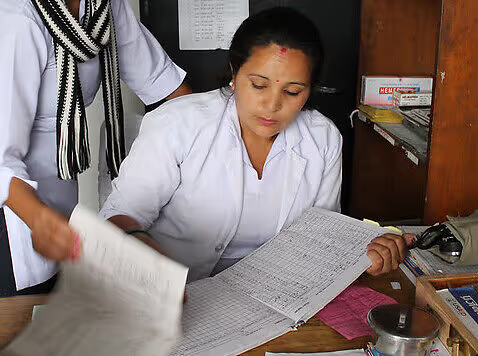
Access to health insurance in India: Direct and spillover effects
Many low-income households in India have been pushed into poverty by high healthcare costs. Uptake of the Rashtriya Swasthya Bima Yojana, the government-run national health insurance programme for below poverty line households, has been less than optimal. This article examines the impact of offering hospital insurance to a sample of above poverty line households in Karnataka. It finds significant peer effects in increasing insurance utilisation; hospital insurance however doesn’t have any significant effect on health outcomes.

मोदीकेयर के सफल आरंभ का रोडमैप
पिछले साल घोषित की गई नेशनल हेल्थ प्रोटेक्शन स्कीम पहले मौजूदा राष्ट्रीय स्वास्थ्य बीमा योजना (रएसबीवाई) को अपने अंदर शामिल करती है, जिसने सबसे गरीब 30 करोड़ भारतीयों को अल्पकालिक अस्पताल के दौरे के लिए स्वास्थ्य बीमा प्रदान किया था। कर्नाटक में आरएसबीवाई पर अपने बड़े पैमाने पर किये गए अध्ययन के आधार पर, मलानी और कीनन ने नए कार्यक्रम के लिए कुछ महत्वपूर्ण सबक दिए हैं।
Modicare: Getting universal health coverage in India right
The recently announced National Health Protection Scheme succeeds Rashtriya Swasthya Bima Yojana (RSBY), which provided health insurance for short-term hospital visits to the poorest 300 million Indians. Based on their large-scale study of RSBY in Karnataka, Malani and Kinnan put forth some important lessons for the new programme.
Impact Evaluation of a Public Health Insurance Plan in India: Post Health Event Survey Pilot
This project pilots a Post Health Event Survey (PHES). The PHES is a potentially more efficient survey strategy than conducting one annual survey of all households. The PHES pilot was conducted in two stages. First, a random sample of households is called to ascertain if the household experienced a serious health event in the last two months.

Measuring the equilibrium impacts of credit: Evidence from India’s 2010 microfinance crisis
In October 2010, the government of Andhra Pradesh issued an emergency ordinance, bringing microfinance activities in the state to a complete halt and causing a nationwide shock to the liquidity of lenders, especially those with loans in the affected state. Using this massive dislocation in the microfinance market, this article identifies the “general equilibrium” impacts of a reduction in credit supply, which encompass changes to wages, employment, and consumption in the economy.