
.svg)
.svg)
%201.svg)
%201.svg)
.svg)

.svg)
.svg)
Daniel Gilligan

Daniel Gilligan is Deputy Division Director at IFPRI’s (International Food Policy Research Institute) Poverty, Health and Nutrition Division. His research addresses the economics of household investments in childhood nutrition and education in developing countries, as well as the impact and cost-effectiveness of social protection, and agricultural and nutrition interventions. Much of his research is based on experimental and quasi-experimental impact evaluations.
Two of his recent projects address the role of information and social networks in the diffusion and sustainable adoption of biofortified crops, and parental incentives to improve cognitive outcomes for children attending early childhood development centres. Dan’s research has been featured in The New York Times, the Economist, and The Atlantic online and in blog posts at the World Bank and The Guardian online. Dan holds a Ph.D. in Agricultural and Resource Economics from University of Maryland.
.svg)

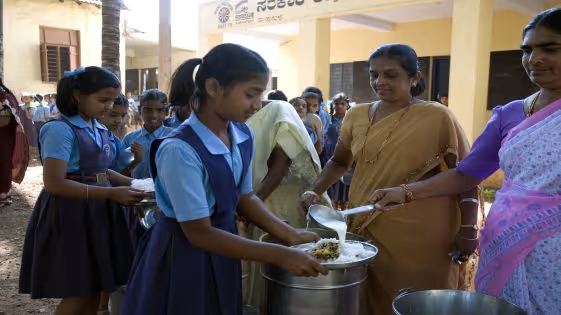
पोषण में सुधार हेतु स्कूली भोजन योजनाओं का महत्व
भारत में अल्पपोषित बच्चों की संख्या दुनिया में सबसे अधिक है और यहां मिड-डे मील (एमडीएम) के रूप में स्कूली भोजन की सबसे बड़ी योजना जारी है परंतु इस योजना के अंतर-पीढ़ीगत प्रभाव पर सीमित साक्ष्य उपलब्ध हैं। राष्ट्रीय परिवार स्वास्थ्य सर्वेक्षण और राष्ट्रीय नमूना सर्वेक्षण के आंकड़ों के आधार पर, यह लेख दिखाता है कि अगर स्कूली शिक्षा के दौरान एक माँ एमडीएम की लाभार्थी थी, तो उसके बच्चों की लम्बाई की कमी में 20-30% की गिरावट आती है।


The power of school feeding programmes to improve nutrition
India has the world’s highest number of undernourished children and the largest school-feeding programme – the Mid-Day Meal (MDM) scheme – but limited evidence is available on the intergenerational impact of the programme. Based on data from the National Family Health Survey and National Sample Survey, this article shows if a mother was a beneficiary of MDM during schooling, there is a 20-30% reduction in height deficits of her children.