
.svg)
.svg)
%201.svg)
%201.svg)
.svg)

.svg)
.svg)
Dean Spears

Dean is an economic demographer and development economist. His research areas include the health, growth, and survival of children, especially in India; the environment, air pollution, and climate change; and population dimensions of social well-being. Dean is Assistant Professor of economics at the University of Texas at Austin, is a visiting economist at the Economics and Planning Unit of the Indian Statistical Institute (ISI) Delhi Centre, is a founding Executive Director of r.i.c.e. (research institute for compassionate economics), and is an affiliate of IZA (Institute of Labor Economics) and of the Climate Futures Initiative at Princeton University. With Diane Coffey, he is the co-author of the award-winning book Where India Goes: Abandoned Toilets, Stunted Development, and the Costs of Caste. .
.svg)

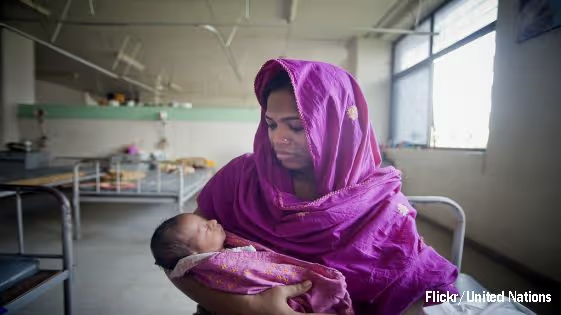
बजट 2021-22: स्वास्थ्य को प्राथमिकता, एक बार फिर से
वर्ष 2021-22 के केंद्रीय बजट का आकलन स्वास्थ्य क्षेत्र के नजरिए से करते हुए, कॉफी और स्पीयर्स यह तर्क देते हैं कि भारत के स्वास्थ्य परिणामों को बेहतर बनाने के लिए पुरानी समस्याओं को पुराने तरीको से हल करने की आवश्यकता है और ‘नए’ बजट में ऐसे किसी हल को ढूंढ पाना कठिन है। विशेष रूप से, वे अगले बजट में मातृ और नवजात शिशु सबंधी स्वास्थ्य कार्यक्रमों के लिए आवंटन बढ़ाने का पक्ष लेते हैं।


Budget 2021-22: Healthcare takes centre stage, again
Assessing the 2021-22 Union Budget from a health-sector perspective, Coffey and Spears contend that improving India’s health outcomes will require old solutions to old problems – and this sort of thing is hard to find in a ‘new’ budget. In particular, they advocate for increased allocation for maternal and newborn health programmes in the next budget.

What can we learn about Swachh Bharat Mission from NFHS-5 factsheets?
Swachh Bharat Mission was introduced by Government of India in 2014 to eliminate open defecation. Based on data from the National Family and Health Survey (NFHS)-5 factsheets, this article shows that the sanitation situation has broadly remained the same between NFHS-4 in 2014 and NFHS-5 in 2019. Half of the rural population in the states of Uttar Pradesh, Madhya Pradesh, Bihar, and Rajasthan, continue to defecate in the open.

भारत में बच्चों की लंबाई: नए आंकड़े, परिचित चुनौतियां
भारत के बच्चे दुनिया के सबसे नाटे बच्चों में आते हैं। देश में बच्चों की लंबाई संबंधी जटिलता और विविधता की जांच के लिए इस आलेख में राष्ट्रीय पारिवारिक स्वास्थ्य सर्वेक्षण-4 (एनएफएचएस-4) के आंकड़ों का उपयोग किया गया है। इसमें पाया गया है कि भारत में बच्चों के हाइट-फॉर-एज (उम्र की तुलना में लंबाई) के मामले में 2005-06 और 2015-16 के बीच सुधार हुआ है। हालांकि यह महत्वपूर्ण बात है परन्तु भारत में कुल मिलाकर कम लंबाई और भारत की आर्थिक प्रगति को देखते हुए यह वृद्धि बहुत कम है।
Child height in India: New data, familiar challenges
Children in India are among the shortest in the world. This article uses the National Family Health Survey (NFHS-4) data to examine the complexity and diversity of child height in the country. It finds that India's overall average child height-for-age improved between 2005-06 and 2015-16. Although important, this increase is small relative to India’s overall height deficit and its economic progress.
Why doesn’t anybody know if Swachh Bharat Mission is succeeding?
In 2014, the Prime Minister announced a goal of eliminating open defecation by 2019. In this article, Coffey and Spears, contend that now almost two-thirds of the way through the Swachh Bharat Mission, nobody knows whether it is succeeding because there is no credible, independent survey that can offer a useful estimate of the fraction of rural persons defecating in the open.

Child stunting and open defecation: How much of the South Asian height
Children in India are shorter on average than children in Sub-Saharan Africa, even though Indians are richer on average. What explains this paradox? This column suggests open defecation as a possible explanation, and recommends that policymakers in India should work towards achieving widespread latrine use.

Left, right, and toilets
Eliminating open defecation in India is a policy priority. This column contends that successful strategies for reducing open defecation may not fit policy stereotypes of the left or the right. While rural sanitation policy in states where this practice is most concentrated has been focused on latrine construction, promotion of latrine use is what will make a difference.

Angus Deaton's ideas for India
In a tribute to Angus Deaton, the 2015 Nobel laureate in Economics, Diane Coffey and Dean Spears – former graduate students of Prof. Deaton at Princeton University – review some of his work on the well-being of the poor in India, and discuss the paradoxes and puzzles that still remain.
Nobel laureate William Nordhaus’ ideas for India
William Nordhaus has won a share of the 2018 Nobel Prize in Economics for his contribution to climate economics. In this post, Dean Spears discusses Nordhaus’ work and its implications for India. He contends that India is even more climate-vulnerable than realised by the Nobel laureate’s quantitative model that describes the interplay between the economy and climate.